|
< Earlier Kibitzing · PAGE 5 OF 5 ·
Later Kibitzing> |
Mar-29-15
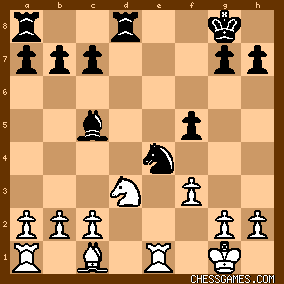
 | | Sally Simpson: One of the Tarrasch Traps in the Lopez. Spotted (recalled) in seconds then about 30 seconds to recall each winning line depending on what Rook takes back d8. I say recalled - I only have to see Marco's name and this game pops up. I'm afraid in my mind he is in the Dufresne, Kieseritzky, Levitsky club (there are other members...) If they want to select their Sunday Problems from famous games or traps I've had on my demo-board in front of a class then no complaints from me. Black comes out of it a piece down if either the a8-Rook or the f8-Rook takes on d8. In the Rf8xD8 line here.
click for larger view
White plays Kf1, The e5 Knight moves and the c5 Bishop falls. (but see below) This Kf1 idea is not available in the Ra1xd8 line.
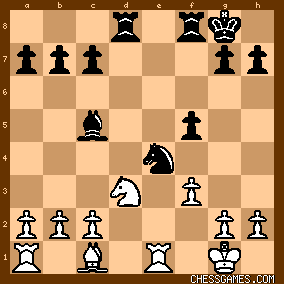
click for larger view
Here White takes on c5 and wins as in the game.
Should White try 15.Kf1 in the Ra8xD8 line.then Black drops the Bishop back to b6. If White takes the e5 Knight then fxe5 is a CHECK. 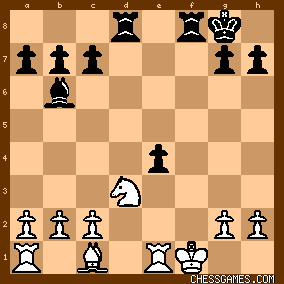
click for larger view
Black is actually good here.
It is worth noting (you might have this OTB as White one day) that even here (in the Rf8xd8 line) with Black to play.
click for larger view
Black can play 15...Rf8 (Reinfeld mentions this try.) 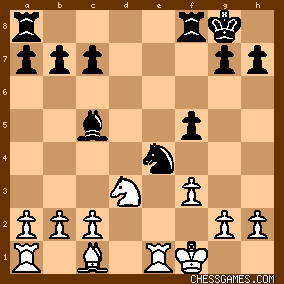
click for larger view
and again White cannot (yet) grab the e5 Knight, He has to prepare it with, according to Reinfeld 16.Ke2 (it looks OK it's one of them better to know than having to dig it out OTB type moves. May even be worth falling for this trick in blitz just to play 15...Rf8.) I will point out that if White tries 16.Re2 intending Nd3-f2 after taking on e5
there is a neat perpetual lurking.
click for larger view16.Re2 Rad8 (this stops the Nd3-f2 idea) 17. fxe5 fxe5+ 18.Nf4 Rd1+ 19.Re1 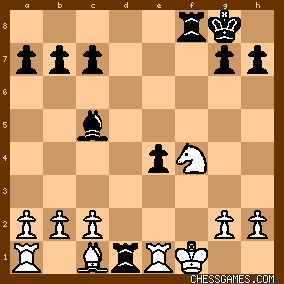
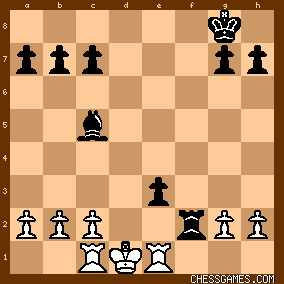
click for larger view19...Rxc1! 20.Raxc1 Rxf4+ 21.Ke2 Rf2+ 22.Kd1 e3.
click for larger view
Actually threatening a cheeky pawn and Rook Epaulette mate. And White's best appears to be to settle for the perpetual with 23.Re2 Rf1+ etc...etc... The final position:
And finally, we must wrap it up correctly and squeeze the last instructive point out of the game, writers (and kibitzers) never seem to go deep enough when discussing this game. Tarrasch had it worked out right down the nth degree. No surprises. Here Marco resigned.
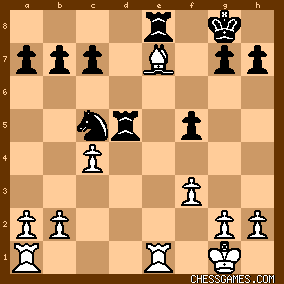
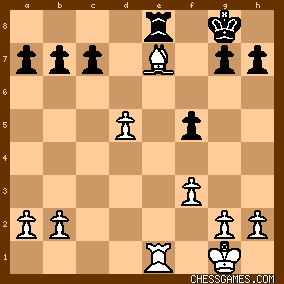
click for larger viewTry 18... Nd3 19. cxd5 Nxe1 20. Rxe1
click for larger view
And no win of the pinned Bishop with 20..Kf7 as 21.Bb4 or Bh4. Well that was fun. |
|
| Mar-29-15 | | kamagong24: Tarrasch made it look sooooo easy! |
|
| Mar-29-15 | | M.Hassan: "Insane"
White to play 8.? and sides are equal
8.Bxc6 Bxc6
9.dxe5 dxe5
10.Qxd8 Raxd8
White exchange Queens so that he would have two protectors of e4 pawn. had he not done so, Blak could have made the exchange of Queens and either Rook or the Knight would be sitting on d1 and e4 pawn would hav had one protector 11.Nxe5
White is now a pawn up. Any attempt to capture e4, will cause further loss to Black: 11...........Bxe4
12.Nxe4 Nxe4
13.Nd3!
e file belongs to White now, there are two unsupported Black pieces there, one has to go: 13...........f5
14.f3 Nf6
15.Rxe7
And White becomes a piece up.
I did not see anything "insane" about this puzzle. |
|
| Mar-29-15 | | randhomykchess: 13.♖xe4?? ♖d1+ 14.♖e1 ♖xe1#
14...♗c5+?! Better is 14...♗h4 15.g3 ♘xg3 16.hxg3 ♗xg3 where Black get two pawns for the knight. If 10...♖fxd8 follows 11.♘xe5 ♗xe4 12.♘xe4 ♘xe4 13.♘d3 f5 14.f3 ♗c5+ 15.♔f1! ♖f8 16.♔e2! a)16...♗b6 17.fxe4 fxe4 18.♘f4 (to prevent 18...♖f2+) g5 19.♘h3 (to prevent 19...♖f2+ again) g4 20.♘f4  b)16...♗d6 17.fxe4 fxe4 18.♘f2 ♗xh2 19.♘xe4 ♖ae8 20.♔d3 ♖f2 21.g4 ♖g2 22.g5 ♗g3 23.♖f1 (23.♖e2 ♖xe2 24.♔xe2 ♖xe4+) ♖d8+ 24.♔c3 ♗e5+ 25.♔b3 ♖d4 26.♘c3 ♖gg4 27.a3 (27.♗e3 ♖b4+ 28.♔a3 ♗d6 Δ 29...♖a4+ and 30...♖gb4# 29.b3 ♖be4+ 30.♔b2 ♖xe3) 27...a5 28.♗e3 a4+ 29.♔a2 ♖c4 30.♗d2 ♖gd4 (30...♗xc3 31.bxc3 ♖g2 32.♖ad1 ; 30...♗f4 31.♗xf4 ♖cxf4 32.♖xf4 ♖xf4 33.♖g1 ♖f2 34.♔b1 ) 31.♖ad1 |
|
| Mar-30-15 | | patzer2: <A.T PHONEHOME> Thanks for the nice comments and compliments. I'll pass them on to my Grandson. |
|
| Mar-30-15 | | CHESSTTCAMPS: In this opening position, the amount of development is similar for both sides, but white certainly has a space advantage and pressure on e5. White can play to win a pawn with 8.Bxc6 Bxc6 9.de de 10.Nxe5, but after Qxd1 11.Rxd1 Bxe4 (Nxe4?? 12.Nxc6 wins a piece) 12.Nxe4 Nxe4 13.Re1 Nf6 black gets the pawn back and seems to be OK. I think I might consider 8.d5 Nb8 9.Bxd7 then play for planting a knight on f5, with white having a big space advantage, the good bishop, and king-side attacking chances. Time for review.... |
|
| Mar-30-15 | | CHESSTTCAMPS: I didn't really have much time for analysis, but in the game line, I'd thought black might (almost) come out ok with 11... Bb4. I'll see if anyone has supplied any engine analysis... |
|
| Apr-02-15 | | patzer2: <CHESSTTCAMPS> I ran 11...Bb4 up to 24 depth on Deep Fritz 14. However, other than giving slightly over a pawn advantage after 11...Bb4 12. Nxc6 bxc6 13. f3  (+1.16 @ 24 depth) the computer doesn't offer much help. (+1.16 @ 24 depth) the computer doesn't offer much help.With an extra pawn and no positional compensation for Black, White should have the better end game chances. |
|
Jan-23-16
 | | Penguincw: Hmm, a Sunday puzzle from less than a year ago, looking like starting from 8.? Seems like a pretty simple solution. |
|
Jan-23-16
 | | al wazir: 13...Rd4. Now what? If 14. f3, then 14...Bc5 15. fxe4 Rxd3+. I think all white can get out of this is a ♙: 14. Be3 Rd7 15. Bxa7 Nf6 16. Be3. |
|
| Jan-23-16 | | goodevans: Recapturing with the B, <10...Bxd8>, looks unnatural but would black be OK after that? |
|
| Jan-23-16 | | Ratt Boy: <Sally Simpson> Thanks for an entertaining and informative analysis from ten months ago. |
|
| Jan-23-16 | | Ratt Boy: <al wazir>: I'm thinking 13...♖d4 14.f3, ♗c5 15.♔f1. Black has two hanging and no Chex. |
|
| Jan-23-16 | | Ratt Boy: Does anyone think the title (I'm not ready to call it a "pun") is worthy of this game? |
|
| Jan-23-16 | | jith1207: Let us just hand over the Oscar to <bobthebob> for successfully having a conversation with cryptics. |
|
| Jan-23-16 | | goodevans: <goodevans: Recapturing with the B, <10...Bxd8>, looks unnatural...> l was barely awake when I made that dumb comment. Of course <10...Bxd8> is useless because only a R-capture prevents <13.Rxe4> with the back row mate threat. Doh! |
|
| Jan-23-16 | | Diagonale du Fou: The game should be pun-titled "Marco Poleaxed" instead, to be precise! |
|
| Jan-25-16 | | kevin86: Black has two pieces under fire and must lose one. |
|
Jan-25-16
| | al wazir: <Ratt Boy: I'm thinking 13...♖d4 14.f3, ♗c5 15.♔f1> f5, with complications. For example, 16. Ke2 Bb6 17. fxe4 fxe4 18. Nf2 Rc4 19. Nd1 Rxc2 20. Bd2 Ba5 21. Nc3 Rd8 22. Red1 Rxb2 23. Rac1 Bxc3 24. Rxc3 Rxa2 25. Rxc7 b6. White has ♗ vs. 3♙s. |
|
| Jan-26-16 | | sneaky pete: After 13... Rd4 14.f3 Bc5 15.Be3 .. is the simplest winning method. |
|
| Oct-31-22 | | Amarande: It's actually interesting to see how the computer vs. the human mind sees some of these games. On silicon, White's advantage at the end is actually a lot more mild than in many games where the loser trudges on for sometimes quite a long time before resigning. It's not even +3! A computer would probably, in fact, hang around quite obstinately as Black here (hope you're good at endgame judgment if it's blitz, because it might very well drag on long enough to make you lose on time, since it often takes a while to convert an exchange up endgame). And yet, from a human standpoint, it's probably one of the most clearly resignable of the bunch: Black must clearly play 18 ... Rxe7, and not only that, gets basically no counterplay as, due to the Rook and c-pawn both being under attack, he pretty much must also submit to having his remaining Rook traded right off as well (19 Rxe7 Rd7 20 Rxd7 Nxd7 etc.), where there will obviously be no chances whatever in the endgame ... |
|
| Feb-14-23 | | generror: <<Amarande> It's actually interesting to see how the computer vs. the human mind sees some of these games. On silicon, White's advantage at the end is actually a lot more mild than in many games where the loser trudges on for sometimes quite a long time before resigning. It's not even +3!> Well, after <14.c4>, my Stockfish NNUE gives it +6 at depth 20, with a slow but constant increase with depth. (I feel that NNUE really makes a difference, creating much more accurate evaluations as a result of just pragmatic unbiased learning, not some puny human trying to tell the machine what and how to evaluate :) As to the trap, it sure is a nasty one and deserves its (in)fame. <7...0-0?> loses a pawn with no compensation whatsoever, but after <14.Bxc5+??>, Black loses at least the exchange, and while its position doesn't look *that* bad to me, to Stockfish it's as if you're down a rook. And both moves look total natural and sensible, which is a key property of any trap deserving its name. Kudos to young Tarrasch for finding it, and even more for actually publishing it in 1891, before he actually used it here for the first time. Imagine that today XD |
|
Apr-14-24
 | | GrahamClayton: Marco's copy of "Schachzeitung" must have been lost in the mail LOL |
|
Jan-12-25
 | | kingscrusher: Incredibly Marc Esserman shows his visualization of this game and analysis beyond which is interesting - 18...Nd3 10.cxd5 Nxe1 20.Rxe1 Kf7 when Marc mentions Bh4 (Bb4 will also do) Rxe1+ Bxe1 https://www.youtube.com/watch?v=Vw3... |
|
| Jul-11-25 | | butilikefur: Whoa wait a second..I remember seeing this whole game as an opening variation in Common Sense in Chess. It was just one line Lasker mentioned although I remember it didn't feel so much like calculation... that's so funny it was an actual game! |
|
 |
|
|
< Earlier Kibitzing · PAGE 5 OF 5 ·
Later Kibitzing> |


 Kibitzing


