|
< Earlier Kibitzing · PAGE 13 OF 13 ·
Later Kibitzing> |
| Feb-21-23 | | N.O.F. NAJDORF: <Honza Cervenka: Spassky should have played 15.f3.> Kraidman played it as early as the eleventh move and went on to miss two winning chances against Fischer: Kraidman vs Fischer, 1968 |
|
| Feb-22-23 | | SChesshevsky: <Spassky should have played 15. f3> Yeah, probably objectively best. But don't think can fault how Spassky played the opening. After Fischer cleverly opens lines on the king side, Spassky now has to consider both trying to get the thematic e5 in without weakening king too much. Move f4 is typically the move to prep e5. But with the open file and strong black DSB maybe not appetizing. Spassky's answer looked ok. He closes the file and gets a decent Bf4 which can support e5. Unfortunately, Fischer gets the Qside going, Spassky maybe loses a tempo, and never gets e5 counter play. While f3 is probably good, I'm not sure what the idea is. In the Kraidman game, he does get in f4 after it looks like Fischer goofs around in a fairly passive opening. But can a tempo burning f3, f4 be counted on? |
|
| Sep-23-23 | | N.O.F. NAJDORF: <While f3 is probably good, I'm not sure what the idea is.> White has to play f3 eventually if he is to save his e-pawn. After 15. Bd2, he cannot play f3 because of:
17. f3 Bd4+ 18. Kh1 g3 19. h3 Bxh3 |
|
| Oct-03-23 | | N.O.F. NAJDORF: Would not 12. f4 have been better than 12. Bxh5? For example,
12. f4 Bd4+ 13. Kh1 Qh4 14. Bxh5
followed by 16. Nf3 ? |
|
| Feb-12-24 | | jffun1958: This game was the turning point of the 1972 match. I remember it well. I was 16 and on high school then. |
|
Jun-30-24
 | | Chessmaletaja: <18 g3?> was not a tactical blunder but a strategic mistake. It demonstrates that Spassky did not understand the position or had some unfounded phantasies concerning White's plans. In fact, after that move, White had no good plans, while Black had a plan to play b5. It is interesting to note that in the CG commentarium here, several commentators claim that 18 g3 was a mistake. But none of the commentators here have tried to explain what is wrong with that move, why it is a bad move. So much about the superficiality and the blind trust of chess engines. |
|
Jun-30-24
 | | Sally Simpson: Hi Chessmaletaja,
<...several commentators claim that 18 g3 was a mistake. But none of the commentators here have tried to explain what is wrong with that move, why it is a bad move.> Best to fall back on what good human players say who we know for sure never used a computer. In three of the instant books that came out after the match and printed in 1972 by Gligoric, Purdy and Reshevsky all three state 18 g3 was a poor choice. Also, these three never wrote by result (panning the losers moves and praising the winners.) Paraphrasing: Weakens the light squares, and underestimates the Black attack on the e4 pawn (which can no longer be protected with f3) The top suggestion is Bg3 and f3 to open the f-file. |
|
Jul-01-24
 | | perfidious: <Geoff>, in particular the professionalism and objectivity of Gligoric were admirable. |
|
| Jul-01-24 | | Olavi: <Sally Simpson> Add Byrne & Nei, Pachman, Timman, various contemporaneous magazines etc. |
|
Jul-01-24
| | Chessmaletaja: Hi, Sally Simpson
18 g3 weakens the light squares around White's king. One may object that Black has no knights and cannot use those light squares, as Black's light-squared bishop has no access to them. However, at the end of the game, Black still had access to these light squares, and it played a vital role. After 18 g3? whenever White plays f4 or f4, then after gxf3, White cannot take with the pawn gxf3, and thus, cannot strengthen the central pawn e4. But if White opens the f-file and plays f3, gxf3, Rxf3, the light squares near White's king are weak. Moreover, the pawn on g3 restricts White's manoeuvres in several ways. First, the movements of the bishop on f4 are restricted. Second, White's rook on f3 cannot access the squares g3 and h3. It makes it difficult to attack Black's weakened king's position. Suppose you already have your rook on f3. Would you play g3 in such a position? |
|
Jul-01-24
| | Sally Simpson: Hi Olavi,
I used those three books because they were on hand and printed in 1972 so very little chance of authors copying from each other with each author using their own assessment. (without computers.) I have about 8-9 books printed in the 70's covering that match. Hard to say which one I think is the best. It all depends on what mood I'm in. Today it's Gligoric. I have none on the modern computer riddled book on the 1972 match. Hi Chessmaletaja,
I was agreeing with you. A few here give a good computer assisted guess at why a move has been classed as an error - often they are only half right or way off track. I was paraphrasing about the weak White squares. Reshevsky notes the King's position is weakened. Purdy goes the deepest, Gligoric is about right. Three good books and they do not always agree on the good or bad merits of a move. Here (me to play)

click for larger viewTBH I would have played 18. g3. Keeps the c8 Bishop out, still hits d6, the Bishop cannot be chased away by a pawn, luft ... (weak white square be damned) 18.g3! |
|
Jul-03-24
| | Chessmaletaja: Sally Simpson, I did not argue against what you said above. Concerning the good sides of the move 18 g3. If White plays so, blocking the kingside, then White has to prevent Black's pawn majority attack on the queenside. Spassky failed to do it. The analyses show it was possible to prevent Black from playing b5 or at least to slow down it. I am using Tibor Karolyi's book
"Fischer - passky 1972" (2022).
It has a digital version that can be read with the app "Forward Chess". The best is to use some tablet because the screen of the mobile phone is too small. So I can read the text, in a good format, and analyse the games in the bus or train. |
|
Jul-03-24
| | Sally Simpson: Hi Chessmaletaja,
I just gave honest post to what I would have played and my reasoning. I always think in 'what would I have done terms.' Here, again being honest and knowing me.

click for larger viewSpassky played 24.Qd3. I'm pretty sure I would have seen no way of improving my position and seeing I was getting bug crushed I'd have lashed out with 24.e5. Patient defending has never been my forte, my reckoning being Black would not have expected it and instead of sitting there watching them comfortably enjoying themselves taking all the time in the world to pressure the e-pawn they can just have it. I'd convince myself I have to act before he doubles up on the e-file. If that happens I'll never win this.
(I always think I'm going to win) 24.e5 Qxc2 25.Rxc2 Bxe4 26.Rce2 with Ne4 and Nxd6 or Nf6+ stuff happening. Probably lost but I 'll lose how I choose not the way my opponent wants to win it. |
|
Nov-16-24
 | | 6t4addict: Suggestion for Pun Title
FIERY, FEROCIOUS, FEISTY AND FISHY FISCHER FEASTS ON HIS FABULOUS FIRST FISH |
|
| Nov-16-24 | | I Like Fish: would have done as well |
|
Nov-17-24
 | | HeMateMe: In his book on the match, C.H. Alexander wrote "Look at the board after 12...gxh5 [black's mangled pawn structure]. Which side would you prefer to be playing?" Quite a surprise from Bobby Fischer. The TN of the century? He also said "At this level of chess theory is *made*, not followed." |
|
| Jan-07-25 | | cormier: Stockfish 17 depth=41
+0.89 13. a4 Ne5 14. b3 f5 15. Bb2 Qe7 16. Rae1 f4 17. f3 b6 18. Nc4 Ba6 19. Nxe5 Bxe5 20. Rf2 Rab8 21. Na2 |
|
| Jan-07-25 | | FM David H. Levin: <<Sally Simpson>: [...snip...]
I have about 8-9 books printed in the 70's covering that match.> Hi, Geoff. Do you have Olafsson's? Timman (in <The Art of Chess Analysis>, p. 7) reckons it to be the best book on the match, though published only in Icelandic unfortunately. |
|
Jan-08-25
| | Sally Simpson: <FM David H. Levin> No. I doubt very much if I'll buy another one. I'll get Spassky's if he ever brings one out. I'll certainly not be getting a modern book on the match. If I want to see the games put to death by computers then I can always come here. I have Alexander, Gligoric, Purdy, Fine, Golombek, Reshevsky (two, he did one joint and one solo) Evans and Smith. That is straight from memory.
I know I sold P.H. Clarke's quite a while ago.
Best? IMO cannot split between Alexander, Gligoric and Purdy though all the others do a job even Rueben Fine's once you get into the games. |
|
Jan-08-25
| | Sally Simpson: Hello Again, <David> I've told you what Fischer - Spassky '72 books I have. Your turn to tell me what Christmas present you had. Did you ever get an Amazing Robot? Amazing Robots, Skewers and The Beatles https://www.redhotpawn.com/chess-bl... I'll have to get the Bio Boys on Edgar Pennell (1902-85) hopefully they can find a game of his featuring a Skewer because it was he who first coined the phrase.
Apparently he was not too good a player. Edward Winter has: 'Mr Pennell is a rotten player himself, as he makes haste to admit. His own pupils beat him.' The Chess Skewer; https://www.chesshistory.com/winter... |
|
| Jan-09-25 | | FM David H. Levin: Hi again, Geoff. I hadn't heard of the "Amazing Robot." I'd imagine that its manufacturer hadn't envisioned the product's being used to select chess moves. |
|
Jan-16-25
| | Sally Simpson: Hello Again David.
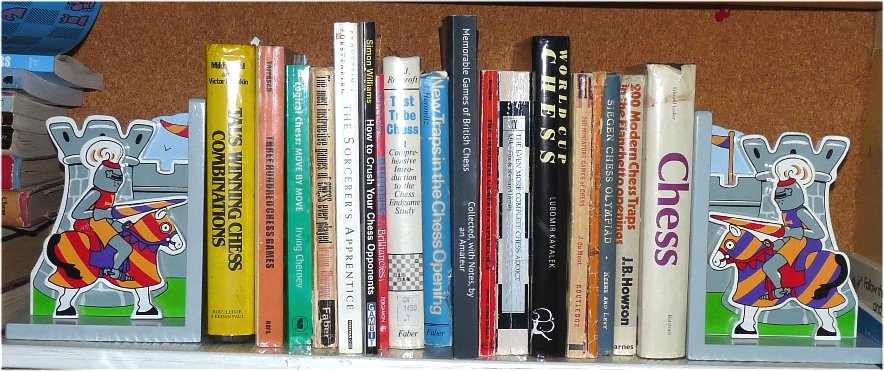
Something else I got for Christmas. Knight Bookends. https://www.redhotpawn.com/imgu/blo... I am the envy of C.G. I can almost hear you all drooling |
|
| Jan-21-25 | | areknames: I am watching this Aussie movie, <Son of a Gun>. It's a crime thriller with a very good cast although it's probably not my cup of tea. The lead character is a young man, good at chess, who ends up in prison for a petty crime. There another inmate tells him that in the 3rd game of the 1972 WC Fischer played a move that had never been played before and then Nh5 is played on the chessboard. The inmate then proceeds to tell him that that move signifies total commitment and there can be no turning back after that. "No interest in a draw mate, just the win". They are trying to recruit the young man in their gang and Nh5 is a metaphor for that. I liked the reference! |
|
| Feb-26-25 | | andrea volponi: 34Kf1!! Rxe1+ - Kxe1 Qe4+ - Kd2 Bf5 - Bh6 Qxd5+ - Kc1 Qe5 - Qxe5 dxe5 - Bd2 (draw for me ). |
|
| Apr-13-25 | | ewan14: Not one of the greatest games ever
Spassky not heeding the warning ( by Geller ? ) that Fischer might play Nh5 |
|
 |
|
|
< Earlier Kibitzing · PAGE 13 OF 13 ·
Later Kibitzing> |


 Kibitzing