|
< Earlier Kibitzing · PAGE 4 OF 4 ·
Later Kibitzing> |
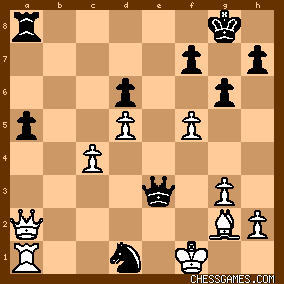
| Feb-16-16 | | stst: Almost by design, c1 is the critical square allowing N snatching W Q and also accessible to Black's Q.
W's back rank is only defended by R, and, by above observation, the obvious move for Black is
25...........Nc1
IF
26.RxN QxR#
ELSE
26. any Q escape then Qe1 (27.Bf1 is redundant as QxB#)
or
26.h3 then NxQ
One other variation possible, but really silly....
25. .........Nf2+ then either
26.QxN and exchange down, or
26.Kg1 Nh3 dbl+
27.Kf1 Qg1+
28.Ke2 Re8+ .... etc |
|
| Feb-16-16 | | patzer2: Can't say my 11 year old memory was any help, but after dismissing the more difficult 25...Nf2+  , which the computers indicate also wins, I quickly found 25...Nc1! (-16.85 @ 31 depth, Stockfish 6). , which the computers indicate also wins, I quickly found 25...Nc1! (-16.85 @ 31 depth, Stockfish 6).White's game starts to slide in the wrong direction after 16. Nce4  . Instead, 16. Na4 = appears to hold the balance. . Instead, 16. Na4 = appears to hold the balance. |
|
| Feb-16-16 | | whiteshark: <25...Nc1!>, and that's it! |
|
| Feb-16-16 | | Nick46: Easy, coz not too many candidates on their starting blocks. |
|
Feb-16-16
 | | Bubo bubo: Missed that one! My first thought was of course <smothered mate again - booooring!>, but on noticing that the white queen guards f2, I went for 25...Nf2+ 26.Kg1 Nd1+. Nice idea and quite similar to the solution, but unfortunately the ♕ still guards f2, so no Qf2# after 27.Kf1. What a bother! |
|
| Feb-16-16 | | wooden nickel: After a failed attempt on a smothered mate and keeping in mind 25... Rb8, I missed the simple 25... Nc1,
finally considering 25... Nf2+ 26.Kg1 Nd1+ 27.Kf1 (would make a good puzzle)
click for larger view |
|
| Feb-16-16 | | CHESSTTCAMPS: Black's nasty knight works well with a queen against a blunted bishop and a weakened king position. In this tactical setting, one would typically look first for a Philidor's legacy (25...Nf2+ etc), but in this case white's queen guards f2, taking away the smothered mate. Black should have no trouble finding a simpler, winning shot: 25... Nc1! breaks the back-rank defense:
A.26.Rxc1 Qxc1+ 27.Bf1 Qxf1#
B.26.Qd2/e2/f2 QxQ wins
C.26.Qxa5 Rxa5 wins
D.26.(other queen move) Qe1+ forces mate.
E.26.(other move) Nxa2 wins. |
|
| Feb-16-16 | | saturn2: After 2 minutes or so i saw Nc1. The move is a double attack both on whites queen and backrank. |
|
| Feb-16-16 | | jith1207: This is a good puzzle. A single move attacks the Queen and the king. And you can't save both. |
|
Feb-16-16
 | | paulalbert: As mentioned by others, my first instinct was to go for Philidor's Legacy with Nf2ch, but saw immediately that white Q on a2 prevents its working, so looked for shield to allow Qe1ch by black. Nc1 does the trick! Instructive puzzle! |
|
| Feb-16-16 | | transpose: I was blinded by my love for smothered mate. |
|
| Feb-16-16 | | BOSTER: I saw double threat in the game Gunina vs Lu Wenjun , Women's World Team Champ , 2013 28. Nd5 , but didn't see it today in POTD.
Maybe should I play in women's tour. |
|
| Feb-16-16 | | kevin86: No smothered mate, but the knight moves to stop up the drain...attacking queen and threatening mate. There is no escape! |
|
| Feb-16-16 | | Herma48852: <transpose>: I was blinded by my love for smothered mate. ^^
This |
|
| Feb-16-16 | | King Harvest: Beauty. |
|
| Feb-16-16 | | WorstPlayerEver: I totally missed it while this guy was talking about interpolation. Little bugger. |
|
| Feb-16-16 | | psmith: Focusing on the smothered mate, I missed the obvious 25... Nc1. Instead I went for 25... Rb8 with the idea of 26... Rb2 followed by smothered mate (or win of Queen). In fact this works. But it's not the most efficient... |
|
| Feb-16-16 | | patzer2: In addition to the decisive 25...Nc1! move played in the actual game, Black also can also win with 25...Rb8 and 25...Nf2+ . Here's the result of my move-by-move look at the two winning 25...Rb8 and 25...Nf2+ alternatives with Deep Fritz 15 at 20 plus depth per move: 25... Rb8 26. h3 (26. Rb1 Rxb1+ 27. Qxb1 Nf2+ 28. Kg1 Nd1+ 29. Kh1 Qe1+ 30. Bf1 Qxf1#) 26... Rb2 27. Qa3 Qxg3 28. Qxb2 Nxb2 (-11.96 @ 21 depth, Deep Fritz 15) 25... Nf2+ 26. Kg1 Nd1+ 27. Kf1 Qd3+ 28. Qe2 Ne3+ 29. Kf2 Qd4 30. Qxe3 (30. Be4 Nxf5+ 31. Kg2 Qxa1; 30. Ra3 Nxc4+ 31. Re3 Re8 ) 30... Qxa1 (-12.32 @ 20 depth, Deep Fritz 15) |
|
| Feb-16-16 | | dark.horse: Tricky Tuesday. |
|
| Feb-16-16 | | gars: very tricky tuesday! |
|
| Feb-16-16 | | PJs Studio: I looked at Nf2 and surrounding ideas, and quickly looked at Re8 which probably wins in due course... But not quick enough. Nc1! came quickly hitting the queen and back rank. Bang! |
|
| Feb-16-16 | | Tiggler: Exchanging N for B is often a good strategy. But not when playing Leonid Stein. |
|
| Feb-16-16 | | zb2cr: 25. ... Nc1 looks like it does the trick. |
|
| Feb-17-16 | | gabriel25: was philidor legacy really his to leave?
i have heard not
anybody knows? |
|
| Feb-17-16 | | gabriel25: take a quadrille paper draw an 8x8 square write a 1 in one of the four center square, say d4, write a 2 in the squares where a knight would fall from 1, a 3 where a knight would fall from 2, and 4 from a 3. make similar boards starting from c4 and c3.
from b4,b3,b1 and finally a4,a3,a2, and a1.
it is a lot of work but when you look at those diagrams you will remember everything you learnt and that you have forgotten and probably some you never knew about knights. |
|
 |
|
|
< Earlier Kibitzing · PAGE 4 OF 4 ·
Later Kibitzing> |


 Kibitzing

 sac: 21...Ne3