|
< Earlier Kibitzing · PAGE 4 OF 4 ·
Later Kibitzing > |
Apr-01-06
 |
| al wazir: <kevin86: Since the en passant capture is available on the next move-the pawn must have stopped at d6> To see the fallacy of this, note that instead of capturing e.p., white could have offered a draw or resigned. In that case the is certainly NOT on d6.Only in quantum mechanics is it possible for an object to be in two places at once. |
 |
| Apr-01-06 |
| gauer: Is this "game" a forgery? I'm also wondering why Fred Deacon hadn't made the player of the day section, some of his so-called "forged" games being wins against Steinitz and Morphy (if so, it could unite a direct carry-over of world champion title, assuming one existed prior to Steinitz). Oh well, next year, I guess they'll have to link the collection of the Deacon best games to his (purported) "compositions". |
 |
Apr-01-06
 |
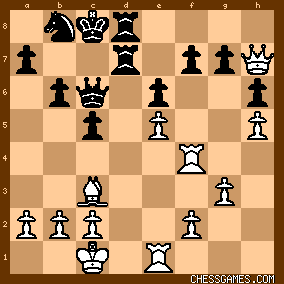
| Sneaky: It's fairly obvious that en-passant was legal as both White's queen and rook are under fire. The queen is being attacked, so you'd think that surely the move before must be one that attacked it, right? Did the rook move from d6 to d7? Hardly--in that position Black would just snip off the rook on f4! So it doesn't take Sherlock Holmes to figure out that ...g5 was the previous move. What is incredible is that hxg6 wins. I'm still really sure I get it. |
 |
Apr-01-06
 |
| Sneaky: <Black argues:the rules of chess allow no en passant capture while the king is in check> Huh? I've never heard of THAT rule. It's CASTLING that you can't do in check, en passant all you want, provided that it gets you out of check. |
 |
| Apr-01-06 |
| Chess Prodigy: Definately April Fool's prank...I had no idea en passant was possible...5/6 for the week though...good thing tomorrow is April 2nd and not April 1st :-) |
 |
| Apr-01-06 |
| gauer: Sneaky: I've never heard of THAT rule. It's CASTLING that you can't do in check, en passant all you want, provided that it gets you out of check. I believe that there was an old version of the chess rules which had "passar bataglia" (Oxford Companion to Chess - Hooper and Whyld) which was the pre-cursor to e.p., and you'd have to look up the definition to make sure it fits what is claimed. Whether it precedes castling or the old bishop move or immediate promotion or modern queen powers or kriegspiel game implementation, I do not know (however, it must've come after the pawn double-step rule). But I wish some engines had a switch to turn them on or off at one's leisure. |
 |
| Apr-01-06 |
| gprice: Article 5: The completion of the game
5.1 The game is won by the player who has checkmated his opponent`s king. This immediately ends the game, provided that the move producing the checkmate position was a legal move. Wouldn't it be fair to say that ...d5
would only be a legal move if the en
passant condition was not available?
In fact any 2 square pawn move is only
valid if an en passant possibility is
not exercised. I guess I would argue
that this d5 move is not legal because
of that very possibility, the move does not hold unless white ignores it.
I think that the en passant rule means in this position that although black tries to get to d5 the pawn gets chopped at d6 and the black king never really is out of check so try another move. |
 |
Apr-01-06
 |
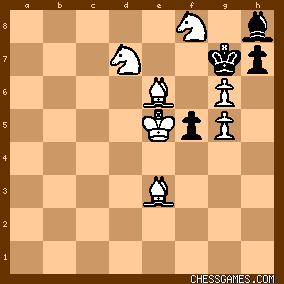
| kevin86: First of all,the puzzle above was a short story entitled "Breach of Priveledge". The argument is clearly philosophical as the rules of chess clearly favor black. The contradiction is this:the pawn MUST advance two squares to stop white's check. If the adjacent pawn forbids the two square move-black is mated. If a one square restriction is conditional on an immediate capture (as the rule seems to say),then white is lost. In short what we have here is a conflict between two opposing ideas:a two square move vs the ability to capture the pawn before it can pass your pawn. BTW,White can capture en passant while in check--but only if the passing pawn gives direct check.  click for larger viewAfter d5+ white can capture cxd5 |
 |
| Apr-01-06 |
| tjshann: Very clever. I looked at this for a long time, and wondered what moves led to a position where both White's Queen and Rook were hanging. So I started the puzzle at move 30 and all was clear. |
 |
Apr-02-06
 |
| ganstaman: I'd like to repeat myself, if I may.
<Also, even when an ep capture is allowed, the captured pawn actually moved foward 2 squares even though it was captured as if it had moved one. That it moved 1 square is the illusion, and that it moved 2 squares is the reality.>In <kevin86>'s position, the pawn really does go to d5. The possibility of an ep capture does not force the pawn to sit on d6 for a move. How can you say that ...d5 is not a legal move? The player picks up the pawn and places it on d5. This blocks the check. Think of it this way. In this position, is 1...d5 2. Bxc6 legal?
 click for larger view
Of course it isn't. The pawn stays on d5. If white plays 2. cxd6, that's legal, but the black pawn is never on d6. |
 |
| Apr-02-06 |
| gprice: <ganstaman> if in your diagram a
bishop was on c8 and the white king
on g4 then d5+ would be legal and no
en passant question.
Now I wonder if a check nullifies
the en passant then in the original
black should win.
very confusing. |
 |
Apr-02-06
 |
| ganstaman: It's not really confusing unless you try to make it so. Check doesn't nullify ep. But the rules are simple: if you are put in check, your next move must get you out of check or else you lose. If an ep capture gets you out of check, then it is legal. If the ep capture doesn't get you out of check, then just like every other move that doesn't get you out of check, it is illegal. Also, the rules for ep are simple. The pawn advances 2 squares. On your very next move, and then only, you are allowed to capture that pawn with a properly placed pawn of your own as if the enemy pawn moved forward only 1 square. You can't capture the pawn ep with a piece, which clearly shows us that the pawn does in fact move forward 2 squares and not one. Maybe I'm just looking at it the wrong way but I don't see how these rules could possibly contradict each other. So yes, black wins in the original puzzle by kevin (white can't capture ep because that leaves him in check, and the black pawn does block the check against the black king since it really does sit on d5). |
 |
| Apr-02-06 |
| gprice: I agree. It's all clear now. |
 |
Apr-02-06
 |
| midknightblue: <fezzik> great handle, great book and great movie! |
 |
| Apr-03-06 |
| likestofork: <Sneaky: It's fairly obvious that en-passant was legal as both White's queen and rook are under fire.> That's like using logic, or something. People, there will be no use of logic in the chess-room. Oh, wait, that's 'no fighting in the war-room'. It's terrible when a mind starts to slip like that. Entropy sucks. |
 |
| Apr-03-06 |
| EmperorAtahualpa: I admire games like these. A lot of calculation, all to gain one pawn! Chess at its finest. I was far from solving this one. :( |
 |
Apr-20-06
 |
| LIFE Master AJ: 32.???
|
 |
Apr-20-06
 |
| chancho: 32.hxg6 en passant. |
 |
Apr-22-06
 |
| LIFE Master AJ: It speaks.
|
 |
Apr-22-06
 |
| chancho: Just trying to help. |
 |
| Jan-24-07 |
| gauer: The double-capture-in-passage reminds me of another old game I used to play as a child: Red Rover, "Red Rover, We Call ___ Over!" In this case, white has a sort of quart-grip with his pawn quartet, ready to clothes-line (to use a wrestling term) the opposing potential peon-theives whom might interrupt a promotion ceremony, by setting free a captured piece. I nominate this theme to be called the Red Rover theme. |
 |
| Feb-15-09 |
| WhiteRook48: why all this fuss about en passant? |
 |
| Feb-27-09 |
| gauer: <WhiteRook48> Pawn tactics such as A Murariu vs Mecking, 2008 & at least one puzzle (other than the famous Excelsior with a totally different Pawn theme mentioned here) by Sam Loyd seem to be a bit harder than average for the Beginner to visualize when without the presence of a board, but do add spice to the soul of the game of chess. The reason? Pawns advance (potential for double-step out of the gates, not allowed afterwards), promote (4 choices of a way to remove one replaced piece with another) & capture (either using en passant, when the piece location they capture at needn't always be the one that they land at; or, using regular P capturing, when this is not the case) in different ways than many of the other Soldiers of this Army that have some sort occupational title. The case above would show the b1-h5 & e8-h5 Diagonals also operating on a sort of Valve opening (to approximate some chess composition terminology, as in the case of the King-Bishop-Pawn running a sort of temporary Interference on a former Diagonal that the Queen might like to retreat on in future), which are in addition to extending a King-Rook & King file for white, along with a 5th Rank, & finally, removal of a counter-attack by another Pawn, such as the King-Knight-Pawn that attempts to attack the Rook. The previously mentioned rules for Pawn & other piece movement innovations also contributed to the game of chess over the Centuries, as mentioned above. Cataloguing them by the theme classifications of a, b, c, ..., ... i, j of the Sahovski "Anthology of Chess Combinations" might be a bit more advanced than the more usual tactical methods. As a result of such Passage-type captures, one might wish to take the bit of extra time to visualize how extra lines can open and/or close as a result of mere Pawn pushes. A favourite book about these Pawn themes is the classic one by Kmoch. |
 |
| Mar-06-09 |
| WhiteRook48: pretty sacrifices |
 |
| Oct-09-09 |
| WhiteRook48: 31 exf6
32 hxg6
50...bxc3 |
 |
 |
|
< Earlier Kibitzing · PAGE 4 OF 4 ·
Later Kibitzing > |