May-03-03
 | | lostemperor: A nice game, Pillsbury could have done better with 15. Nxe8 (can your chessengine find this simple move?). 15...Re8 (15...Rxc1 16.Qxc1! Rxe8 17. Bc7) 16. Ne5 Bb5 17. Bxh7 Kxh7 18. Qh5 Kg8 19. Qf7 Kh7 20. Rxc8 and 21. Qxe7 and a clear advantage. |
|
| May-03-03 | | Calli: 15. Nxe8! is excellent. Can white play Bh7+ immediately. 15.Nxe8 Re8 16. Bxh7+ Kxh7 18. Ne5 |
|
| Sep-22-03 | | suenteus po 147: Maybe it's just because I hate to see people resign, but couldn't Pillsbury have continued with 38. Ne3? If 38...d2, then 39. h5 d1/Q 40. NxQ RxN 41. h6 Rc1 42. h7 Rc8 43. Rg8 Ng6 44. f4 f5 45. g4 f5xg4 46. f5 Nh8 47. Rxg4 and then black doesn't have a good move to follow up, leaving a good chance for a draw. And if Steinitz tries to transpose moves with 41...Ng6, then 42. Rxg6 and Steinitz can't stop the pawn from queening. That's all assuming of course that Steinitz followed through with the promotion threat first. And he might have! Pillsbury should have played 38. Ne3 and found out for sure before resigning. |
|
| Sep-22-03 | | Calli: They are not people, they are GMs! In your line Steinitz would play 39...Re1 40.h6 Rxe3 a)41.h7 Re1 43.h8/Q d1/Q 
b)41.fxe3 d1Q 42.h7 Ng6 and Rxg6 loses to Qh5+
This is what the players saw and why GMs resign faster than you and I. They realize its hopeless a few moves earlier. |
|
| Sep-22-03 | | ChessPraxis: <to surentus po 147> Black could have pursued the promotion threat in a different way after 38. Nd3 with 38 ... Re1 with the idea of capturing the knight and then promoting the pawn. Black ends up with much more than a knight for the pawn. |
|
| Sep-22-03 | | ChessPraxis: Calli and I wrote our notes simultaneously. I still prefer moving the rook to e1 a move earlier. |
|
| Sep-23-03 | | suenteus po 147: 38...Re1, eh? Heh, I sure didn't see that one, but I guess that's the point if I made that whole inept comment earlier. I do want to say though, Grand Masters are people too. The only difference is that they're the people who are the best at chess, that's all. |
|
| Sep-23-03 | | Calli: Your comment was not inept. It was a good question. Thats what the forum is here for. Have a question, then fire away. Someone here may have the answer. I had to stare at the position for a good bit to grasp what was going on. Your line seemed entirely reasonable. Always realize the players spend hours over board during the game and see more variations than usually anyone else has the time for. We like to laugh at their blunders, but I always start with the idea that they are more likely to be right than me when first looking at a position. Especially if they are Steinitz and Pillsbury. Was joking about them not being people, of course. See, they are not normal chess players , .... ah forget it , I'm not explaining it. |
|
| Sep-23-03 | | suenteus po 147: Thanks, Calli. I appreciate your encouragement. After reviewing our posts, I very much like your approach of assuming the grandmasters are right before I am. It will force me to exhaust every possible line and countermove before making any kind of recommendation, which is what I should be doing anyway. And in the meantime, I can always ask more questions. Okay, so here's a question, what happens if, following the line 15. Nxe8 Rxe8 16. Ne5 black plays 16...Rxc1 after the knight move? What does white do then? |
|
| Sep-23-03 | | Calli: So the question is whether White has Bxh7+ in that line? Seems so 15.Nxe8 Rfxe8 16.Ne5 Rxc1 17.Bxh7+ Kxh7 18.Qh5+ Kg8 19.Qxf7+ Kh7 20.Bxc1
looks like a win. The d7 bishop is hanging and white threatens Re3-h3. Don't see a defense. Not totally sure about lostemperor's line with 15...Rxc1. 15. Nxe8 Rxc1 16.Qxc1 Rxe8 17. Bc7 Qb4 looks good but maybe not winning. |
|
| Apr-24-08 | | Ulhumbrus: 11 Nb5?! starts an attack not from an equal position but from a position where White has a slight advantage. The more modest 11 Qd2 may be better. 11...Ne8?! undevelops the KN. It may be that Steinitz acts as if White has attempted to attack unsoundly from an equal position, whereas White's error consists actually of trying to aim for too much in what is only a slightly advantageous position. It may be that whereas 11...Ne8 is advisable in the former event, in the latter event the developing move 11...Bd7 is better. With 15...exd5 Black's e pawn moves a second time to take a N which has moved four times, making a gain of two tempi. 16 Rxe7 gains the bishop pair and Black's KN will have lost two tempi in going back to f6. With 16...Nf6 Black threatens ...Bg4 as well as ...Qxb2. However 17 b3! Bg4 18 Be2 may gain some advantage. After 38 Nh4 Steinits simply allows White to prosecute an attack and to chase the black King to d7, following which the check ...Qc1+ wins quickly. There may be a lesson there. |
|
| Oct-22-11 | | sevenseaman: White had an edge most of the time but Black kept the coolest nerve to grind out a win that must have shattered Pillsbury's morale. "Chill Pill"! What an appropriate pun; makes my day. |
|
| Oct-22-11 | | monkeyfish18: This was my pun! |
|
| Oct-22-11 | | sfm: 32.-,Rc8! is really a nasty response, stopping the show. Maybe Pillsbury only looked at 32.-,d3?
So, it would appear that the attack with 31.Rg3+ can't work. What else? Maybe 31.f4.
Simply 28.Nd4 gives White a small but clear advantage. Whatever Black plays he is bound to suffer from his wide open king position.
Anyone with silicon? |
|
| Oct-22-11 | | kevin86: Black's king was much more exposed-but it was white's game that was in crisis. That's funny about Steinitz--- |
|
| Oct-22-11 | | Prudov: Comment by Euwe on this game in his book “Practical Chess Lessons†(Vol. IV (1928) p. 104, my translation) after 16. Re7:
“A superb combination; not only did White neutralize the disadvantage of a weak d-pawn, but acquired the advantage of the two bishops as well. However, and this must have made Steinitz’s opponents desperate, Black is better after all!â€
Euwe goes on to explain that Black played naturally and White played artificially. He concludes that it is better to be guided by logical principles, than to look for combinations, adding that an outstanding player should have mastered both styles. Euwe himself showed this plentifully in his later career. |
|
Oct-22-11
 | | Honza Cervenka: <11...Ne8?! undevelops the KN. It may be that Steinitz acts as if White has attempted to attack unsoundly from an equal position, whereas White's error consists actually of trying to aim for too much in what is only a slightly advantageous position. It may be that whereas 11...Ne8 is advisable in the former event, in the latter event the developing move 11...Bd7 is better.> The purpose of 11...Ne8 was to cover c7. The problem with "developing move 11...Bd7" is that it runs into 12.Bc7 Qa6 13.Nd6 etc. Of course, 11...Ne8 has its drawbacks and maybe 11...Nd5 was a better solution at the moment but it is clear that Steinitz reacted on the threat made by 11.Nb5 rather than anything else. But I don't like his 12...Na5 and I see it as the main source of later problems. Instead of that he should kick the Knight on b5 by a7-a6. As <lostemperor> pointed out long time ago, 15.Nxe8 could have got black in real troubles. Pillsbury missed this opportunity and after a few moves Steinitz at least equalized. Pillsbury then somewhat overestimated his position and did not notice the dangerous counter-play of black based on weak back rank and passed d-Pawn when he played 32.Qd2, which was probably a decisive mistake of the game. |
|
| Oct-25-16 | | Cucurbit: Euwe and Kramer's _The Middlegame Book 2, Dynamic and Subjective Features_, describes this game as "the punishment of a premature attack," but it's hard to see how white's attack is premature. At move 11, his pieces are developed to good squares, his king is castled and free of danger, and his only clear weakness is the isolated queen pawn, which says rather to attack and not to play passively. Of course, at move 15 there's no way at all that I'd have found Nxe8 Rfxe8 16. Ne5. Sometimes it's easy to evaluate a position but harder to figure out how to make it work like it's supposed to. |
|
| Apr-24-19 | | whiteshark: On <15.Nxe8!>
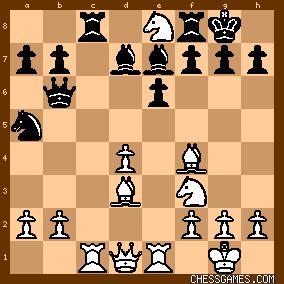
click for larger view
Black to move
1) +2.55 (31 ply) <15...Rxc1 16.Qxc1 Bxe8 17.Bc7 Qb4 18.a3 Qb3> 19.Qb1 Nc4 20.Ne5 Nd2 21.Bxh7+ Kh8 22.Bc2 Nxb1 23.Bxb3 Nd2 24.Ba2 Ba4 25.d5 exd5 26.Bxd5 Bf6 27.Nxf7+ Kh7 28.Bd6 Rc8 29.Bxb7 Rc2 30.b4 Bc6 31.Bxc6 Rxc6 32.Bc5 Nc4 33.Rd1 a6 34.Nd6 Nxa3 35.Ne4 Nc2 36.f3 2) +3.47 (31 ply) 15...Rfxe8 16.Ne5 g6 17.Nxd7 Qxd4 18.Be4 Rxc1 19.Bxc1 Qxd1 20.Rxd1 f5 21.Bf3 Rc8 22.Bd2 Nc4 23.Rc1 b5 24.Ne5 Bf6 25.Nxc4 bxc4 26.Be2 Bxb2 27.Rxc4 Rxc4 28.Bxc4 Kf7 29.Be3 a5 30.g3 a4 31.Kf1 a3 32.Ke2 Kf6 33.Bb6 e5 3) +3.77 (31 ply) 15...Rcxe8 16.Bc7 Qxb2 17.Ne5 Bc6 18.Bxa5 Qxa2 19.Nxc6 bxc6 20.Bc7 Bf6 21.Bd6 Qd5 22.Bc5 Be7 23.Be4 Qg5 24.Qc2 h6 25.Bxa7 Bb4 26.Re3 Qa5 27.Bc5 Bxc5 28.dxc5 Qc7 29.Qc3 Kh8 30.Rd1 Rd8 31.Rd6 Rxd6 32.cxd6 Qxd6 33.Rd3 Qe7 34.Qxc6 Kg8 35.Rd7 6.0 minute analysis by Stockfish 9 v010218 |
|
| Apr-24-19 | | whiteshark: On <15.Nxe8! Rxc1 16.Qxc1 Bxe8 17.Bc7 Qb4 18.a3 Qb3>
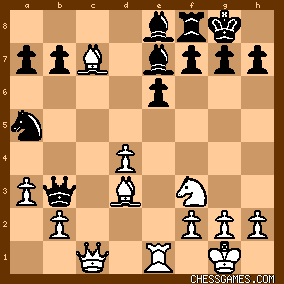
click for larger view White to move 1) +3.95 (31 ply) <19.Re3!> Qd5 20.Qc2 Nc6 21.Bxh7+ Kh8 22.Be4 Qb5 23.d5 f5 24.a4 Qa6 25.Bd3 Nb4 26.Bxa6 Nxc2 27.Rxe6 Bf6 28.Bxb7 Bxa4 29.Ra6 Bb5 30.Ra5 Rf7 31.d6 Bd7 32.Rxa7 Rf8 33.Bb6 Bxb2 34.Ba6 Rb8 35.Bc5 Bc6 36.Bd3 Be4 37.Bc4 Bf6 38.Nd2 Rb7 39.Rxb7 Bxb7 40.Bd3 2) +2.88 (31 ply) 19.Qb1 Nc4 20.Ne5 Nd2 21.Bxh7+ Kh8 22.Bc2 Nxb1 23.Bxb3 Nd2 24.Ba2 Ba4 25.d5 exd5 26.Bxd5 Bf6 27.Nxf7+ Kh7 28.Re3 Bb3 29.Rxb3 Nxb3 30.Bxb3 Bxb2 31.a4 Rc8 32.Bf4 Rc3 33.Bd1 Ra3 34.Kf1 Bf6 35.Ng5+ Bxg5 36.Bxg5 Ra1 37.Ke2 Ra2+ 38.Kf3 Kg6 39.Be3 b6 40.Kf4 Rb2 41.g4 Rb4+ 42.Ke5 3) +1.93 (31 ply) 19.Bc2 Qd5 20.Re5 Nb3 21.Bxh7+ Kh8 22.Qc3 Qc6 23.Bc2 Qxc3 24.bxc3 Nc1 25.c4 Kg8 26.Re1 Bxa3 27.Bf4 Na2 28.Ra1 Nc3 29.Rxa3 Ne2+ 30.Kf1 Nxf4 31.g3 Ng6 32.Ng5 b5 33.Rxa7 bxc4 34.Rc7 Bb5 35.Bxg6 fxg6 36.Ke2 Ba6 37.Nxe6 Re8 38.Rxg7+ Kh8 39.Rxg6 c3+ 40.Kf3 c2 41.Rh6+ Kg8 6.0 minute analysis by Stockfish 9 v010218 |
|


 Kibitzing



