| chessgames.com: <Any chance the [automatic] opening classification system be rehauled?> To really get into this I'd have to begin by explaining how we derive opening designations, because it's far from obvious. (We do not simply look at the moves of the game as you suggested; in fact the moves are actually irrelevant: to determine the opening we covert the game into an array of FEN positions and analyze it from the end to the beginning.) Next, we'd have to discuss the folly of the ECO system and other systems that attempt to solve its deficits. And then we should discuss the deficits of THOSE systems. Overarching the entire endeavor is a somewhat philosophical question of whether determine a game's opening is truly a question that can be defined with mathematical rigor, or if it intrinsically has a human element. I used to believe the former, now I've come to (somewhat unwillingly) accept the latter. <Why is it an Uncommon Opening (A00) when after four moves it reaches a typical Modern/Robatsch (B06) position?> It's sort of like this. You are advocating that this position be assigned to B06: 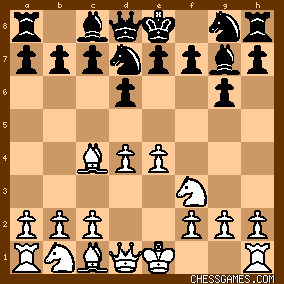
click for larger viewI personally don't know enough about the Modern/Robatsch to actually know if you are correct in this assertion, but I think you are, so let's go with that. I could add that position to our opening database (and I might just do that) and then of the 9 games that saw that position, 5 of them will be assigned to B06. (The other 4 already are.) Which brings up: <the question is why it's not doing it all the time?> The four of them that already are being assigned to B06 actually saw 1.e4 g6; the others transposed into various positions that are not known to our database. <Chessbase does it rather well, couldn't cg.com do the same?> I'm not sure what Chessbase does to derive their opening classifications so that's a hard question to answer. For all I know they hire people to review games manually and modify them where their algorithm failed. Anyhow, we can and do make tiny addenda to our database of opening positions that attempt to ID games, and sometimes these fixes change huge number of wrongly designated games. The hardest classifications are always the "systems", including the Modern/Robatsch in your example. The King's Indian Attack is another notorious one. I've done some work into developing a system of "partial FEN" to help with this, so you could for example define a position like this: 
click for larger viewThe idea is to create a rule: "If White's pieces are ever in this position, it's a King's Indian Attack, regardless of where Black's pieces are." This is still in an experimental phase but I believe it could help fix a multitude of games that can't properly be detected any other way. For some designation problems, like a glaring gaff with the Grunfeld found recently, action should be taken immediately. When it comes to the London System or the Robatch not being spotted correctly, the argument could be made that we should upgrade the software before trying to expand the database to include a near-infinite number of possible FEN codes. <Also, why "uncommon"? The standard term in chess literature has always been "irregular", AFAIK.> I honestly don't remember, but it must have been derived from a file of ECO definitions acquired years ago. I believe you are right, that Chess Informant (who invented the ECO system) used the term "irregular" in their English publications. Maybe we should change it. <What is this system based on, anyway?> When it doesn't display simple ECO names, you are reading designations from the Caxton Opening Database authored by Eric Schiller. It has some glaring holes in it like the Anti-Marshall that you metnioned, and more than a few strange misspellings, and some very whimsical but non-standard names to offbeat openings. Nevertheless, it's very expansive, so improving upon it seems like the smarter approach than rebuilding from scratch. Anyhow in conclusion I've said a lot on this subject and yet I feel like I've glossed over just about everything. I don't think we should take action on this Robatsch example you cited, although fixing the Anti-Marshall would be a definite improvement. | 

 Kibitzing