|
< Earlier Kibitzing · PAGE 11 OF 11 ·
Later Kibitzing> |
| Nov-27-16 | | Howard: That statement is rather debatable, in my view. There are many other games where the winning move was comparable to that one. Not only that, wouldn't
24...Ne2+ have also won, too? Either move wins-it's largely a matter of taste. Karpov, no doubt, would have played the simplier move. |
|
Dec-17-16
 | | kamalakanta: Here is another game that has a similar Queen move to end the game! Bronstein vs Geller, 1961 |
|
Mar-28-19
 | | Sally Simpson: ***
Horowitz liked this game.
In his 1958 book 'All about Chess' which is a collection taken from his chess column in the Saturday Review he gives this game twice (pages 63 and 150) In both cases Horowitz adds that Marshall's wife. Caroline, debunks the shower of gold story. *** |
|
| Dec-18-19 | | Chesgambit: Qh5?? black to play and forse varition |
|
| Dec-19-19 | | Chesgambit: knight + rook windmill |
|
| Feb-17-20 | | dinkstover: nice game! |
|
| Apr-05-20 | | MordimerChess: Frank Marshall: "Perhaps you have heard about this game, which so excited the spectators that they 'showered me with gold pieces!' I have often been asked whether this really happened. The answer is - yes, that is what happened, literally." It's also interesting how Frank Marshall play Sicilian Defense against 1. d4 hahahaha :D Improvements:
10. Na4 Qa5 11. b3 Ne4 12. Bxe7 Nxe7 13. Bd3 Nxc5 14. Nxc5 Qxc5 ⩲ 16. a3 Ba5 17. Ne4 Bxd 21 8. Nxd6 Re7 19. g3 =
20.Qe4 Rf4 21. Qe5 Qc4 22. Rd7 Ne2+ 23. Kh1 Ng3+ 24. hxg3 Qxf1+ 25. Kh2 Rf6 26. Qc7 Rg6 ∞ My video-analysis:
https://youtu.be/FjByjyOwCy8
Enjoy the game and thanks for support. |
|
Jul-01-20
| | Bishoprick: You might want to look at Nicolas Rossolimo vs Paul Reissmann. Before Reisman's resignation, Rossolimo leaves his queen "en prise" three different ways, any of which will lead to Reisman being mated. |
|
| Sep-28-20 | | Chesgambit: 23...Qf3?? Rc7 |
|
| Dec-11-20 | | Justin796: Black is already up a piece...Qg3 accomplishes what exactly...queen and rook trades according to the engine lines...although I wouldnt see a GM defending any other way. |
|
Apr-03-21
 | | FSR: 24.Qe5 Nf3+ would have added to the picturesqueness. |
|
| Jan-03-22 | | N.O.F. NAJDORF: By a strange coincidence, I was considering that variation for the first time just before reading your comment, and noticed that 24 ... Ne2+ wins just as quickly. I don't want to take anything away from Marshall, but even if he had not spotted 23 ... Qg3, he would have won easily by: 23...Qa3 24. Rc7 Ne2+ 25. Kh1 Rxh2+ 26. Kxh2 Qd6+ with an extra pawn compared with the result of the variation actually played. |
|
Jan-24-22
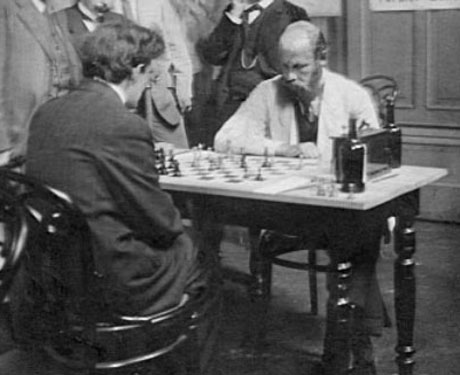
 | | Stonehenge: Photo:
https://learningchess.net/blog/wp-c... |
|
| Aug-24-23 | | EvanTheTerrible: What do you even do at the board when your opponent plays a move like this? |
|
| Jul-28-24 | | probium: *23... Qg3!!* is iconic for a golden coin shower and for good reason.
But we must not let slip the first blow made by Marshall - *22... Rxh3!!* Directly preceding the queen sac is a rook sac that you must not accept, otherwise you fall victim to a knight fork that targets the king, queen and rook. Most likely, you will lose your queen. After 23. Rc5 there are some alternate moves such as 23... Ne2+, which also results in checkmate similarly to 23... Qg3!!. If one is to ask why the move 23... Qg3!! is overrated, it is not because it has been repeated a few times but because of the move that precipitated it - 22... Rxh3!!. This deserves two exclamation marks, not one. |
|
| Jul-28-24 | | Granny O Doul: Possibly Frank denied the gold coins story to Carrie because he spent all the money in a wild night on the town. |
|
Jul-28-24
 | | perfidious: 'Wild night in Breslau'?
Hard to imagine. |
|
Aug-24-24
| | Sally Simpson: Thanks to this game Nepomniachtchi vs Giri, 2024 I am back going though Marshall's games looking for a Qh1-a8 move. Always a pleasant experience revisiting Marshall. Played over half-a-dozen games. Pure joy. I never went over this game, I've done that more times than I can remember but I re-read the last comment about the gold coins. "I have often been asked whether this really happened. The answer is - yes, that is what happened, literally." 'Marshall's 'My 50 Years of Chess' almost certainly ghost written by Reinfeld with Marshall's memories tagged on https://www.chesshistory.com/winter... and we know the shower of gold coins never happened. I now see 'literally' as every time someone praises this game in print then that is another gold coin dropped on the board..literally. A wonderful game - ching, yet another gold coin. |
|
| Jul-19-25 | | HealTheWorld: Marshall's brilliancy 23...Q-KN6!!! is a move that "all of us would love to play at least once in our lives". I however, dispute the opinion that there was any real "shower of gold" - at the time, the world's Gold Standard was on the decline (culminating in the fatal blow delivered by that rat Richard Milhaus Nixon in 1971 which abolished it entirely), so the story was probably fabricated by journalists just to promote the brilliancy and earn them extra money. |
|
| Jul-19-25 | | Petrosianic: <HealTheWorld> I thought it was settled years ago that the gold coin incident did happen, but they were from losing gamblers paying off their debts, rather than admirers. Nixon wasn't involved with the story at all. |
|
| Jul-19-25 | | HealTheWorld: @Petrosianic Yes, you are correct, Nixon was not involved with the story at all. My point was that the International Gold Standard was just on the decline since the late 1800s (which led to it being abolished by the Nixon administration in 1971 - that is the only connection). So, by the time the Levitzky-Marshall game took place, the Gold Standard was already not as much paid attention to as it had been half a century ago, because people were switching over to Paper Money by that time. I know this because I myself collect gold and silver bullion coins (we call them Dinars and Dirhams, respectively) made of actual 99.99% pure gold and silver. I know contextually also that journalists from times past, and today still, are well-known for exaggerating stories to put in their tabloids so that they can earn more money. This is a proven fact - the best example is the Paparazzi. Therefore, just my personal opinion (and I respect yours too), but there is no evidence of anybody throwing anything made of pure gold onto a stage like that to date. On that note, as a collector of gold and silver bullion coins, I need to point out that such coins can be quite heavy, and it does hurt if you throw even one such coin, not to mention multiple such coins, at another. |
|
| Jul-20-25 | | FM David H. Levin: For what it's worth, <Chess Step by Step> (copyright 1924) by Marshall and Macbeth states on page 151, "In the actual game, White resigned after Black's move of Q-K Kt6, upon which the spectators were so delighted with this wonderful dénouement that they enthusiastically made up a gold collection and presented a handsome purse to the victor." |
|
| Jul-20-25 | | FM David H. Levin: The ECO designation B23 seems to be incorrect. According to ECO Volume C (copyright 1974), the position reached by 3...c5 is covered in C10, line 1. I'm about to submit a correction slip. |
|
| Jul-20-25 | | HealTheWorld: @FM_David_H_Levin Yes, now that story sounds like something much more credible. I do know that organizers do give cash prizes in chess matches so that is definitely something that would be expected. |
|
| Jul-20-25 | | HealTheWorld: And to add to what I just posted, I'm aware that organizers also give "brilliancy prizes". So given Marshall's brilliancy, it would definitely be expected that he would receive not only a cash prize for winning but also for the brilliancy. |
|
 |
|
|
< Earlier Kibitzing · PAGE 11 OF 11 ·
Later Kibitzing> |


 Kibitzing