|
< Earlier Kibitzing · PAGE 3 OF 3 ·
Later Kibitzing> |
| Jan-28-19 | | TheaN: Repeat, shame. |
|
| Jan-28-19 | | zb2cr: White's Queen is <en prise>, but Black can't take it, because Ra8+ with mate to follow. So, a sacrificial solution is in order: 22. ... Qxf2+ leads to two possible branches. If 23. Qxf2, Rxb2+; 24. Kf3, Rxc1 and now 25. Ra8+ can be met with 25. ... Rc8 and the Black Rook is protected by the Black Bishop on h3. Black wins, being a Rook up. If 23. Kh1, Qxb2; 24. Ra8+ will be met by 24. ... Rb8. Black wins decisive material and probably will mate quickly. |
|
Jan-28-19
 | | Jimfromprovidence: <jith1207> <Why are most of you have chosen the text line of Kxf2? White can reply by Qxf2. Not that it saves White, but after 23...Rxc1, White can reply Qe1 (not Qf1 as in <CHC> line) which would require Black rook to move from c file.> After 22 ...Qxf2+ 23. Qxf2 Rxc1+ 24. Qe1 Rxe1+ 25. Kf2, below, black has multiple ways to keep the advantage. 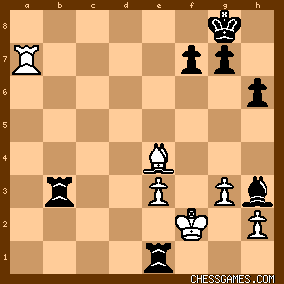
click for larger viewThere is the already mentioned 25...Rf1+, plus 25...Rc1 or interestingly by moving the g pawn like in 25...g6 below. 
click for larger view |
|
| Jan-28-19 | | KingMJA: Got it but it seemed a bit much for a Monday. |
|
| Jan-28-19 | | paulthebox: gee I must be getting old, still vividly remember the impression this made in me me when i was just beginning chess in 1983 |
|
| Jan-28-19 | | cormier: Oct-02-18
Premium Chessgames Member patzer2:
Necessary instead was 22. Qd2 Rxc1+ 23. Qxc1 Rb4 24. f3 = (-0.14 41 ply, Stockfish 9) or 24. Bg2 = (-0.32 42 ply, Stockfish 9) |
|
| Jan-28-19 | | cormier: Oct-02-18
patzer2: .
For a White improvement, instead of 11. Bxf6 =, our Opening Explorer indicates White has had more success with the popular moves 11. Be3 as in White's win in Kasparov vs Illescas Cordoba, 1994 and 11. Bf4 as in White's win in E Can vs S Khanin, 2013 |
|
| Jan-28-19 | | TheBish: Well, I solved it, but it took me longer than 5 seconds. Conclusion: Not a Monday puzzle! Maybe a Tuesday, but could also pass for a Wednesday puzzle I think. And now I see the previous note indicating that this was indeed a Tuesday puzzle, as recently as Oct-02-18. |
|
Jan-29-19
 | | piltdown man: Isn't this yesterday's puzzle? |
|
| Jan-29-19 | | DonChalce: the puzzle from yesterday used as a gotd now? weird. |
|
| Jan-29-19 | | ChessHigherCat: The whole site is going to the dogs. The neonazi(s) have triumphed on the Rogoff page and nobody else wants to play there until they clean up the dog-shyte. That's what happens when you have a big vacant lot. |
|
| Jan-29-19 | | goodevans: <DonChalce: the puzzle from yesterday used as a gotd now?> Well, I guess that's better than the other way around. ;o) |
|
| Jan-29-19 | | Ironmanth: What a slugfest. Great miniature, chessgames! Thanks, all, and may all enjoy the Super Bowl Sunday! |
|
Jan-29-19
 | | chessgames.com: <ChessHigherCat: The whole site is going to the dogs. The neonazi(s) have triumphed on the Rogoff page and nobody else wants to play there until they clean up the dog-shyte. That's what happens when you have a big vacant lot.> The Rogoff page has now been assigned as a top moderation priority, and <Additional Moderators> have just been designated to clean things up. <Please blow the whistle> (again, if necessary) on any posts which violate either the letter <or> the spirit of the guidelines. The <posting guidelines will soon be updated> to address situations which weren't formally covered by the original ones. <DonChalce: the puzzle from yesterday used as a gotd now? weird.> The puns are selected manually, and Sargon didn't realize that this game had just been used for the puzzle of the day, which is done week by week. This misstep has never happened before, as far as we are aware. There are always going to be occasional mistakes, but conditions are steadily improving. For instance, <correction slip processing has resumed>. It had thus far been delayed due to issues deemed to be of higher priority. As some here might recall, when Sargon took over correction processing a few years ago, he had to clear a backlog of over 3000 slips! All site <Ownership and Staff are working tirelessly and in good faith>. We appreciate the <patience> being shown by all members—and we hope that the more prominent and vocal among them will remain cognizant of the <formidable task> which is still underway. It's a monumental challenge to try to absorb—in only <6 months> or thereabouts—the wisdom and <experience of 15+ years that Daniel accumulated> nurturing this community. Those members who <keep faith with us> will ultimately be rewarded handsomely. With the advent of 2019, a <new development phase> is beginning for Chessgames.com which will enable Sargon and his ilk to proceed with making <numerous improvements> to existing features, as well as ambitious plans to add many <new features>—so we <anticipate significant growth> over the next several months and into a bright and exciting future. Best regards,
Chessgames.com Owners and Staff |
|
Jan-29-19
 | | Richard Taylor: I "talked" to Lobron. He was commenting on things on a chess site I was on. Once he was talking about the World Championships that took place in Libya. He seemed a likable fellow. Good game here. Either White mated or Black...something like that. |
|
Jan-29-19
 | | Honza Cervenka: 22...Qxf2+ was an ugly surprise for Yasser. Instead of 22.Rxa7 it was better to play 22.Qd2 or 22.Qa1. Maybe 22.Rxc3 Rxb2 23.Rxb2 Qxc3 24.Rb8+ Bc8 25.Bf5 Qa1+ 26.Kg2 g6 27.Rxc8+ Kg7 28.Be4 Qe5 29.Rc4 a5 30.Rd4 is sufficient for draw too but it is not necessary here to give up the Queen. |
|
| Jan-29-19 | | The Kings Domain: Wasn't this the puzzle from yesterday? I hope chessgames isn't getting lazy. |
|
Jan-29-19
| | Honza Cervenka: <The Kings Domain: Wasn't this the puzzle from yesterday? I hope chessgames isn't getting lazy.> Just a coincidence. |
|
Jan-29-19
| | Honza Cervenka: Btw, I remember this game from one of dozens of chess books, which I have at home, but I already forgot that I had made a comment on this game here some 16 years ago....:-) |
|
| Jan-29-19 | | PJs Studio: This game is filthy! Wicked hot. Maybe London had one too many cups of coffee before this round?.... Jeeezus |
|
| Jan-29-19 | | PJs Studio: GM Lobron |
|
Jan-29-19
 | | gezafan: <ChessHigherCat: The whole site is going to the dogs. The neonazi(s) have triumphed on the Rogoff page and nobody else wants to play there until they clean up the dog-shyte. That's what happens when you have a big vacant lot.> <ChessHigherCat> has lied when he talks about "neo-nazis" on the Rogoff page. I have yet to see one. To some leftists anyone to the right of Josef Stalin is a "neo-nazi." <ChessHigherCat> seeks to shut down freedom of speech because his far left arguments kept getting refuted. This is a typical tactic on the part of some leftists. We have been enjoying freedom of speech on the Rogoff page. This has applied even to <ChessHigherCat>'s crude, vulgar and nasty posts. Most don't have a problem with it. It's freedom of speech. I hope freedom of speech is allowed to continue on the Rogoff page. |
|
Jan-29-19
 | | Penguincw: Interesting. One day after being the POTD, this game is the GOTD. |
|
Jan-29-19
| | chessgames.com: Counterargument noted, now let's get back to this game here, please. |
|
| May-07-23 | | syracrophy: <Jan-29-19 Penguincw: Interesting. One day after being the POTD, this game is the GOTD.> I could go even a bit further by saying this position deserves to be seen by every user here: 
click for larger view |
|
 |
|
|
< Earlier Kibitzing · PAGE 3 OF 3 ·
Later Kibitzing> |


 Kibitzing

