chessgames.com

Ivan Sokolov vs Simon Kim Williams
XXII Reykjavik Open 2006  ·  Dutch Defense: Classical. Huisl Variation (A96)  ·  0-1


explore this opening
find similar games 1 more I Sokolov/S Williams game
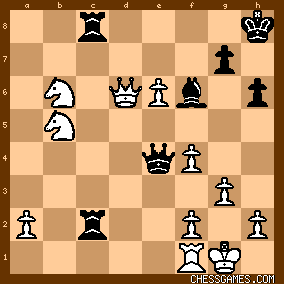
sac: 33...Rxf2 PGN: download | view Help: general | java-troubleshooting

TIP: Some games have photographs. These are denoted in the game list with the icon.

Java Viewer:  What is this?
For help with the default chess viewer, please see the Chess Viewer Deluxe Quickstart Guide.

Kibitzer's Corner
< Earlier Kibitzing  · PAGE 3 OF 3 ·  Later Kibitzing >
Jun-05-08
Premium Chessgames Member
  johnlspouge: <<Alphastar> wrote: <johnlspouge: (2) 34. Kxf2 Rc2+ 35. Kg1 Qe2 and mate Qg2# or Qxh2# follows.> I have a suggestion, why not the immediate 35. ..Qg2# ? :)>

It sounds good to me. Thanks for pointing it out.

Jun-05-08
Premium Chessgames Member
  johnlspouge: <<johnlspouge> wrote: The question of whether to play 33...Rd8 is simply: do you want the White Qd6 at d6 or h3?>

I see my chess dyslexia is asserting itself again: <h3> here should be <a3>.

<AlphaStar> made me look over my own shoulder a little. I am now a little amused by 35...Qe2 in my second line: like a good mathematician, I reduced the problem to the previous case :)

Jun-05-08
Premium Chessgames Member
  dzechiel: <mgyver: i want to add to the dzechiel analysis...in the 37..instead Qxf2+, Rxf2+ 38 Kh3 Qf1+ 39 Kg4 Qe2 40 Kf5 (not Kh3 Qh5 mate) Qc2+ 41 Kg4 Qg6+ 42 Kh3 Qh5 mate>

<mgyver> seems to have successfully found a line I looked for (a mate starting with 37...Rxf2+), but was unable to come up with. Good stuff.

Jun-05-08
Premium Chessgames Member
  zenpharaohs: Murphyman: "Interesting - none of us so far spotted 35)....Rc2 and the defence 36) Qd5.

What are people's views on how far you had to see to claim you solved this one - given there looks to be a couple of winning lines?"

I mentioned this aspect of the defense (putting the queen on the long diagonal). Solving the puzzle should mean finding all the possible solutions and making sure there are no escapes.

Jun-05-08
Premium Chessgames Member
  Jimfromprovidence: I like 29 Nb6 as a stronger move for white.


click for larger view

Both black rooks are now under attack, probably leading to the exchange 29…Rxc3 30 Nxc8 Rxc8, with 31 Qd7 as a strong follow up move for white. This takes a lot of pressure off of white’s position.


click for larger view

Jun-05-08   zb2cr: Boo. Also Ick. I went for the prosaic 33. ... Rc6, which wins a Knight.
Jun-05-08
Premium Chessgames Member
  johnlspouge: <<zenpharaohs> wrote: [snip] Solving the puzzle should mean finding all the possible solutions and making sure there are no escapes.>

Hi, <zenpharaohs>. As I mentioned yesterday, "solution" legitimately means different things to different people. For me, your definition is too restrictive: for me, *one* path to a best outcome suffices.

I can think of a few people who might be relieved to know that even I have no intention of trying to enumerate every winning line ;>)

Jun-05-08
Premium Chessgames Member
  kevin86: I missed this one-I went for the fiscally strong 33...R2 c6. Black wins a knight and the game will follow. It misses the KO punch of the text.
Jun-05-08
Premium Chessgames Member
  YouRang: Foo. I had peeked at 33...Rxf2, but didn't carry it far enough.

Then I got hung up trying to make 33...R2c6 work (essentially trading both rooks for the queen), but it didn't go far either. Then I ran out of time and looked at the answer...

It appears that 33...Rxf2 is in fact a forced mate. Good puzzle, but dismal performance by me. :-(

Jun-05-08
Premium Chessgames Member
  playground player: Rxf2 was the only move that suggested itself to me. It was the only move that White absolutely, positively has to respond to--and by responding, to open the door to a flood of evils.
Jun-05-08
Premium Chessgames Member
  kevin86: Belay my above comment! I'm glad I'm not in charge of the Fed. After 33...R2c6 34 Nxc8 Rxd6 35 Nxd6-white has a rook and knight and three pawns-in fact,an advantage, over the queen.
Jun-05-08
Premium Chessgames Member
  johnlspouge: Unless Black knew the puzzle position (among the other, simpler possibilities) was fatal for White, the move 30...f4 had little meaning. Far be it from me, of course, to suggest that Black had calculated all the puzzle lines even at move 30...f4 ;>)
Jun-05-08
Premium Chessgames Member
  chrisowen: hope it helps but dont change the channel brother,o yesh we can fear the dutch of Williams.
Jun-05-08
Premium Chessgames Member
  swordfish: Btw nice upset as Black for Williams over a really strong GM.
Jun-05-08
Premium Chessgames Member
  patzer2: For today's Thursday puzzle solution, the
demolition 33...Rxf2! generates a mating attack.
Jun-05-08   Reisswolf: Remarkable! A Thursday puzzle, and I was able to get it rather easily. Maybe I should buy a lottery ticket today.

To be fair, this one is rather easy for a Thursday puzzle.

Jun-05-08   jovack: white is lost after he loses that pawn and black can just replace the rook pretty simple
Jun-05-08
Premium Chessgames Member
  Once: The first thing I noticed about this position was the weakness of the white squares around the white king and the dominant position of the black queen on e4. And the white king is stalemated.

So I really want a white squared bishop on the long diagonal or a knight to plonk on h3 - classic mates against an empty fianchetto.

Of course, that's when you spot that you don't have a knight or white squared bishop. Drat. But holding the mating pattern in mind, we soon spot that Rxf2 also threatens the mate. Hmm. Interesting. Let's look a little deeper.

There follows a forced sequence - 33. ... Rxf2 34. Rxf2 Rf1+ 35. Rf1. Black has a tremendous position. The f2 pawn is gone allowing checks along the second rank and the a7-g1 diagonal.

At this juncture, I wanted to play Qe3+ with a king hunt that white surely cannot survive. I didn't spot the much stronger 35... Rc2 when I was analysing Rxf2, but hopefully in a real game I would have spotted it when I got there.

Incidentally, my criteria for "solving" a position is whether or not I would have won from the puzzle position (or drawn if that is the most that could be achieved). So I don't mark myself down for not spotting the fastest continuation, as long as my continuation also works. But I do count it as a failure if I don't spot enough of the crucial line to win.

I mentally disallow speculative moves, if I would not have the confidence to play them in a real game.

But in the final analysis, I am not here to compete with anyone. I am here to learn. The key for me is whether:

1. In a real game I would have spotted that a combination was "on" and so decided to invest time to look for a forcing continuation.

2. I can spot the key features in the position which determine what kind of attack to play for.

3. I can calculate the line to enough of an advantage that I would have played it in real life.

Jun-05-08
Premium Chessgames Member
  Marmot PFL: This is much harder than yesterday. I thought this was a puzzle they used before and I vaguely remembered the solution, but even with that it was much harder, and I wasted time looking at Rc6. Evidently it wasn't used before, but it still looks very familiar. I recall same theme of attacking with Q+R on the 7th was used fairly recently.
Jun-05-08   jadedpawn: One way to find Rxf2 is by realizing that in the position the f2 pawn is the only thing preventing Qg2#, the second thing to note is that black has two rooks on the same file so a "reloader" theme is possible. So 33... Rxf2 34 Rxf2 removing the pawn and then 34... Rc1+ 35 Rf1 Rc2 and black's attack is too strong.
Jun-05-08   Magic Castle: Rxf2 is almost instinctive to me. I mean I will grab the pawn without much ado and analyze later. The trigger of my mind set, is the open line for the other rook to the back rank, black queen on nearby to generate checks and threats, with the black king momentarily safe. I have experienced the same positions several times in friendly games and at times without the luxury of a safe king position. So I ended up thinking of continuous checks so as not to give white the tempo until the game is won.
Jun-05-08
Premium Chessgames Member
  YouRang: <Once><Incidentally, my criteria for "solving" a position is whether or not I would have won from the puzzle position (or drawn if that is the most that could be achieved). So I don't mark myself down for not spotting the fastest continuation, as long as my continuation also works. But I do count it as a failure if I don't spot enough of the crucial line to win.>

Yes, I've come to the same conclusion with regard to defining what it means to 'solve' a puzzle. I found that other attempts at definitions suffer from being too vague or too arbitrary to be generally useful. :-)

Jun-05-08
Premium Chessgames Member
  zenpharaohs: <zenpharaohs>. "As I mentioned yesterday, "solution" legitimately means different things to different people. For me, your definition is too restrictive: for me, *one* path to a best outcome suffices."

If you always put yourself in the position of the player who gains by the problem, then this can make sense.

But if you consider how you might use the knowledge you get from the problem, perhaps you will be on the wrong side - that you will have to defend. And defense normally requires you to handle all the successful attacking lines.

There are different points of view, but to some extent, if you are going to look into a position seriously, then you might as well do the whole thing.

I agree though in this case, an explicit enumeration of all the lines would take up more space than it might be worth. There are a few motifs that contribute to create many variations but the understanding of the motifs is enough to get the whole picture.

Jun-05-08
Premium Chessgames Member
  johnlspouge: <<zenpharaohs> wrote: [snip] If you always put yourself in the position of the player who gains by the problem, then this can make sense.

But if you consider how you might use the knowledge you get from the problem, perhaps you will be on the wrong side - that you will have to defend. And defense normally requires you to handle all the successful attacking lines.>

Occasionally, the puzzles involve trying to draw, so sometimes explicitly "I" am the defender. Even when "I" am to win, my "solution" must win against all defenses, so implicitly "I" am the defender, too.

"You know these things as thoughts, but your thoughts are not your experiences, they are an echo and after-effect of your experiences: as when your room trembles when a carriage goes past. I however, am sitting in the carriage and often I am the carriage itself."

Friedrich Nietzsche

Chess imitates Life. Perhaps one needs to be both White and Black at once :)

In general, I enjoy your comments greatly. Thanks for responding.

Feb-13-09
Premium Chessgames Member
  notyetagm: 33 ... ?


click for larger view

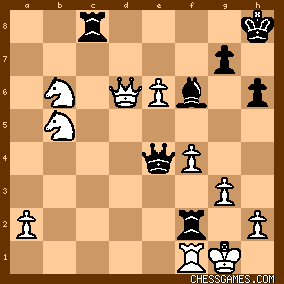
33 ... Rc2xf2!


click for larger view

<patzer2: For today's Thursday puzzle solution, <<<the demolition 33...Rxf2! generates a mating attack.>>>>

Jump directly to page #    (enter number from 1 to 3)
< Earlier Kibitzing  · PAGE 3 OF 3 ·  Later Kibitzing >

Winning Middlegames by Sokolov
NOTE: You need to pick a username and password to post a reply. Getting your account takes less than a minute, totally anonymous, and 100% free--plus, it entitles you to features otherwise unavailable. Pick your username now and join the chessgames community!
If you already have an account, you should login now.
Please observe our posting guidelines:
  1. No obscene, racist, sexist, or profane language.
  2. No spamming, advertising, or duplicating posts.
  3. No personal attacks against other users.
  4. Nothing in violation of United States law.
Blow the Whistle See something which violates our rules? Blow the whistle and inform an administrator.


NOTE: Keep all discussion on the topic of this page. This forum is for this specific game and nothing else. If you want to discuss chess in general, or this site, you might try the Kibitzer's Café.
Messages posted by Chessgames members do not necessarily represent the views of Chessgames.com, its employees, or sponsors.
Spot an error? Please submit a correction slip and help us eliminate database mistakes!
This game is type: CLASSICAL (Disagree? Please submit a correction slip.)

Featured in the Following Game Collections [what is this?]
f7/f2 sacrifices
by notyetagm
Dutch Defense: Classical. Huisl Variation
from DUTCH DEFENCE by gambitfan
237-point difference
from Beat the Elite with Black by Whitehat1963
Mating Net's Dutch Doozies
by Mating Net
Dutch Defense: Classical. Huisl Variation
from GAMES OF THE DAY by gambitfan
33,-- een mooie matvoering
from chgames dagopgaven by Q. Voorstander
33...Rxf2! is a demolition leading to mate
from Mating Attack by patzer2
Dutch Defense
by notyetagm
Thursday, June 5 (Almost my contribution.)
from Puzzles I've suggested, used since Jan. 1, 2008 by Whitehat1963


home | about | login | logout | F.A.Q. | your profile | preferences | Premium Membership | Kibitzer's Café | new kibitzing | chessforums | new games | Player Directory | World Chess Championships | Opening Explorer | Guess the Move | Game Collections | ChessBookie Game | Chessgames Challenge | Little ChessPartner | privacy notice | contact us
Copyright 2001-2009, Chessgames.com
Web design & database development by 20/20 Technologies