|
< Earlier Kibitzing · PAGE 2 OF 2 ·
Later Kibitzing> |
| Jul-03-06 | | MrMelad: <dakgootje: can you still call Rxe2 a sac? Well yes it sacs material but almost all the following moves are nearly forced> A sacrifice that doesn't lead to a forced win is often called a mistake, so I guess most good sacs lead to a forced win.. Ofcourse there are some sacrifices that are more beautiful then others because the forced win is not as obvious as it is in (four two letters words in a row!) this game. |
|
| Jul-03-06 | | ajile: Brutal demolition of White. White needed to defend the Nc3 on move 12. Qc2 looks OK. |
|
| Jul-04-06 | | dakgootje: Nah not neccessary that a sac leads to a forced win. Most positional sacs dont and a lot of justified sacs just lead to a good attack or a better position |
|
| Jul-07-06 | | MrMelad: a better position leads to a forced win usualy :) |
|
Jul-07-06
 | | keypusher: <can you still call Rxe2 a sac? Well yes it sacs material but almost all the following moves are nearly forced> I think Spielmann would not have called it a sacrifice, but rather a combination (or the first move of a combination). He reserved the term <sacrifice> for cases where compensation for the lost material was speculative, long-term and uncertain. So I guess 4. b4 in the Evans Gambit would meet his definition of a sacrifice, but ...Rxe2+ here wouldn't. Nor would 2. c4 in the Queen's Gambit, since black can't keep the extra pawn. I think it's fine to call ...Rxe2+ either a sacrifice or a combination, as long as people can agree (or agree to disagree) on their definitions! |
|
| Jul-11-06 | | zb2cr: Spielmann, in his book <The Art of Sacrifice>, distinguished 2 categories of sacrifice. 1. The "sham sacrifice", which led to forced lines with either mate, obvious material advantage, or obvious positional advantage. 2. The "real sacrifice", which <keypusher> referred to above, characterized by taking on a certain degree of risk. I remember his comment on a game with the defensive master Akiba Rubenstein, concerning his sacrifice of a Rook: "This was as far as the sacrifice was calculated. Black will be down a Rook, but he drives the White King up to the 4th rank. Such an attack must succeed!". Well, yes, I suppose...if you have the playing strength and iron nerves of a world-class player. |
|
| Oct-21-16 | | dfcx: Looks easy for a Friday puzzle. King chase with 17...Rxe2+
18.Kxe2 (Qxe2 Qxc1+) Ba6+
19.Kd2 Qf2+
20.Kd1 Rb8
21.Rb1 Qe3+
22.Kc2 Qc5+
23.Kd2 Qd4+
24.Kc1 Qf4+
25.Kc2 Qc4+
26.Kd2 Qd3+
...
and white king will be mated in 2. |
|
Oct-21-16
 | | An Englishman: Good Evening: <xb2cr>, if I had Black, this would have counted as a real sacrifice, partly because I could never calculate that far ahead (10 moves!), and partly because I would sacrifice the Exchange immediately and only later bother to analyze the position. |
|
| Oct-21-16 | | diagonalley: well, after 17... RxB+ i wondered if white can save the situation with 18.K-B1 (?) ... black's Q & R are still en prise... and i haven't yet been able to find a clear winning continuation for black |
|
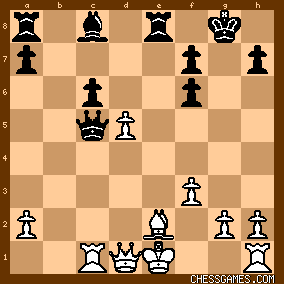
| Oct-21-16 | | YouRang: Friday 17...?
click for larger view
My first surprise was to see that this depleted position occurred at only move 17. As for the solution, I circled around a bit, and on my second go-around I noticed how <17...Rxe2+!> opens a deadly attack against the white king.
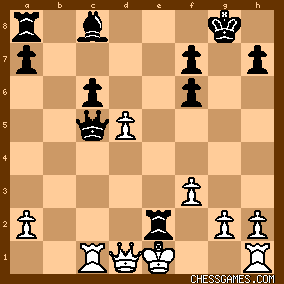
click for larger view
Since the queen is guarding Rc1, white needs <18.Kxe2>, putting the K on a light square that can be hit by <18...Ba6+ 19.Kd2>.
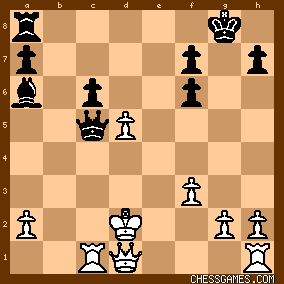
click for larger view
I got this far on my first pass, but I didn't notice how strong it was. The second time around, I noticed that <19...Qf2+ 20.Kc3 Rb8!> threatened mate!
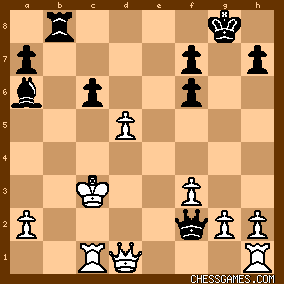
click for larger view
Those "open board" mates can be hard to see, but the threat is ...Qb2#, a dovetail mate thanks to the bishop blocking iff c4 abd d3. How does black avoid this fate?
The key in this postition is to use the queen (on dark squares) and bishop (light squares) to trap the king, while white's rook sits uselessly on h1. - 21.Rc2? Qe3+ is practically an epaulette mate, save for 22.Qd3 Qxd3# (queen mate). - 21.Rb1? Qe3+ 22.Kc2 Rxb1 23.Kxb1 Qc3
click for larger view
And white is helpless against the Q+B attack following ...Be3+. I think white will have to give up the Q for the bishop to stave off mate. |
|
| Oct-21-16 | | agb2002: The material is identical.
White threatens Rxc5, dxc6 and d6.
Black can expose the white king with 17... Rxe2+ 18.Kxe2 (18.Qxe2 Qxc1+ wins a piece at least; 18.Kf1 Qf2#) 18... Ba6+ 19.Kd2 (19.Ke1 Qe3+ 20.Qe2 Qxe2#) 19... Qf2+ 20.Kc3 cxd5: A) 21.Qd2 Rc8+ wins the queen.
B) 21.Rc2 Qe3+
B.1) 22.Kb2 Rb8+ 23.Ka1 Qe5+ and mate in two.
B.2) 22.Kb4 Rb8+ 23.Ka4 (23.Ka5 Qa3#) 23... Qf4+ and mate soon. C) 21.Qxd5 Rc8+
C.1) 22.Kb3 Rb8+ 23.Ka4 (23.Kc3 Qb2#; 23.Ka3 Qb2+ 24.Ka4 Qb4#) 23... Bb5+ 24.Ka3 (24.Kb4 Bc6+ wins the queen; 24.Ka5 Qb6+ 25.Kb4 Bc6+ wins; 24.Qxb5 Qxa2+ 25.Kb4 Qb2+ wins) 24... Rb2 C.1.a) 25.Ra1 Qb6 26.Qe4 Bd3 looks winning (27.Qxd3 Qb4#). C.1.b) 25.a3 Qb6 and the threat Bb5+ looks decisive. C.2) 22.Kb4 Qb2+ 23.Ka4 (23.Ka5 Qa3#; 23.Qb3 Rb8+ wins decisive material) 23... Rxc8 wins a piece at least. |
|
| Oct-21-16 | | 5hrsolver: Looks like 20...Rb8 is the most forcing line. I went with 20...cd5 which I calculated to a win. |
|
| Oct-21-16 | | 5hrsolver: <YouRang>
- 21.Rb1? Qc5+ 22.Kd2 Qd4+ 23.Kc1 Qc3+ 24.Qc2 Rb1 25 Kb1 Bd6 wins the queen. |
|
| Oct-21-16 | | 5hrsolver: I mean 25...Bd3 wins the queen. |
|
| Oct-21-16 | | evlozare: 23....Wc4 is a "perfect queen side-step" plus the coming "queen side-step" at 25...Qe3. i have seen winning moves with the queen "side-steps" from a white square to a black one (or vice-versa) especially with the games of GM champ RJF. just enjoy. |
|
Oct-21-16
 | | Willber G: <diagonalley: well, after 17... RxB+ i wondered if white can save the situation with 18.K-B1 (?) ... black's Q & R are still en prise... and i haven't yet been able to find a clear winning continuation for black> 18... Qf2# |
|
| Oct-21-16 | | patzer2: Got the first five moves of today's Friday puzzle with 17...Rxe2+! 18.Kxe2 Ba6+ 19.Kd2 Qf2+ 20.Kd1 Rb8 21.Rb1 Qc5+, but after 23. Kd2 all I could visualize was a draw by repetition with 23...Qf2+ 24. Kd3 Qc5+ 25. Kd2 Qf2+ 26. Kd3 Qc5+ 27. Kd2 Qf2+ =. What I missed was the neat two-move shuffle of the Queen with 22...Qd4+ 23. Kc2 Qc4+ to force 25. Kd2 Qd3+  with the dual mate threat
26. Kc1 Rxb1# or 26. Ke1 Qe3+ 27. Qe2 Qxe2#. with the dual mate threat
26. Kc1 Rxb1# or 26. Ke1 Qe3+ 27. Qe2 Qxe2#.
With the three consecutive moves 21...Qc5+, 22...Qd4+ and 23...Qc4+, the Queen moves in a three-step triangular pattern from c5 to d4 to c4. This three-step, Queen dance is essential to solving today's puzzle and forcing mate with 24...Qd3+ . P.S.: Many years ago when I was taught dance as a child, either at summer camps or in physical education classes, the dance instructors taught a four-step box movement for ball room dance and square dancing. I was never taught a three-step move used in many modern dances. So perhaps I can blame my failure to find the Queen's three-step dance in today's Friday puzzle on the fact that I never learned a three-step dance move. |
|
Oct-21-16
 | | Sally Simpson: Usually skip Friday, Saturday & Sunday but saw the Tartakower name so had a look. His name is like a 2nd hand shop, you have to pop in, you never know what you will find. (or in this case, find again.) I got this almost right away. About as quick as it takes to recall the name of someone you have not seen for quite a while. Recognised it and recall the Queen and Bishop shuggling the White King into position to be mated. Regarding the above discussion. Here...
click for larger view...was 17..Rxe2+ a 'Sacrifice' or a Spielmann 'Sham Sacrifice'. Tartakower when noting up this game calls it a 'Logical Sacrifice.' |
|
| Oct-21-16 | | dark.horse: 1) Nice king hunt.
2) I basically "solved" it up to 18...Ba6+ quickly; I saw that the White king is in trouble; sufficient compensation for me to make the sac. But I'm wondering how far ahead a master would need to see before making the move. Did Tartakower see all the way to the final position before making the sac? |
|
Oct-21-16
| | Sally Simpson: Hi dark.horse,
I say yes to Tartakower definitely getting to here
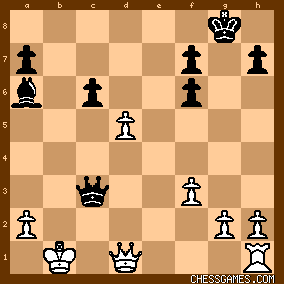
click for larger viewhaving just played 21...Ra8-b8 threatening mate on b2 before playing 17...Rxe2+. That is a forced position with best play. Then his judgement 'this is a win' took over and he played 17...Rxe2+ He says in his notes the co-operation between the Queen and Bishop on the diagonals and on the files between the Queen and Rook 'one need not wonder at the orgy of threats.' More or less saying you should be surprised at all about a win coming from this position. He also has a note here. (white to play)
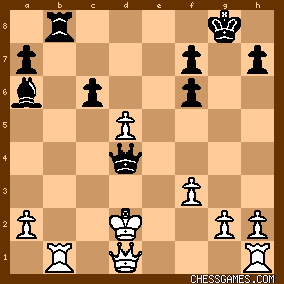
click for larger viewIf 23. Kc1 Qc3+ 24. Qc2 Qe3+ 25. Kd1 Be2+ 26. Ke1 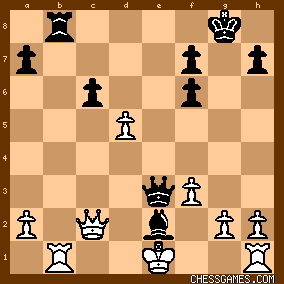
click for larger view26...Bd3+ and wins.
Yes but 26...Bxf3+ mates in a few.
That very moot point possibly hints that Tartakower felt no need to analysis the position into dust prior to 17...Rxe2+ there are wins all over the board. Here is recalling a variation he saw in passing not giving it the full treatment as he was waiting for his opponent to play their 23rd move. |
|
| Oct-21-16 | | kevin86: Black will win quickly. |
|
| Oct-21-16 | | patzer2: For a White improvement in this game, I'd look to the opening. Instead of 6. e4, allowing 6...Bb4 = with a near level game, the Opening Explorer indicates White can improve his winning and drawing chances with the popular move 6. g3 as in White's win in B Lalith vs Short, 2016 or the draw in Topalov vs Caruana, 2016. Even so, after 6. e4 Bb4 White still has level or better chances. However, instead of 7. f3 I believe White can improve his winning chances with 7. Qb3 as in White's win in A Ramirez Alvarez vs G P Jonsson, 2016 or 7. Nxc6 as in the draw in Karjakin vs Grischuk, 2016. The win/draw/loss data for each move at Opening Explorer support the conclusion that 7. Nxc6 and 7. Qb3 are superior to 7. f3. |
|
| Oct-21-16 | | YouRang: <Shrsolver><21.Rb1? Qc5+ 22.Kd2 Qd4+ 23.Kc1 Qc3+ 24.Qc2 Rb1 25 Kb1 Bd6 wins the queen.> Yes, more than one way to skin a cat.
After <17...Rxe2+ 18.Kxe2 Ba6+ 19.Kd2 Qf2+ 20.Kc3 Rb8 21.Rb1>, black can win with either 21...Qe3+ or 21...Qc5+ (among others). The 21...Qe3+ line struck me as simplest, but it matters little in the end. Both lines end up winning the queen and the game. |
|
Oct-21-16
 | | FSR: In blitz, I have always played 2...cxd4 3.Nxd4 Nf6, when 4.Bf4?? (yes, this has been played against me) is met by 4...e5! 5.Bxe5 Qa5+ and wins. |
|
Oct-22-16
| | Sally Simpson: Not only blitz FSR.
This one had a time control of 7 days!
http://www.redhotpawn.com/chess/che... |
|
 |
|
< Earlier Kibitzing · PAGE 2 OF 2 ·
Later Kibitzing> |


 Kibitzing

 sac: 17...Rxe2+
 icon.
icon.