|
< Earlier Kibitzing · PAGE 3 OF 3 ·
Later Kibitzing> |
| Jan-21-14 | | whiteshark: 1st RULE: You do not talk about <Rule number 8>. |
|
| Jan-21-14 | | RookFile: Bogo had a space advantage, then traded pieces at every opportunity, in order to reach an endgame against Capa. In other words, he pursued an illogical strategy on general principles, in order to play into a strength of his opponent. Not surprisingly, he lost the game. |
|
May-30-14
 | | sleepyirv: Bogged Down |
|
| Jul-25-14 | | kamikazzi: why is this called kasparov variation when the game was played before he was even born???????? |
|
| Jul-25-14 | | siggemannen: because Kasparov played and won a lot of games with it completely dominating most of his opponents |
|
| Feb-26-17 | | edubueno: La partida muestra una enorme diferencia de nivel entre un aficionado fuerte y el más grande. Bogo no era un genio, Capa sin dudas SÍ. |
|
| Jul-01-18 | | goser: If the goal of white was a draw, I don't understand 21. f4 and 22. f5. What black would do if white plays b3, keeps its knight on d2 and holds the C line? |
|
Jun-07-19
 | | Fusilli: <kamikazzi: why is this called kasparov variation when the game was played before he was even born????????> This question comes up frequently.
For an analogy, think of the discovery and naming of diseases. People did not start to have, say, multiple sclerosis in 1868, when it was recognized as a distinct disease. Yet, if we figure out, based on historical accounts, that Ben Franklin had MS, we would say that Ben Franklin had MS, even if MS "didn't exist" before 1868. By the same token, if Ben Franklin had all the symptoms of MS but at the time they called that "neuroweirditis", we would switch to call it MS now, not neuroweirditis (Clarification: I made that up. No reason to think BF had MS.) For a closer example. I see you have no avatar at the moment. If you go ahead and choose one (I think they are for premium members only), CG will insert the avatar in all your posts, including those posted before you chose the avatar... Even if back then your avatar didn't exist! |
|
Jun-07-19
 | | keypusher: <Fusilli> Eloquently put! But...I can't see any evidence that Kasparov ever played this variation, with either color. http://www.chessgames.com/perl/ches... Whereas the variation in this game, one of Kasparov's great early wins, is called the Andersson Variation. Kasparov vs Ulf Andersson, 1981 |
|
Feb-17-20
| | sleepyirv: <Bogged Down> |
|
| Mar-04-20 | | Gaito: This particular game, despite its relative simplicity and lack of fireworks, was once chosen by former world champion Tigran Petrosian as one of his all-time favorite games. That happened during an interview for a Mexican magazine. |
|
Mar-04-20
 | | perfidious: Not hard to believe Petrosian rated this as a favourite game, and one which he would likely not have minded playing himself. |
|
| May-16-20 | | MaczynskiPratten: I'm definitely with Petrosian here! It could be the finest positional game ever played. The genius of Capablanca is shown in how he totally outplays a fellow world championship candidate from an apparently level position at move 14 with queens off and just two rooks and a knight each. By move 19 he has opened the c file and by 23 is dominating it with White's b pawn fixed as a weakness. By 25 he has occupied the strong point c4 and White dare not do the same on c5, nor can his Knight reach the alternative e5. Soon, tactical threats are apparent (30...Nxb2 wins 2 pawns) and by move 35 various mating nets are appearing. Every strategic move is timed tactically, such as the moment of occupying the 7th rank with 35...Rc2 when White cannot swap Rooks. Soon the encirclement is complete and the final artistic touch would be to mate with a pawn by 42...e4# if Bogo hadn't resigned on the previous move. Quiet, but utterly beautiful! |
|
Jun-18-22
 | | kingscrusher: Beautiful and reminds me of one of my favorite Michael Adams games where he beat Kasparov in a simul using the light square weaknesses: Kasparov vs Adams, 1988 |
|
Jun-18-22
| | kingscrusher: Objectively it seems as if 24.b3 and White should be able to hold:
click for larger view 177: Efim Bogoljubov - Jose Raul Capablanca 0-1 9.0, Bad Kissingen 1928
click for larger viewAnalysis by Stockfish 15 - 3 threads max:
1. = (-0.03): 24...d5 25.Nc5 Ne5+ 26.dxe5 Rxc5 27.Rhc1 Rac8 28.Rxc5 Rxc5 29.Rf1 a5 30.Kd2 Rc6 31.Rf4 Ra6 32.Kd3 Ra8 33.Rd4 Rc8 34.Kd2 Rf8 35.Kd3 f6 36.fxe6 Kxe6 37.exf6 In the game continuation it seems as though the White king, Knight and g4 pawn become tactical liabilities celebrating basically black's positional pressure build up. 24.b3 and it seems a real challenge for black to get something concrete as an advantage e.g. also
if Na5 even Rhb1:

click for larger viewAnd white is a tough nut to crack here
If say Rc7 to try for pressure build up:
177: Efim Bogoljubov - Jose Raul Capablanca 0-1 9.0, Bad Kissingen 1928
click for larger viewAnalysis by Stockfish 15 - 3 threads max:
1. = (0.00): 25...d5 26.Nc5 e5 27.Ra2 Rc7 28.Rc2 Kf6 29.e4 exd4 30.exd5 Ke5 31.f6 g6 32.d6 Kxd6 33.Ne4+ Kd7 34.Nc5+ Kd6 Capablanca's analysis advice was good :
" <timothee3331> : Capablanca once said that you should concentrate on the winner during an analysis so that the logic of his play could penetrate you and help you to get the right frame of mind." Good advice for it's time but we can now (with engines) kind of scientifically dissect where real mistakes are made - and then try and understand why they are mistakes. It seems there is a lesson here at least to me - that in a position of discomfort, try to minimise the tactical liabilities - so the dog's bark is worse than it's bite rather than the other way round. Okay black did generate Queenside play but if White was slightly more tactically solid, it may have been tenable. |
|
| Dec-31-22 | | ndg2: <copablanco><"Capablanca was among the greatest of chessplayers,but not because of his endgame play..." -- Bobby Fischer>
It's interesting that Fischer and Alejechhin basically share the same sentiment about Capa's endgame prowess. They both conclude that Capa's endgame is certainly very good but not stellar and that his games are mostly decided in the middle game. |
|
| Dec-31-22 | | Mosaichino: Two of the greatest players of all time. Fantastic Capa but Bogoliubov was able to stand up to him. |
|
Dec-31-22
 | | offramp: I was thinking today about Bogdan Lalic. Wouldn't the pun "Bogged Down" better used for BOGDAN? |
|
| Dec-31-22 | | Messiah: <offramp: I was thinking today about Bogdan Lalic. Wouldn't the pun "Bogged Down" better used for BOGDAN?> I rarely think about Bogdan Lalic. Interesting pastime, tho! |
|
Mar-20-24
 | | scutigera: <keypusher>: Look again! The opening of Kasparov vs Adams, 1988 has been retconned into “Kasparov-Petrosian. Andersson Variation.” and plain ol’ “Andersson Variation” has gone the way of neuroweirditis. |
|
| Mar-20-24 | | sudoplatov: The local Stockfish shows Bogo drifting into problems around move 24 or 25. By move 29, Capa is about a Pawn up in positional score. Also, 38....R8c6 mates in 14. I assume Capa saw this. |
|
| Jul-23-25 | | unspiek: White's play in the opening was super cautious, but not really bad. But his choice to allow the Queens to leave at move 13 seemed not only chicken, but out of character. If he'd had that position against Alekhine, I'm sure he'd have played 13. h4 -- not that it's enormously better, but it tries to do something, which was where Bogoljubov had some strength. |
|
| Jul-23-25 | | sudoplatov: Capablanca seems to be one player who understood (if only implicitly) the idea of the Macheeide. Chess consists of setting problems for your opponent while avoiding those set for you. Similar issues face athletes in other fields; one may out-muscle (or out-calculate in chess or bridge) the opponent, but as one gets older, physical abilities deteriorate, so one has to acquire technique. Capablanca, Alekhine, Lasker, and some others realized that chess is a struggle at all levels. One must try to win at all stages. (Alekhine said something like that.) A "simplified position" may still be too complicated to adjudicate. Marshall could play to win from an equal position too. Marshall vs K Treybal, 1933 |
|
| Jul-23-25 | | FM David H. Levin: <<morfishine>: Clearly, <25.Nc5> had to be played. If now <25...e5> then White continues <26.a4> trying to close the position with 27.a5> On 25. Nc5, White might have been more concerned about 25...Ne5+ 26. dxe5 Rxc5. 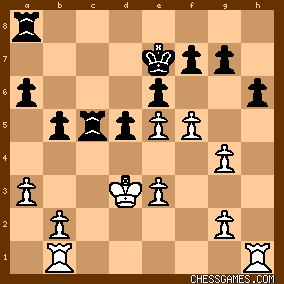
click for larger viewIf now 27. Rbc1, then 27...Rc4 28. Rxc4 dxc4+, with Black's having the healthier majority and sounder pawn structure overall. |
|
| Jul-30-25 | | unspiek: <FM David H. Levin> In FM Levin's suggested line, 27. Rbf1 looks somewhat better than 27. Rbc1, since a clash on the c-file has the drawbacks which he points out. But Black gives the impression of being better either way. I tried to find some path toward a real Black advantage, but it looked more and more equal the longer I looked. Finally I consulted the silicon friend, and teased a line out of it which looked human-reasonable: 25. Nc5 Ne5+ 26. dxe5 Rxc5 27. Rbf1 Rc4 28. g5 hxg5 29. Rh7 Rg8 30. f6+ gxf6 31. exf6+ Ke8 32. b3 Rh4 33. Rg7. Black's seeming edge after move 27 would be at one with Nineveh and Tyre, at his move 33, and it all looks pretty credible. But Capablanca had a tremendous hidden advantage here: Bogoljubov's apparent doomed frame of mind. EB seemed to expect to lose since early in the game, and played probably the most pessimistic game I've ever seen from him. The weak move 25. Nc3 set him firmly toward that goal. |
|
 |
|
|
< Earlier Kibitzing · PAGE 3 OF 3 ·
Later Kibitzing> |


 Kibitzing


