|
< Earlier Kibitzing · PAGE 4 OF 4 ·
Later Kibitzing> |
| Nov-25-17 | | mel gibson: I didn't see it yet it's so obvious when it's shown. The computer says:
26. Bxf7+
(26. Bxf7+ (♗a2xf7+ ♔g8xf7 ♕d2-a2+ ♔f7-f8 ♘d4-e6+ ♖e8xe6 ♕a2xe6 ♕c5-g5
♖d1xd7 ♗c8xd7 ♗c7-d6+ ♘g6-e7 ♕e6xd7 b7-b6 ♖e1-e3 ♔f8-g8 ♗d6xe7 ♕g5-h5
♗e7-a3 ♕h5-e8 ♕d7-d4 ♕e8-e6 f2-f3 c6-c5 ♕d4-d5 ♖a8-e8 ♕d5xe6+ ♖e8xe6 ♖e3-d3
♔g8-f7 ♔g1-f2) +3.38/20 234)
score for White +3.38 depth 20 |
|
| Nov-25-17 | | kungfufighter888: white 25th move bc7 is the winning move. Preventing black King to escape on Q8. |
|
| Nov-25-17 | | patzer2: After a long look, I finally spotted 26. Bxf7+! Kxf7 27. Qh2+ +- for today's Saturday puzzle solution. After 27...Kf8, the Knight fork tactic 28. Ne6+ Rxe6 29. Qxe6 +- (4.91 @ 32 ply, Stockfish 8) was my planned follow-up. However, the computer indicates a stronger continuation for White after 27...Kf8 is 28.Nf5! +- (+ 6.76 @ 32 ply, Stockfish 8) which threatens 29. Bd6+ +-. After 28. Nf5!, play might continue 28...Ne7 29.Bd6 Qxc3 30.Re3 Qf6 31.Rf3 a3 32.Nh4 g5 33.Ng6+ Kg7 34.Rxf6 Nxf6 35.Nxe7 Bd7 36.Qa1 +- (+8.87 @ 24 ply, Stockfish 8). Getting back to the game continuation, from which I digressed with the discussion of the alternative 28. Nf5! +-, after 29...Ne7 I failed to see the strong and decisive follow-up 30. Re3! +- (+21.72 @ 32 ply, Stockfish 8). Instead, I went for the inferior second best move 30. Bd6 ± to +- (+2.12 @ 32 ply, Stockfish 8) which allows Black to put up much more resistance with 30. Bd6 Qg5 31. Rd3 Ne5 32. Qxe5 Qxe5 33. Bxe5 a3 +- (+2.29 @ 32 ply, Stockfish 8). P.S.: Black's decisive error according to the computer was 25...Ra8?, which allows our puzzle solution 26. Bxf7+! +-. Instead, Stockfish 8 indicates Black's only chance to fight for the draw is sacrificing the exchange with 25...Ndf8 26. Bxa5 ± (+1.21 @ 31 ply) or 25...Nf6 26. Bxa5 ± (+1.35 @ 31 ply). Earlier, instead of 23...exd4? allowing 24. Nxd4 ± (+0.66 @ 27 ply, Stockfish 8), Black could have kept the game level with 23...a3 24. c4 Ra6 = (-0.07 @ 32 ply, Stockfish 8). |
|
Nov-25-17
 | | Dionysius1: I don't like the weekend puzzles. They're usually about using combinations which don't win in themselves, but from which other combinations CAN emerge which win. Too indirect for me. The result is that I quite often get the first few moves but don't see how the win is forced. Sometimes I'm even suspicious that the win isn't forced and only comes because the defender's nerve breaks. And that wouldn't really be a puzzle then. Hmm |
|
| Nov-25-17 | | 5hrsolver: The finish is 32. Bd6 Qg5 33. Rf7 |
|
| Nov-25-17 | | malt: 26.B:f7+ K:f7 27.Qa2+ Kf8
(27...Kf6 28.Bd8+! Ke5 29.Qf7)
28.Ne6+ (28.Nf5)...R:e6 29.Q:e6 (Threatening Bd6+) |
|
| Nov-25-17 | | schachfuchs: Not so 'very difficult' saturday?! I got the first 4 moves, only missing the final rook lift 30.Re3 |
|
| Nov-25-17 | | morfishine: <patzer2> Thanks for confirming the strength of <28.Nf5> Thats what I had due to the primary threat <29.Bd6+> ***** |
|
| Nov-25-17 | | Geronimo: A bit easy for a Saturday, but I still didn't get it. I'll give myself a quarter-point though for spotting the first move and important a2-g8 diagonal step. I also spotted how e6 would be the key to this, but I wouldn't have got all the way through it over the board. |
|
Nov-25-17
 | | Jimfromprovidence: <Dionysius1> <I don't like the weekend puzzles. ...
The result is that I quite often get the first few moves but don't see how the win is forced. Sometimes I'm even suspicious that the win isn't forced and only comes because the defender's nerve breaks. And that wouldn't really be a puzzle then. Hmm> This statement has a lot of merit. When people deem a weekend puzzle easy, many times it is because the loser does not defend as well as possible. The puzzle line is a good example of that scenario. On move 29, black plays 29...Ne7, preventing 30 Bd6+, which would win the queen. Much better is to move the queen out of harm's way with 29...Qg5, and still have access to e7. 
click for larger viewNow if white tries 30 Bd6+, black can interpose with 30...Ne7. Also, if white tries 30 Re3, black has 30...Nde5. 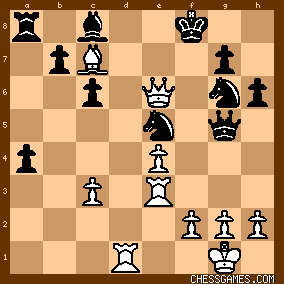
click for larger viewWhite is still winning, but has to find another plan to do so. |
|
| Nov-25-17 | | njchess: Brilliant combination from Kramnik. Granted, Black's development is less than ideal, but Kramnik makes him pay dearly. I saw 26. Bxc7+ easily enough, but I was at a loss for how to follow up. How to get the Black king onto a black square for the knight fork? It took me a few minutes to find 27. Qa2+! Crushing move. Black's position begins to crumble after 28. Ne6+. From there, the rest is academic as White's pieces swarm the hapless Black king. |
|
| Nov-25-17 | | wtpy: David2009, I suspect even crafty throws in the towel after 28 Nf5, which was the continuation I saw in my analysis. I am in the group that thinks that this is a pretty easy Saturday; however since this is a famous game may have seen it years ago, so moves might be salted in my subconscious. |
|
| Nov-25-17 | | agb2002: White has the bishop pair for a bishop, a knight and a pawn. The square f7 looks very weak. This suggests 26.Bxf7+ Kxf7 27.Qa2+: A) 27... Kf8 28.Ne6+ Rxe6 29.Qxe6, with the double threat Bd6+ and Qxg6, looks winning. B) 27... Ke7 28.Qe6+ Kf8 29.Bd6+ wins decisive material. C) 27... Kf6 28.Bd8+
C.1) 28... Rxd8 29.Qe6+ Kg5 30.Nf3+ Kf4 (30... Kh5 31.g4#) 31.g3+ Kxf3 32.Rd3+ Qe3 33.Rd(e)xe3#. C.2) 28... N(Q,R)e7 29.Qe6+ as above. |
|
| Nov-25-17 | | morfishine: <cormier> Please stop flooding forums with this obnoxious drivel. I've reported this using the 'Blow the whistle' function Hopefully, <CG> will delete this nonsense ***** |
|
| Nov-25-17 | | tonsillolith: Some people may actually find cormier's analysis helpful. I have on occasion. But it does slightly get in the way of conversation. Too bad there's not a better place for it. In the pgn, perhaps? On the other hand, I do have confidence in morfishine's ability to suck it up and stop whining. |
|
| Nov-26-17 | | Magpye: <cormier> is now the first person I have been forced to put on Ignore. If he improves, I will be glad to take him off Ignore and then continue to skip over his Bible links without reading them. |
|
| Nov-26-17 | | Pedro Fernandez: My great friend <chrisowen>. Time to speak with you, isn't it? Anyway, this time I found the solution very quickly but just before 30.Re3, a fine move by Kramnik. No relevant at all (IMO). Greetings <Chris>! |
|
| Nov-26-17 | | morfishine: <tonsilloth> You hit the nail on the head: flooding forums with repeated, irrelevant posts disrupts the conversational flow. Putting <cormier> on ignore is the simplest solution, which I've done ***** |
|
Nov-26-17
 | | moronovich:
<morfishine: <cormier> Please stop flooding forums with this obnoxious drivel. I've reported this using the 'Blow the whistle' function
Hopefully, <CG> will delete this nonsense>Thank you.This idiocy has been going on for years. And this is CG,not a church. |
|
Nov-26-17
 | | perfidious: The things I have missed by having <cormier> in iggydumb for years; <morf> is right, though: those strings of 'analysis' really are of little value. |
|
| Mar-07-21 | | Gaito: Kramnik annotated this game in Chess Informant No. 97. In fact it was voted as the best game of the second part of the year 2006.
The following position was interesting:
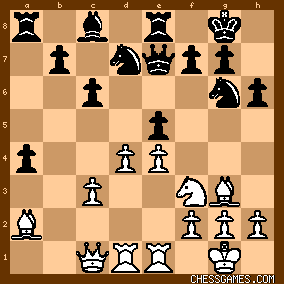
click for larger view
BLACK TO MOVE
The chess engine (Stockfish 13) evaluates this position as equal; moreover, all the previous play by both sides is endorsed by the engine as almost free from significant errors. Here Black played 22...Ra5. In his Informant comments Kramnik only wrote: "if 22...b5, then 23.h4 exd4 24.Nxd4!". Nevertheless, the engine seems to like the move 22...b5, to which it assigns an evaluation of -0.59 (depth 38).
SF13 offers the following variation:
22...b5! 23.h4 Nf6 (instead of Kramnik's suggestion of 23...exd4) 24.Nxe5 Nxe5 25.Bxe5 Nh5 26.Bh2 Qxh4 27.d5 cxd5 28.Bxd5 Be6! (Stronger than 28...Ra6 according to the engine's opinion) 29.Bxa8 Rxa8 (Δ...a3-a2) 30.Bd6 Qg4 (∞) (Evaluation: +0.00) (DIAGRAM)

click for larger view |
|
| Mar-07-21 | | Gaito: Stockfish 13 didn't quite approve of the move 22...Ra5, and after 23.Qd2! (Δ c4) it suggests that Black move the rook back to where it was: 23...Ra8 (with an evaluation of 0.00). Kramnik gives a lentghy analyisis with many possible variations and sub-variations, and apparently his conclusion was that Black's best move was 23...Ra6⩲. But Kramnik doesn't mention the possibility of returning the rook back to a8. True, that would mean two tempi wasted by Black, but in spite of that, the computer evaluates the position as equal. |
|
| Mar-07-21 | | Gaito: The computer dislikes the move 23...exd4?, and apparently that was the "point of inflection" of the game, as it were. Once you give Kramnik a "minimal" advantage, he will steadily be increasing it until he manages to transform it into a "big" advantage. |
|
| Mar-07-21 | | Gaito: After 25.Bc7 the engine believes that Black is already lost (computer evaluation: +2.18).
The remainder of the game was one more demonstration by Kramnik of the speedy way to win a won a game. |
|
| Mar-07-21 | | Gaito: Black could have given up the exchange with 25...Ndf8 as a lesser evil; he would of course have lost the game, but his agony might have been longer. Very possibly the Cuban grandmaster didn't see the coming sacrifice 26.Bxf7+!!, as otherwise he wouldn't have touched his attacked rook. Or if he saw what was coming, then it was because he deliberately chose the short agony instead of the longer one. |
|
 |
|
|
< Earlier Kibitzing · PAGE 4 OF 4 ·
Later Kibitzing> |


 Kibitzing


 sac: 26.Bxf7+