|
< Earlier Kibitzing · PAGE 25 OF 25 ·
Later Kibitzing> |
Apr-28-25
 | | MissScarlett: British Chess Review (edited by Daniel Harrwitz), vol.i, December 1853, p.381: <THE WILFUL MIS-STATEMENTS OF MR. STAUNTON.Although we do not usually descend to notice the egregious falsehoods and ridiculous absurdities brought out, week after week, in the Chess column of the I. L. N., and, month after month, in the pages of our superannuated contemporary, the C. P. C., we deem it a duty to publish the richly-merited chastisement awarded to the editor of the above publications, on a late occasion. Many of our readers will have noticed, in the Chess part of the I. L. N., of the 5th of November, a statement to the effect that Mr. Harrwitz had made a boast of intending "to win a love-match of Mr. Lowenthal." On the 7th of Nov., Mr. Harrwitz, in the presence of the above-named scribe, and, lest he should deny it, in that of some half-dozen gentlemen, denounced the report alluded to, as a gross falsehood, in strong terms, strong but well suited to the taste of the offender. "It is quite amusing," writes a clever correspondent, "to see that individual stultifying and contradicting himself, from week to week, in the I. L. N., with his glaringly one-sided and partial statements. He must be very hard up indeed, to use such pitiful subterfuges as fill the Chess column of that paper. No one but himself believes the rubbish he is continually putting into print." Indeed, we have every reason to believe, that not even himself believes the "rubbish" he would like others to believe. If, for instance, Mr. Harrwitz is really such a poor player as he is represented to be, why did Mr. Staunton slink his challenge in May last? and why the one Mr. Harrwitz gave to all the world in June? He writes against the practice of playing for money; and he himself got his living by playing shilling games, and even for sixpence, not many years ago. But then, tempora mutantur, and when he now offers to play for £250, he should not be taken at his word, for it is against his principles to play for money, - where he fears to lose. He publicly contradicts Mr. Lowenthal's statement, of having beaten him in the majority of games played, because Mr. L. is not likely, under present circumstances, to assert the truth. <He vituperates the members of the London Chess Club, to whom he owes so much gratitude, ignoring the existence of certain letters which might, some day, be unpleasantly forthcoming.>> What can it all mean? |
|
| Apr-28-25 | | stone free or die: I recognize that source... |
|
| Apr-28-25 | | stone free or die: (No online link? On (mis-)principle I suppose.) |
|
| Apr-28-25 | | stone free or die: https://books.google.com/books?id=9... Better unprincipled than misprincipled! |
|
| Apr-28-25 | | stone free or die: RE: <Harrwitz, BCR> Winter has the very article <Missy> quoted from, and much more context, subtext, and possibly prolex: https://www.chesshistory.com/winter... (About half-way down) |
|
| May-04-25 | | stone free or die: <CHESS INTELLIGENCE.
THE following paragraph is from the Berlin Charivari: "The projected match at Chess between Messrs. Anderssen and Staunton will not take place, since the former has as little time to go to London, as the latter has inclination to come to Breslau. We, from the first, doubted that Mr. Staunton would come to Breslau, since he is still too matt* to undertake a journey of that sort without danger." The proposed match between Messrs. Staunton and Harrwitz is still in statu quo, probably owing to Mr. Staunton's absence from England. * Mat is the German for mate, and matt is weak, feeble.> (BCR v1-2 (1853) p319)
https://books.google.com/books?newb... |
|
May-28-25
| | MissScarlett: Townsend provides a summary of his research into Staunton's origins: C.N. 12149 |
|
May-29-25
| | MissScarlett: <Mary Frailing was buried at Brompton on 14 November 1835, referred to as “Mary Fearling Staunton”, aged 25; the cause of her death is not known.> This should be 1834, not 1835. Undoubtedly just a typo on Townsend's part, but I will take its correction in the next 48 hours as confirmation that Townsend is reading this. As for <Fearling>, it does look this way, but it could simply be a misreading of the cursive. |
|
Jun-01-25
| | MissScarlett: <More important is an entirely new address, 15 Brompton Row, Fulham Road, which appears on two 1845 letters owned by the Liverpool Chess Club. This address was in the parish of Brompton, being very close to Knightsbridge. It is his earliest known residence in Brompton. Searches in rate-books and London directories strongly suggest that it was a lodging house at that time.> The Patriot, November 9th 1855, p.234:
<Deaths. [...]
November 3, at 15, Brompton-row, Alexander Greig, Esq., in his 91st year, in the full assurance of faith in Christ his Saviour.> <Greig>, not <Grieg>, which appears in another similar notice, seems to be correct. Wait, this is 1855, not 1845, isn't it?
Yes, but the 1841 census has an entry for Brompton Row for an <Alexander Greig>, aged 75, and of independent means, and (presumably) his wife, <Lucy>, aged 70. In this census (the first), ages for adults were typically rounded down to the nearest 5. It also neglected to record individual property numbers within a street or property, so it can be difficult to determine whether the markings that indicate separate households distinguish separate properties or divisions within a property. However, it seems as if the Greigs may have been the sole occupiers of No.15 at that point. Based on this, my first assumption was that Greig was the long-time owner/occupier and that he may well have lived there as landlord in 1845 when Staunton resided there. But then I found the 1851 census. 15 Brompton Row (now clearly marked) is subdivided into three households (totalling 8 adults) and the Greigs are absent. One household is headed by <Ann Goff>, aged 54, <Lodging House Keeper>. Was No.15 a house of multiple occupation already by 1845? <Brompton Row is an interesting street because it was much favoured by actors, an occupation thought to have been pursued by Staunton. Still, there is no proof that Staunton was an actor, despite this and other evidence.> Strictly speaking, Brompton Row was part of a larger street, not one in itself: https://www.british-history.ac.uk/s... From a brief survey of the 1841 and 1851 censuses, I formed no impression that Brompton Row was popular with actors. Why does Townsend think differently? |
|
Jun-04-25
| | MissScarlett: <The elder child, Agnes Staunton, went to school in Fulham and was married at Paddington in 1848 at the age of 18, her father being named as “Charles Staunton”. She had several children and died in Naples in 1888.> Interesting is the use of the word 'several.' In the 2014 <Historical Notes on Some Chess Players> (now he uses capitals?), Townsend identified four children from the marriage of Thomas Gibson and Agnes: Agnes E. Gibson, born c.July 1850 in Bona, Africa (now Annaba, Algeria). John Knapp Gibson, born November 5th 1853 in Norwood, Lambeth, England. Delphi M(ary?) A. Gibson, born c.1861 in Alexandria, Egypt. Henry Gibson, born c.1866, Hampstead, England.
Whether all of the children went with their parents to Naples/Italy (Thomas also died in Naples, in 1891) at some point is unknown. In fact, to my knowledge, there's no documentary trace of the children after the 1871 census when the whole family lived together in London. I'm wondering if Townsend since discovered that there was a fifth child. She was <Emily Philadelphia Knapp Gibson>, born at 21 Sidney Square, Mile End, London on May 26th 1852. Her death was recorded in the <South Eastern Gazette> of February 24th 1857, p.8: <On the 12th inst., at Penge, Surrey, Emily Philadelphia Knapp, daughter of Thomas William Gibson, Esq., aged 4 years.> If this was indeed Staunton's grand-daughter, her death must surely have been a crushing blow. |
|
| Jun-05-25 | | DataFly: Delphi's full name was apparently Delphi Mary Alexandrina Gibson. She married in 1876 but after that I can't find her.
https://www.familysearch.org/en/tre... |
|
Jun-05-25
| | MissScarlett: Now you mention it, I have seen that reference to the marriage in Q1 1876, but since she would only have been about 15 years old, didn't know what to make of it. Where does the <Alexadrina> come from? With regard to her place of birth, it makes it a practical certainty to be her. |
|
| Jun-09-25 | | DataFly: I got the full name from findmypast.com. Unfortunately I don't have a subscription to it so I just rely on what the results page shows. Anyway, the top result for a search Delphi Mary Alexandrina Gibson is a Roman Catholic baptism in 1876, presumably just before she got married. Often adult baptisms have the date of birth of the person, or at the very least their age, and the search result gives a year of birth on 1860. I think my local library has a subscription to findmypast, so I'll wander over there tomorrow to see if I can see a scan or transcription of the baptism. |
|
Jun-09-25
| | MissScarlett: Go to it! I think we'll need some further help on the Italian front (no war jokes, please). |
|
| Jun-12-25 | | DataFly: The scan of the baptism record gave a little more information - date of birth was 22nd October, 1860. Date of baptism was 26th February, 1876. So Delphi would have been 15 and a bit if she married in the first quarter of 1876. That really is very unusual - in the vast majority of the marriages I've researched over the last few years, both parties have been over 18. In theory girls could marry as young as 12 in Victorian England, but I have only come across one other case of a 15 year old marrying, and none of anyone younger than this. |
|
Jun-12-25
| | MissScarlett: In what church - and parish, if there was one - did the baptism take place? Just to confirm - is the name definitely Alexandrina and not Alexandra/Alexandria? |
|
| Jun-13-25 | | DataFly: The parish was given as "Dover, St Paul" and since it was a Roman Catholic baptism the church must have been St Paul's Roman Catholic Church, Dover. Delphi's name was transcribed as Delphi Mary Alexandrina Gibson, but there might be mistakes in the transcription since her mother's name was transcribed as Agnes Staunlon (Agnes's first name was Latinized, as was Delphi's father's). See: https://i.postimg.cc/7YVvhDPS/Delph... I apologise for the lousy picture, I didn't want to take a screenshot and email it to myself as it was a public computer. |
|
Jun-13-25
| | MissScarlett: Ah, I hadn't realised the record was a transcription, i.e., not an image of the bapstimal register itself. Since <Mary> in the marriage record becomes <Maria> in the baptismal record, I'm wondering if <Alexadrina> isn't also a latinisation. That said, this variation is more common than I was aware. It was Queen Victoria's first Christian name. |
|
| Jun-13-25 | | DataFly: For some reason findmypast is letting me look at some records today, including scans of both Delphi's baptism and of her marriage (just three days later): https://i.postimg.cc/pXsRCMVb/Delph... https://i.postimg.cc/3x297Ykz/Delph... |
|
Jun-13-25
| | MissScarlett: <So Delphi would have been 15 and a bit if she married in the first quarter of 1876. That really is very unusual - in the vast majority of the marriages I've researched over the last few years, both parties have been over 18.> Her being pregnant would be a plausible explanation. So maybe there could be another baptismal record shortly thereafter - mother's name, Delphi Romano? |
|
Jun-15-25
| | MissScarlett: The only thread I've been able to unravel somewhat is the reference in the marriage record to the address <2 Duoro Place, Dover>. The <Dover Express> was a weekly newspaper that regularly (but not constantly) ran a feature called <Visitors>, an updated alphabetically sorted list of local visitors. Starting with the issue of August 13th 1875, through to September 29th 1876, every list included <Gibson, Mr., Mrs., and family, 2, Douro place>. This timeframe seems consistent with the hypothesis that a pregnant Delphi was removed to Dover in order to prepare for conversion and marriage and have the child. |
|
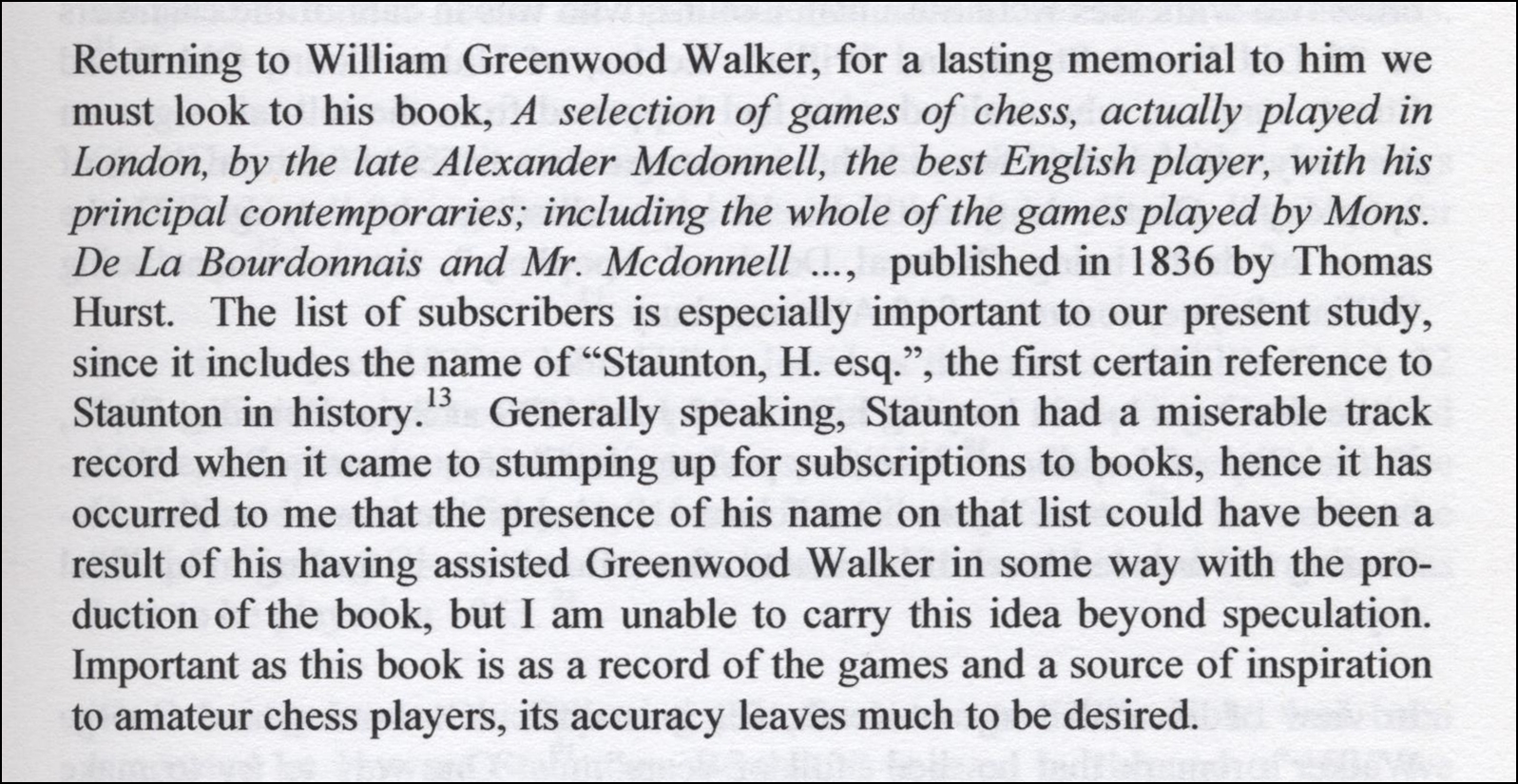
| Aug-27-25 | | stone free or die: Turns out Howard and I share a common trait or two... <Returning to William Greenwood Walker, for a lasting memorial to him we must look to his book <A selection of game of chess, actuall played in London, by the late Alexander Mcdonnell (etc.)>. The list of subscribers is especially important to our present study [Note on the life of Howard...], since it includes the name of "Staunton, H. esq.", the first certain reference to Staunton in history.[13] Generally speaking, *Staunton had a miserable track record when it came to stumping for subscriptions to books,* hence it has occurred to me [Townsend] that the presence of his name on that list could have been a result of his having assisted Greenwood Walker in some way with the production of the book, but I am unable to carry this idea beyond speculation. ..."> [emphasize added]
https://blogger.googleusercontent.c... |
|
| Aug-28-25 | | Granny O Doul: Whew, I was afraid he died. |
|
| Aug-28-25 | | stone free or die: I don't get it, <Granny>, but I'll grant you a smile for awhile. |
|
| Aug-29-25 | | Granny O Doul: My last post should be understood in the context of the time in which it was written. Something like 3 or 4 AM if memory serves, but memory has been known to refuse me service. I sure hope it reads its Yelp review! |
|
 |
|
|
< Earlier Kibitzing · PAGE 25 OF 25 ·
Later Kibitzing> |
|
|
|


 Kibitzing