|
< Earlier Kibitzing · PAGE 149 OF 163 ·
Later Kibitzing> |
May-23-25
 | | FSR: Submitted:
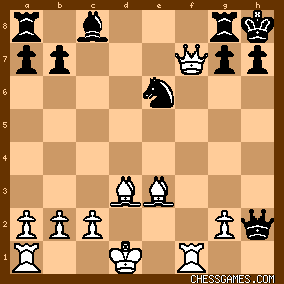
[Event "Online blitz"]
[Site "lichess"]
[White "Frederick Rhine"]
[Black "NN"]
[ECO "D06"]
[Result "1-0"]
[Date "2025.05.23"]
[PlyCount "25"]
[Source "lichess.org"]
1. d4 d5 2. c4 Nf6 3. cxd5 Nxd5 4. Nf3 Bg4 5. Ne5 Bh5 6. Qb3 b6 7. e4 Nf6 8. Bb5+ Nbd7 9. g4 Bg6 10. g5 e6 11. gxf6 gxf6 12. Bxd7+ Ke7 13. Nc6+ 1-0 |
|
May-23-25
| | FSR: Submitted:
[Event "WSTT/RD/F14"]
[Site "ICCF"]
[EventType "correspondence thematic tournament"]
[Date "2025.05.01"]
[Round "-"]
[White "Hagnere, Jean-Michel"]
[Black "Rhine, Frederick"]
[ECO "C43"]
[Result "1/2-1/2"]
[WhiteElo "2254"]
[BlackElo "2341"]
[Source "https://www.iccf.com/game?id=1546014"]
1.e4 e5 2.Nf3 Nf6 3.d4 Nxe4 4.Bd3 Nc6 5.Nxe5 Nxe5 6.dxe5 Nc5 7.Bc4 d6 8.Qf3 Ne6 9.exd6 Bxd6 10.Be3 Qe7 11.Nd2 Nd4 12.Qxf7+ Qxf7 13.Bxf7+ Kxf7 14.Bxd4 Re8+ 15.Be3 a5 16.O-O-O b5 17.Rhe1 a4 18.Nb1 Bb7 19.g3 Bf3 20.Rd3 Rad8 21.h4 c6 22.Nd2 Bd5 23.Rd1 Bxa2 24.Nf3 Bd5 25.Nd4 a3 26.bxa3 Be4 27.Nxc6 Bxa3+ 28.Rxa3 Rxd1+ 29.Kxd1 Bxc6 30.Ra6 1/2-1/2 |
|
May-24-25
| | FSR: PART ONE OF SIX
Three years ago, <kramnikstudent> asked me on Chessable: <Hi Krakatoa , you seem to be extremely knowledgeable about openings.I have been an 1 e4 player all my life but never ever learned openings systematically.
I am planning to switch to 1 d4 and learn it comprehensively. My questions are:
a) Can you guide me how I can go about doing it? Which Chessable courses , published books would you recommend? b) Are Avrukh's book still relevant? or are they outdated? c) I am not happy with the way many chessable courses cover the sidelines (own Shankland's course but he seems to have focused on main lines only)> My response (slightly edited):
Hi, kramnikstudent. My apologies for the belated response. There is no simple answer to your question, at least for me. I haven't found any course that provides a happy answer to everything Black can play. So I advocate cobbling together a repertoire from multiple sources. In general, Barrish's two-part course "The Principled Queen's Gambit" seems to be closest to my approach - grabbing the center if possible, playing aggressively but not recklessly, and trying to get an advantage as White. https://www.chessable.com/the-princ... ; https://www.chessable.com/the-princ... If you wanted to choose one author's approach as your primary weapon, I think Barrish would be a good choice. Although I don't like some of Shankland's opening choices, he's plainly a very strong player (#34 in the world at the moment) and you can be sure his lines are thoroughly engine-checked. (I did once find a mate in one he'd overlooked in the Four Knights Game, but that was an aberration.) So his lines also deserve careful consideration. Here are my thoughts on specific openings:
A. Everyone seems to play the Slav these days, so you really need to find a line you like against it. At the moment Nf3 followed by Nbd2, as advocated in https://www.chessable.com/1-d4-for-... , appeals to me. There are many other lines, obviously. If you want to try to "play for two results," you can try the Exchange Slav. https://www.chessable.com/the-solid... ; https://www.chessable.com/course/35... (alternative line). I have played it in blitz sometimes, but am not entirely happy with it. There is 3.Nc3 Nf6 4.e3, which I haven't really looked at. https://www.chessable.com/course/35... There is 3.Nf3 Nf6 4.e3, which is significantly different. Avrukh has a course on 3.Nf3 Nf6 4.Qb3, but to my mind the lines didn't make too much sense and were hard to memorize. https://www.chessable.com/course/37... I have played 3.Nf3 Nf6 4.Qc2 in tournament games, which seems to be White's highest-scoring line against the Slav (60.8% on ChessBase Online), but have not been that happy with it. And of course there's the main line (1.d4 d5 2.c4 c6 3.Nc3 Nf6 4.Nf3, allowing 4...dxc4) for which you can see Plichta https://www.chessable.com/course/23... and others. 4...e6, the Semi-Slav, is also an extremely important line, when White's main lines begin with 5.Bg5, offering the Anti-Meran Gambit, or 5.e3, with further outbranchings in either case. Note that the natural 4...Bf5 is a serious inaccuracy. See my recent blitz game F Rhine vs NN, 2022 and my comment to it. B. Against the mainline QGD, I like the Exchange Variation, 1.d4 d5 2.c4 e6 3.Nc3 Nf6 4.exd5, which scores very well for White. https://www.chessable.com/course/35... After the usual 4...exd5, the lines with Nge2 score a lot better than those with Nf3. (That will be a problem if you play 1.d4 Nf6 2.c4 e6 3.Nf3, since after 3...d5 you can't play that line.) Black can also play the Semi-Tarrasch with 4...Nxd5, but to my mind those lines are somewhat difficult for Black to play. White scores around 60%, which is very high. A more sophisticated move order for Black is 1.d4 d5 2.c4 e6 3.Nc3 Be7, when White should play 4.cxd5 exd5 5.Bf4. |
|
May-24-25
| | FSR: PART TWO OF SIX
C. The annoying Triangle System, 1.d4 d5 2.c4 e6 3.Nc3 c6, is very popular these days. Black threatens to take and keep the pawn. Black can play his second and third moves in either order, which can result in move order problems for White depending on his repertoire choices against the Slav and the mainline QGD. For example, if White likes to play Nbd2 against the Slav, he can't do it now. Importantly, the Exchange Variation is much less effective than against 3...Nf6, since it is easier for Black to develop his "problem" queen's bishop to f5. Valkova tries to make it work anyway. https://www.chessable.com/1-d4-for-... I keep meaning to look at Plichta's treatment of the Marshall Attack, 4. e4, which is the sharpest and best-scoring line against the Triangle. https://www.chessable.com/go-for-th... 4.e3 is also possible, of course, when 4...f5 is possible. Then 5.g4!? is interesting, but objectively nothing special. D. The Tarrasch (1.d4 d5 2.c4 e6 3.Nc3 c5) was once a favorite of both Kasparov and Spassky. We know what happened when Kasparov tried it against Karpov in their first world championship match. AFAIK, everyone recommends the 6.g3 line against it. I have no opinion as to whose treatment is the best. Incidentally, if Black plays the rare von Hennig-Schara Gambit (4.cxd5 cxd4), 5.Qa4+! is considered better than the immediate 5.Qxd4. E. Against the Queen's Gambit Accepted, I advocate the aggressive and ambitious 3.e4! https://www.chessable.com/course/35... ; https://www.chessable.com/go-for-th... The main line 3.Nf3 Nf6 4.e3, as advocated by Shankland and others, gives White only a small advantage. F. No one strong will play the Marshall Variation of the QGD (1.d4 d5 2.c4 Nf6?! or 1.d4 Nf6 2.c4 d5?!) against you, but you see it all the time in blitz. ChessBase Online, whose database I think is primarily composed of games at slower time controls, actually shows it as the most common response to the Queen's Gambit after the Big Three (2...e6, 2...c6, and 2...dxc4). Valkova has an unusually thorough discussion of it. https://www.chessable.com/1-d4-for-... (Shankland, by contrast, didn't discuss it at all until people complained.) I have spent some time working out how to destroy it, and do so with great regularity. See my blitz games at https://www.chessgames.com/perl/che... (five games) and F Rhine vs NN, 2022 (my most recent game). To my astonishment, GM Demuth actually overlooked a crushing Bxh7+! sac in one of the lines in his course. I pointed out my game with that move, improving on his analysis. He agreed, but never changed his course! G. I don't know too much about the Chigorin Variation of the Queen's Gambit Declined, 1.d4 d5 2. c4 Nc6, which is fairly rare. I play 3.Nc3, the best-scoring move, and respond to either 3...Nf6 or 3...dxc4 with 4.Nf3. One line is 3...Nf6 4.Nf3 dxc4 5.e4 Bg4 6.Be3 e6 7.Bxc4 Bb4 8.Qc2! O-O (8...Bxf3 9.gxf3 Nxd4?? 10. Bxd4 Qxd4 11.Qa4+ wins) 9.Rd1. A trap you should know occurs after 3.Nc3 dxc4 4.Nf3 Bg4? 5.d5! Bxf3 6.exf3 Ne5 7.Bf4 Ng6 8.Bxc4!, when Black is already lost. After 8...Nxf4?, Stockfish 15 assesses both 9.Qa4+, as in my game F Rhine vs NN, 2022, and 9.Bb5+, as about +10. H. You see the Albin Counter-Gambit (1.d4 d5 2.c4 e5) once in a while. After the usual 3.dxe5 d4, White should play 4.Nf3 Nc6 and now either 5.Nbd2 or 5.a3. All the d4 repertoire courses cover this. I haven't looked into it as deeply as I should. Don't fall for 4.e3? Bb4+! 5.Bd2 dxe3! 6.Bxb4? (6.fxe3=) exf2+! 7.Ke2 fxg1=N+!, the famed Lasker Trap. G Thompson vs Lasker, 1902. |
|
May-24-25
| | FSR: PART THREE OF SIX
I. The Baltic Defense to the QGD (2...Bf5) is rarely seen. I have never faced it in tournament play. In blitz, I play the greedy 3.Qb3!? attacking both d5 and b7. Almost no one knows how to respond, and I end up grabbing a pawn, e.g. 3...dxc4 4.Qxb7 Nd7 5.Nf3. I have also seen 3...Nc6? 4.cxd5 Nxd4?? 5.Qa4+ winning a piece. The insane-looking 3...e5! is the theoretical response, but only very sophisticated players know that. Then the engines say that best play is 4.Nf3! Nc6 (4...e4 5.Nfd2) 5.cxd5 Nb4 6.e4! Bxe4 7.Nxe5! Bxd5! 8.Bc4 Nf6 and White ends up with a big advantage (around +0.9). J. The Symmetrical or Austrian Defense to the Queen's Gambit is 2.c4 c5, a radical attempt to equalize immediately. White gets some advantage after 3.cxd5 Nf6 4.e4! Nxe4 5.dxc5 or 3...Qxd5 4.Nf3 cxd4 5.Nc3! and now 5...Qa5 6.Nxd4 or 5...Qd8 6.Qxd4. K. After 1.d4 Nf6 2.c4 e6, there is the eternal question: allow the Nimzo or not? The Nimzo-Indian is simply Black's best defense to 1.d4, scoring 49% for Black. White can avoid it with 3.Nf3, which Shankland has opined "is simply a better move than 3.Nc3." Statistics bear him out, though he sometimes plays 3.Nc3 himself. Or the Catalan with 3.g3 (another mountain of theory). But playing 3.Nf3 means that if Black plays 3...d5 you can't play the best form of the QGD Exchange Variation, since you'd rather have the knight on e2. You will have to learn the Queen's Indian, Bogo-Indian, Ragozin, Blumenfeld Counter-Gambit, 3...a6, etc. For these reasons, Barrish has stated (and I am inclined to agree) that it's best to bite the bullet and play 3.Nc3. Against the Nimzo (3...Bb4), I recommend learning the sharp 4.f3 and the solid 4.e3 O-O 5.Bd2. Both are covered in Barrish's course. https://www.chessable.com/course/37... I also recommend the coverage of 4.f3 in Cyrus Lakdawala's book "Opening Repertoire: 1.d4 with 2.c4" and Victor Moskalenko's book "An Attacking Repertoire for White with 1.d4." Incidentally, I recently drew GM Alex Yermolinsky with 4.e3 O-O 5.Bd2 in a standard tournament game despite knowing nothing about the line. F Rhine vs Yermolinsky, 2022 L. Against the King's Indian, I really like the Makogonov Variation, 5.h3, the best-scoring line against the King's Indian. I recommend the book "The Makogonov Variation: A ruthless King's Indian killer" by IM Cyrus Lakdawala and FM Carsten Hansen. Cyrus credits me with inspiring him to write it. M. The Gruenfeld is one of Black's best and highest-scoring openings against 1.d4. Tons and tons of theory, which is frustrating. Try Svidler's course on it (for Black) if you want to get dizzy. https://www.chessable.com/lifetime-... Probably the Modern Exchange Variation with Nf3 and Rb1 is best, but again tons and tons of theory. If Black plays correctly, there is no way for White to get a serious advantage in any line. For some reason, not too many people seem to play it at my level (around 2100 USCF these days). Probably the aforementioned tons and tons of theory is a deterrent. Look at different authors' recommendations and play what you like. N. The Benko Gambit is supposed to be close to busted, but I don't think it's so easy to play against. Shankland's lines against it look interesting. You may also consider Barrish's suggestion 4.cxb5 a6 5.e3. https://www.chessable.com/course/37... The quiet 4.Qc2!? is a low-theory approach that is supposed to give White a plus. O. I'm not a great authority on the Modern Benoni and other Benonis (such as the Czech Benoni with ...c5 and ...e5), which I don't see too often. After 1...c5 2.d5, I generally prefer following up with c4 rather than Nc3. But after the very rare Clarendon Court, 1...c5 2.d5 f5, White should play 3.Nc3 Nf6 4.e4! fxe4 5.Nge2, which gives White a huge advantage. P. The Budapest Gambit, 1.d4 Nf6 2.c4 e5, is considered a little dodgy. After 3.dxe5, Ne4?! is the dubious but trappy Fajarowicz Variation. Best is 4.a3! intending to immediately harass the knight with Qc2, e.g. 4...d6 5.Qc2! Bf5 6.Nc3! Ng3 7.e4! Nxh1 8.exf5 with a big advantage. I think 4.a3 is discussed in several of the 1.d4 repertoire courses. See also my game F Rhine vs D Bungo, 2013, which was very enjoyable for me although both sides played inexactly. The standard Budapest, 3...Ng4, is more common and sounder. I have usually played 4.Bf4 Nc6 (even 4...g5!? is a move) 5.Nf3 Bb4+ 6.Nbd2 Qe7 7.e3, but am a bit dissatisfied with it, since Black seems to get an OK game if he plays well. Or maybe I'm playing it inexactly. I may study Shankland's recommendation, the sharper and better-scoring 4.e4. https://www.chessable.com/course/47... |
|
May-24-25
| | FSR: PART FOUR OF SIX
Q. The Black Knights' Tango (1.d4 Nf6 2.c4 Nc6) may deserve more respect than it usually gets. White only scores 50.4% against it on ChessBase Online. But White scores well with 3.Nc3 e5 4.d5 Ne7 5.Nf3. https://www.chessable.com/course/37... R. The Accelerated Queen's Indian, 1.d4 Nf6 2.c4 b6, is rarely seen. 3.f3 is arguably the most critical response. https://www.chessable.com/course/37... S. Against the Dutch, the lines with 2.g3 are supposed to be great, but I've never been that wild about them. I recommend these two free courses on 2.Bg5! and 2.Nc3: https://www.chessable.com/destroyin... https://www.chessable.com/destroyin... T. The Englund Gambit, 1.d4 e5?, is Black's worst first move besides 1...g5? But it is fairly common, at least in blitz. White has lost thousands of games after 2.dxe5 Nc6 3.Nf3 Qe7 4.Bf4 Qb4+ 5.Bd2 Qxb2 6.Bc3?? Bb4! and White can already resign. For the correct treatment of this and other lines, fork out $1.99 for the excellent https://www.chessable.com/ending-th... U. 1...Nc6, the Bogoljubow Defense, is offbeat but not bad. You'll see it once in a blue moon. Short has played it often, and Carlsen and many others have done so on occasion. Shankland considers it too absurd to discuss, although he spends seven lines on 1...Na6, which you'll probably never see in your life. (If you're wondering why he's so fascinated by 1...Na6, see Shankland vs A Ipatov, 2018.) After 2.e4, both 2...d5 and 2...e5 score well for Black. 2.c4 allows 2...e5 or 2...d5 (transposing to the Chigorin). 2.Nf3 d5 3.c4 is the Chigorin again, while 3.Bf4 is also more or less OK for Black. Best is probably 2.d5 Ne5 3.f4! (3.e4 e6 4.f4 allows exd5!, which should end in a draw by perpetual check. See Gleizerov vs M Ulybin, 2013 and V Erdos vs Rapport, 2012.) Ng6 4.e4 e5 (or 4...e6) 5.dxe6! with a small advantage. https://www.chessable.com/course/35... V. Shankland mentions 1.d4 b5 2.e4 Bb7 3.Bxb5 Bxe4 4.Nf3, when "White has an easy plan of 0-0, c4, Nc3, and a fantastic position due to the extra space."
https://www.chessable.com/learn/475... He writes of 1...b5, "It is hard to believe anyone would be this stupid." Spassky has been that stupid multiple times, including in a world championship match . . . W. If Black moves a pawn one square (e.g. 1...a6, 1...b6, 1...c6, 1...d6, 1...e6, or 1...g6) , I'm inclined to punish him by playing 2.e4! X. Against the evil French Defense, I have always played 3.Nc3. It is undoubtedly good, but there is a lot to learn, especially in all the different Steinitz lines (3...Nf6 4.e5) at Black's disposal. I am considering switching to 3.e5, which is hot these days. The gambit line 3...c5 4.c3 Nc6 5.Nf3 Qb6 6.Bd3 cxd4 7 7.O-O Bd7 8.Re1 (improving on the old Milner-Barry Gambit 8.cxd4 Nxd4 9.Nxd4 Qxd4 10.Nc3) scores 59.0% for White on ChessBase Online and seems difficult for Black to handle. (Note that Gawain Jones considers 6...Bd7, which is very common, inaccurate because of 7.dxc5! Bxc5 8.O-O.) I recommend Gawain Jones, 1.e4 Coffeehouse Repertoire Volume 2 (the title is misleading); https://www.chessable.com/lifetime-... ; https://www.youtube.com/watch?v=X1x... and
https://www.youtube.com/watch?v=myU...
On 1...e6 2.d4 c5, the Franco-Benoni, 3.d5 is more challenging than 3.Nf3, allowing Black to transpose to a Sicilian. One disadvantage of responding to 1...e6 with 2.c4 instead is that 2...f5 gives Black a Dutch without White having the sharp options of 2.Bg5 and 2.Nc3. If you're happy with the g3 lines against the Dutch, that isn't a big deal. The rare Keres or "Kangaroo" Defense, 1.d4 e6 2.c4 Bb4+, is also possible, but few people lose sleep over it. |
|
May-24-25
| | FSR: PART FIVE OF SIX
Y. 1...d6 is interesting. I don't recommend the routine 2.c4, when 2...e5! already gives Black a plus score, especially if White is foolish enough to exchange queens. (3.Nc3 is the only move that gives White a plus score, thereby restoring the natural order of the universe. See my award-winning Wikipedia article https://en.wikipedia.org/wiki/First....) 2.Nf3 is OK, but allows the Wade System 2...Bg4, which is all right for Black. White should play 2.e4!, usually leading either to a Pirc after 2...Nf6 3.Nc3 g6 or a Philidor after 2...e5 or 2...Nf6 3.Nc3 e5. Against the Pirc 4.Be3 is probably the most dangerous. See Gawain Jones, 1.e4 Coffeehouse Repertoire Volume 2; https://www.chessable.com/fighting-... I have played Plichta's recommendation 4.Bg5 Bg7 5.e5!? a lot in blitz. https://www.chessable.com/course/23... It is a lot like crack - tons of players play 5...dxe5?! 6.dxe5 Qxd1+? 7.Rxd1 Ng4?, which seems really strong for Black but just loses. You keep winning, so you keep playing it and become addicted to the line. 5...Nfd7! is correct, when Black is OK. Objectively, other fifth moves are stronger and give White the advantage. Barrish advocates the somewhat unusual 4.Bf4, which he says is similar to Be3 and Bg5 - White plays for Qd2 and Bh6 - but avoids harassment of the bishop by Ng4. https://www.chessable.com/learn/375... Z. Against the Philidor, I just play the main lines, e.g. 1.d4 d6 2.e4 Nf6 3.Nc3 e5 4.Nf3 Nbd7 5.Bc4 Be7 6.O-O. Another opening I should look at more deeply. Black also sometimes tries to attack White's king with ...h6 and ...g5, the Black Lion. But see the classic game Polo vs Pasqualini, 1923. Black can also play an early ...exd4, e.g. 1.d4 d6 2.e4 e5 3.Nf3 exd4. I would probably play 4.Nxd4 Nf6 5.Nc3 Be7 6.Bf4, intending Qd2 and O-O-O, but again I'm not a great authority. Take a look at Barrish's treatment of the Philidor. https://www.chessable.com/course/37...
Note that Black has to be careful about playing an early ...Nd7, the Hanham Variation, e.g. 1.d4 d6 2.e4 e5 3.Nf3 Nd7?! 4.Bc4 and now 4...Ngf6? is punished by 5.dxe5! dxe5 6.Ng5! and 4...Be7? by 5.dxe5 and now 5...dxe5?? 6.Qd5! and wins, as in my game F Rhine vs NN, 2021, or 5...Nxe5 6.Nxe5 dxe5 7.Qh5! winning a pawn with a crushing position. Another fun trap was seen in Polo vs Pasqualini, 1923. AA. I treat the Modern, 1...g6, similarly to the Pirc, i.e. 2.d4 Bg7 3.Nc3 (3.c4 with a possible transposition to the King's Indian, is also reasonable, but there are independent lines like 3...Nc6!? 4.d5 Nd4 and 3...d5 4.Nc3 e5 5.dxe5 dxe5 6.Qxd8+ Kxd8 7.f4!, when Black is apparently OK if he plays exactly.) Bg7 4.Be3. Gawain Jones, 1.e4 Coffeehouse Repertoire Volume 2; https://www.chessable.com/fighting-... I DO NOT recommend 1.d4 g6 2.c4 Bg7 3.Nc3 c5 4.d5 Bxc3+ 5.bxc3 f5. The computers will tell you this is great for White, but Black gets a big plus score (56.5% for Black on ChessBase Online). https://www.chessable.com/the-dzind... |
|
May-24-25
| | FSR: PART SIX OF SIX
BB. After 1...b6, White should transpose to Owen's Defense with 2.e4! Of course Black shouldn't play the now-refuted line 2...Bb7 3.Bd3 f5? 4.exf5! See, e.g., https://www.chessable.com/course/47... ; https://www.chessable.com/course/12... ; and my game F Rhine vs NN, 2010 (the comps say 8.Nh3! is even more crushing than the "traditional" 8.Nf3). But even after the more sensible 3...e6, play can get seriously dangerous for Black. See https://www.chessable.com/course/47... ; https://www.chessable.com/course/12... ; and Gawain Jones, 1.e4 Coffeehouse Repertoire Volume 2. I won a tournament blitz game against FM Jon Jacobs with Shankland's recommendation 1.d4 b6 2.e4 Bb7 3.Bd3 e6 4.Nf3 Nf6 5.Nc3 Bb4 6.Nd2. Jon was impressed by my erudition, remarking that he'd been playing Owen's Defense for years and that I was only the second person to play 6.Nd2 against him. Perhaps the rarely seen double fianchetto with 3.Bd3 g6 is best. I would respond to the Guatemala Defense, 2...Ba6, with 3.c4. This is a very rare bird. For comic relief, see my ridiculous game F Rhine vs NN, 2021. CC. Shankland and Giri in the above courses also address 1...a6 à la Karpov-Miles, Skara 1980 (0-1, 46). DD. 1...c6 is rarely seen. If you want to play against the Slav (does anyone?), you can play 2.d4. Probably theoretically best is 2.e4! d5 3.e5! Space - the final frontier! https://www.chessable.com/course/12... But that's a lot more theory to learn. EE. To answer your question, I think Avrukh's books are still relevant, but to my mind, much of his analysis is too deep to be useful to non-professional players. You won't have time to read it all, and without trainable variations you'll never remember it. A funny aside: as a teenager in 1977, I played the blitz game E Sollano vs F Rhine, 1977 (I gave time odds of three minutes to my opponent's five minutes), winning in beautiful fashion. I later got it added to chessgames.com's database. Mato Jelic somehow happened upon the game and did a video about it, calling it with some hyperbole "The Greatest Ever Blitz Game Played in Chicago." https://www.youtube.com/watch?v=wl8... In that game I played the surprising sacrifice 7...Bxc5!! Avrukh in his 2012 book "Beating 1.d4 Sidelines" instead recommended the flaccid 7...Bg6. Engines confirm that my move, played the year before Avrukh was born, is MUCH stronger. (I am not offering this as a general commentary on the quality of Avrukh's analysis, but it amuses me.) Hope that helps. |
|
May-24-25
| | FSR: In the three years since my comments to <kramnikstudent>, Chessable has released GM Dariusz Swiercz 's two-part course on 1.d4. It looks amazing, and very comprehensive. https://www.chessable.com/lifetime-... https://www.chessable.com/lifetime-... |
|
May-24-25
| | FSR: Submitted:
[Event "WSTT/2/25/3"]
[Site "ICCF"]
[EventType "correspondence thematic tournament"]
[Date "2025.03.01"]
[Round "-"]
[White "Rhine, Frederick"]
[Black "Gierden, Horst"]
[ECO "A57"]
[Result "1/2-1/2"]
[WhiteElo "2339"]
[BlackElo "2385"]
[Source "https://www.iccf.com/game?id=1530982"]
1.d4 Nf6 2.c4 c5 3.d5 b5 4.cxb5 a6 5.e3 g6 6.Nc3 Bg7 7.e4 O-O 8.a4 Bb7 9.Bg5 h6 10.Bxf6 Bxf6 11.Nf3 Qa5 12.Ra3 d6 13.Be2 Qb4 14.e5 dxe5 15.Nd2 axb5 16.Bxb5 Qd4 17.Nc4 Ba6 18.Bxa6 Nxa6 19.Qe2 Rfb8 20.O-O Rb4 21.Ne3 Bg5 22.h3 Bxe3 23.fxe3 Qc4 24.Qf3 Rf8 25.d6 exd6 26.Nd5 Rxb2 27.e4 f5 28.exf5 gxf5 29.Qh5 Rxg2+ 30.Kxg2 Qxd5+ 31.Kh2 Qd2+ 32.Kg1 Qd4+ 33.Rf2 Rf7 34.Rg3+ Kf8 35.Qxh6+ Ke7 36.Qg5+ Kd7 37.Qg8 Re7 38.Qf8 Nc7 39.Rg8 Qc4 40.Qxf5+ Kc6 41.Qg5 Rh7 42.Kh2 e4 43.Qg2 Qd4 44.a5 Qe5+ 45.Kh1 Nd5 46.Qf1 Nc7 47.Qg2 Nd5 48.Qf1 Nc7 49.Rf7 Rxf7 50.Qxf7 Qa1+ 51.Kh2 Qxa5 52.h4 Qd2+ 53.Rg2 Qd4 54.h5 e3 55.Rg7 Qe5+ 56.Kg2 e2 57.Qxc7+ Kb5 58.Qb7+ Kc4 59.Qa6+ Kc3 60.Qa1+ Kd2 61.Qa5+ Kd1 62.Qa4+ Kd2 63.Qa5+ Kd1 64.Qa4+ 1/2-1/2 A dramatic game. Almost a third of the moves (40/127) were checks! |
|
May-24-25
| | FSR: Submitted:
[Event "USCF/WS/25A01 (USA)"]
[Site "ICCF"]
[Date "2025.03.03"]
[Round "-"]
[White "Ingersol, Harry"]
[Black "Rodriguez, Keith A."]
[Result "1/2-1/2"]
[ECO "B90"]
[WhiteElo "2417"]
[BlackElo "2399"]
[PlyCount "92"]
[Source "https://www.iccf.com/game?id=1530083"]
1. e4 c5 2. Nf3 d6 3. d4 cxd4 4. Nxd4 Nf6 5. Nc3 a6 6. h3 e5 7. Nb3 Be6 8. f4 b5 9. f5 Bc8 10. Bg5 Be7 11. a4 b4 12. Nd5 Nxd5 13. Qxd5 Bxg5 14. Qxa8 Qb6 15. h4 O-O 16. Qd5 Qe3+ 17. Kd1 Bf4 18. Qd3 Qf2 19. Qf3 Qa7 20. Ke1 Nd7 21. g3 Bh6 22. Rd1 Qc7 23. Qd3 Nf6 24. Rh2 Rd8 25. Qc4 Qb6 26. Re2 g6 27. a5 Qb7 28. Nd2 gxf5 29. exf5 Bxf5 30. Rf2 Be6 31. Qxa6 Qe7 32. Nc4 Ne4 33. Rg2 d5 34. Qb6 Rd7 35. Bd3 Rb7 36. Qg1 b3 37. Bxe4 dxe4 38. a6 Rc7 39. Qb6 Rxc4 40. Rd8+ Kg7 41. a7 bxc2 42. Rxc2 Rxc2 43. a8=Q Rc1+ 44. Ke2 Bg4+ 45. Kf2 e3+ 46. Kg2 Rc2+ 1/2-1/2 |
|
May-25-25
| | FSR: PART THREE OF MY ICCF DIARY
Filling in my final placings in the unfinished tournaments I mentioned: Oswaldo Olivo indeed won the King's Indian thematic tournament, scoring an impressive 8.5/10. I was second with 7.5, a point ahead of Johnny Owens. Olivo had three wins and a draw against Owens and Manfred Welti, while I had one win and three draws against them. Unusually, the game scores in this tournament are secret, so unfortunately I can't see how Olivo achieved his wins. In the Anti-Moscow Gambit tournament, as expected I tied for first with correspondence IM Emil Ackermann, and won on tiebreak. This qualifies me for the tournament final. In the Chess 960 tournament I tied for first with Igor Tkachenko and Sergio Pomante, and edged both of them out on tiebreak. This result qualifies me for the Chess 960 semifinals. |
|
| May-25-25 | | stone free or die: OK, you've said that virtually all corr games end up as draws. Which makes me wonder how you managed to win a tiebreak? |
|
May-25-25
| | FSR: <stone free or die> In the tournaments I won on tiebreak, I won one or more games. Most of those were either thematic tournaments or Chess 960 tournaments. There it's easier to win games because (a) often some of my opponents are low-rated and (b) in some of the thematic tournaments, one side or the other starts out with a big advantage, making a decisive result more likely. For example, in the Blackmar-Diemer tournament, White is ~.6 worse to start the game. In the King's Indian tournament, after 1.d4 Nf6 2.c4 g6 3.Nc3 Bg7 4.e4 d6 5.Nf3 O-O 6.Be2 e5 7.O-O Nc6 8.d5 Ne7 9.b4, Black is ~.55 worse. I'm also playing in a Fried Liver (1.e4 e5 2.Nf3 Nc6 3.Bc4 Nf6 4.Ng5 d5 5.exd5 Nxd5? 6.Nxf7! Kxf7 7.Qf3+ Ke6 8.Nc3) tournament. That opening is almost, but I think not quite, a forced win for White. My one win in the Chess 960 tournament was strange. I was up the exchange for a pawn in an ending, but my pawn structure was bad. 
click for larger viewStockfish assessed this position as +0.7, a large but not decisive advantage. I think that Black can hold a draw. I was very surprised when my opponent resigned. |
|
May-26-25
| | FSR: I am delighted to have Donald Trump as King of the World. In that capacity, He* can do whatever he likes, reshape the United States and the world to suit Himself. The Gulf of Mexico and the Persian Gulf have had those names for centuries, but must be renamed to his liking. Ditto for Denali; ax that DEI name and rename it Mount McKinley for a White Man! (Mount Trump would be even better, but He's reserving that for Everest.) Abolish USAID and FEMA and the Department of Education, as He desires. Let his liege Bobby Kennedy gut the National Institutes of Health and turn HHS into an anti-vaxx fiefdom. Make Measles Great Again! As King, he rules by royal decrees (also called executive orders), which trump legislation and the Constitution. Congress has no independent role, and exists only to carry out his wishes. He need not heed the orders of mere courts. Harvard University is the most prestigious educational institution in the United States, and 140 years older, but King Trump is entitled to bend it to His divine will. Same for the Kennedy Center, which He now rules. He shall impose tariffs of His choosing on every country and company and uninhabited island! And dictate where companies manufacture their goods, and the prices they charge. Eat those tariffs, even if it drives your company bankrupt! The King has so decreed! And if the King's tariffs cause a global recession or depression, so be it! If members of the media dare disrespect the King, He will sue them for billions and send them to prison! Speaking ill of the King is blasphemy! Of course the King is entitled to be handsomely compensated, with billions in crypto receipts and Trump resorts built with foreign money, and a $400 million plane! He deserves it! I can't wait for His birthday military parade. God Save the King! * References to deities are capitalized. |
|
May-27-25
| | FSR: Submitted:
[Event "Online blitz"]
[Site "lichess"]
[White "Frederick Rhine"]
[Black "NN"]
[ECO "D06"]
[Result "1-0"]
[Date "2025.05.27"]
[PlyCount "19"]
[Source "lichess.org"]
1. d4 d5 2. c4 Nf6 3. cxd5 Nxd5 4. Nf3 Bg4 5. Ne5 Bh5 6. Qb3 b6 7. e4 Nf6 8. Bb5+ Nbd7 9. Bg5 a6 10.Bc6 1-0 |
|
May-27-25
| | FSR: Submitted:
[Event "WSTT/2/25/1"]
[Site "ICCF"]
[EventType "correspondence thematic tournament"]
[Date "2025.03.01"]
[Round "-"]
[White "Helosmaa, Rami"]
[Black "Laforgia, Gaia Camilla Federica"]
[Result "1-0"]
[ECO "A57"]
[WhiteElo "2145"]
[BlackElo "2338"]
[PlyCount "27"]
[Source "https://www.iccf.com/game?id=1530934"]
1. d4 Nf6 2. c4 c5 3. d5 b5 4. cxb5 a6 5. e3 axb5 6. Bxb5 Bb7 7. Nc3 Qa5 8. Bd2 Qb6 9. Nf3 Nxd5 10. a4 g6 11. Nxd5 Bxd5 12. Bc3 Bxf3 13. Qxf3 Qxb5 14. Qxa8 1-0 This game will be going in my "Horrible theoretical novelties" collection (10...g6??). 10...e6 was better, when Black is worse but can hold with exact play. |
|
May-27-25
| | FSR: Submitted:
[Event "Online blitz"]
[Site "lichess"]
[White "Frederick Rhine"]
[Black "NN"]
[ECO "D07"]
[Result "1-0"]
[Date "2025.05.27"]
[PlyCount "21"]
[Source "https://lichess.org/zgCMSIdWKIvG"]
1.d4 d5 2.c4 Nc6 3.Nc3 dxc4 4.Nf3 Bg4 5.d5 Nb4 6.Qa4+ c6 7.Qxb4 cxd5 8.Qxb7 e6 9.Ne5 Bf5 10.Qb5+ Ke7 11.Nc6+ 1-0 |
|
May-28-25
| | FSR: Submitted:
[Event "RoW/C2024/sf. 5"]
[Site "ICCF"]
[Date "2024.09.30"]
[Round "-"]
[White "Rhine, Frederick"]
[Black "Leite, Denis Moreira"]
[ECO "C47"]
[Result "1/2-1/2"]
[WhiteElo "2334"]
[BlackElo "2385"]
[Source "https://www.iccf.com/game?id=1493104"]
1.e4 e5 2.Nf3 Nc6 3.d4 exd4 4.Nxd4 Nf6 5.Nc3 Bb4 6.Nxc6 bxc6 7.Bd3 O-O 8.O-O d5 9.exd5 cxd5 10.h3 Re8 11.Qf3 c6 12.Bg5 h6 13.Bh4 Be6 14.Rad1 Bd6 15.Rfe1 Rb8 16.b3 Rb4 17.Bg3 Rb7 18.Bh4 g5 19.Bg3 Kg7 20.Ne2 Rbe7 21.Nd4 Bg4 22.Rxe7 Bxf3 23.Ne6+ Kg8 24.Nxd8 Bxe7 25.gxf3 Bxd8 26.b4 Nh5 27.Bh2 Re7 28.b5 cxb5 29.Bxb5 Bc7 30.Rxd5 Bxh2+ 31.Kxh2 Nf4 32.Rd6 Kg7 33.Ra6 Rc7 34.c4 h5 35.h4 gxh4 36.Rd6 Rc5 37.Rd4 Rf5 38.Bd7 Ne6 39.Bxe6 fxe6 40.Rd7+ Kf6 41.Rxa7 Rxf3 42.Kg2 Rc3 43.Rh7 Kg6 1/2-1/2 |
|
May-29-25
| | FSR: Submitted:
[Event "WSTT/7/24/6"]
[Site "ICCF"]
[EventType "correspondence thematic tournament"]
[Date "2024.12.15"]
[Round "-"]
[White "Oomen, Rens"]
[Black "Seidel, Hans Guenther"]
[Result "1-0"]
[ECO "B21"]
[WhiteElo "1691"]
[BlackElo "1800"]
[PlyCount "84"]
[Source "https://www.iccf.com/game?id=1516308"]
1. e4 c5 2. d4 cxd4 3. c3 dxc3 4. Nxc3 Nc6 5. Nf3 e6 6. Bc4 a6 7. O-O b5 8. Bb3 Bb7 9. a4 b4 10. Nd5 Na5 11. Bg5 f6 12. Ne5 exd5 13. Qh5+ g6 14. Nxg6 hxg6 15. Qxg6+ Ke7 16. exd5 Bh6 17. Bxh6 Nxh6 18. Rfe1+ Kf8 19. d6 Nxb3 20. Re7 Qxe7 21. dxe7+ Kxe7 22. Qg7+ Ke6 23. Re1+ Kf5 24. Qxd7+ Kg6 25. Qxb7 Rae8 26. Rxe8 Rxe8 27. g3 Nd4 28. Qxa6 Nhf5 29. Kf1 Nf3 30. Qd3 Re1+ 31. Kg2 Ne5 32. Qc2 b3 33. Qc3 Re2 34. Qxb3 Kh6 35. Qc3 Ne3+ 36. Qxe3+ Rxe3 37. fxe3 Nd3 38. e4 Nb4 39. a5 Kg5 40. Kf3 f5 41. h4+ Kg6 42. exf5+ Kxf5 1-0 |
|
May-29-25
| | FSR: Submitted:
[Event "2nd GO 0-2750 7 (GER)"]
[Site "ICCF"]
[Date "2025.04.30"]
[Round "-"]
[White "Rhine, Frederick"]
[Black "Tsuprik, Aleksandr"]
[ECO "D45"]
[Result "1/2-1/2"]
[WhiteElo "2341"]
[BlackElo "2341"]
[Source "https://www.iccf.com/game?id=1543589"]
1.d4 d5 2.c4 c6 3.Nc3 Nf6 4.e3 e6 5.Nf3 Nbd7 6.Qc2 Bd6 7.Bd3 dxc4 8.Bxc4 O-O 9.O-O b5 10.Bd3 Bb7 11.a3 a5 12.e4 e5 13.dxe5 Nxe5 14.Nxe5 Bxe5 15.h3 Ba6 16.Rb1 Re8 17.Rd1 Qe7 18.b4 axb4 19.axb4 Bc8 20.Ne2 Bd7 21.Be3 Bd6 22.Qd2 Rad8 23.Bb6 Rb8 24.Be3 Rbd8 25.f3 Be6 26.Nd4 Bd7 27.Bc2 Bc7 28.Rb3 h6 29.Rd3 Qe5 30.g4 Nh7 31.Qg2 Qf6 32.Bb3 Be6 33.Bxe6 fxe6 34.Nxc6 Rxd3 35.Rxd3 Ng5 36.Bxg5 1/2-1/2 |
|
May-30-25
| | FSR: Submitted:
[Event "RoW/C2024/sf. 5"]
[Site "ICCF"]
[Date "2024.09.30"]
[Round "-"]
[White "Mark Neale"]
[Black "Frederick Rhine"]
[ECO "D38"]
[Result "1/2-1/2"]
[WhiteElo "2284"]
[BlackElo "2334"]
[Source "https://www.iccf.com/game?id=1493099"]
1.d4 Nf6 2.Nf3 d5 3.c4 e6 4.Nc3 Bb4 5.Qa4+ Nc6 6.e3 O-O 7.Qc2 Re8 8.Bd2 a6 9.a3 Bd6 10.h3 Bd7 11.Bd3 dxc4 12.Bxc4 h6 13.O-O e5 14.Rac1 Qe7 15.d5 Na5 16.Bd3 b5 17.Rfd1 Nc4 18.Bxc4 bxc4 19.e4 Nh5 20.Re1 Rf8 21.Nd1 f5 22.exf5 Bxf5 23.Qxc4 e4 24.Rc3 Rae8 25.Rce3 Nf4 26.Nd4 Qg5 27.Rg3 Nxh3+ 28.Rxh3 Qxd2 29.Rhe3 Re5 30.R3e2 Qg5 31.Ne6 Qh5 32.Nxf8 Re7 33.g3 Bg4 34.Ng6 Qxg6 35.Re3 Qh5 36.Nc3 Bf3 37.Rxf3 exf3 38.Rxe7 Qh3 39.Re8+ Kf7 40.Re7+ Kf8 41.Re8+ Kf7 42.Re7+ Kf8 43.Re8+ Kf7 1/2-1/2 |
|
Jun-02-25
| | FSR: Submitted:
[Event "WSTT/3/25/2"]
[Site "ICCF"]
[EventType "correspondence thematic tournament"]
[Date "2025.04.15"]
[Round "-"]
[White "Koken, Ali"]
[Black "Rhine, Frederick"]
[ECO "C50"]
[Result "1/2-1/2"]
[WhiteElo "1993"]
[BlackElo "2341"]
[Source "https://www.iccf.com/game?id=1541277"]
1.e4 e5 2.Nf3 Nc6 3.Bc4 Bc5 4.d4 Nxd4 5.Nxe5 Qe7 6.Bxf7+ Kf8 7.Bxg8 Kxg8 8.Ng4 Qxe4+ 9.Ne3 b6 10.Nc3 Qe5 11.O-O Ba6 12.Re1 Re8 13.Bd2 Re6 14.Ned5 Be2 15.Nxe2 Nxe2+ 16.Kh1 Bxf2 17.Nf4 Bxe1 18.Nxe6 Bxd2 19.Qxd2 Qxe6 20.Re1 Qf7 21.Qxe2 h5 22.h3 Rh6 23.Rf1 Qe6 24.Qa6 Qc6 1/2-1/2 |
|
Jun-03-25
| | FSR: Submitted:
[Event "2nd GO 0-2750 7 (GER)"]
[Site "ICCF"]
[Date "2025.04.30"]
[Round "-"]
[White "Dillenburg, Alberto Francisco"]
[Black "Rhine, Frederick"]
[ECO "B69"]
[Result "1/2-1/2"]
[WhiteElo "2344"]
[BlackElo "2341"]
[Source "https://www.iccf.com/game?id=1543575"]
1.e4 c5 2.Nf3 d6 3.d4 cxd4 4.Nxd4 Nf6 5.Nc3 Nc6 6.Bg5 e6 7.Qd2 a6 8.O-O-O Bd7 9.f4 Be7 10.Nf3 b5 11.Bxf6 gxf6 12.Kb1 Qb6 13.f5 O-O-O 14.g3 Kb8 15.fxe6 fxe6 16.Bh3 Na5 17.Qd3 b4 18.Ne2 Bb5 19.Qd4 Qc7 20.Qxb4 d5 21.Qe1 dxe4 22.Nfd4 e5 23.Nxb5 axb5 24.Nc3 Bb4 25.Rd5 Qb7 26.Rxd8+ Rxd8 27.Qxe4 Bxc3 28.Qxb7+ Kxb7 29.bxc3 Nc4 30.Be6 Kc6 1/2-1/2 |
|
Jun-03-25
| | FSR: Submitted:
[Event "2nd GO 0-2750 8 (GER)"]
[Site "ICCF"]
[Date "2025.04.30"]
[Round "-"]
[White "Wydornik, Robert"]
[Black "Rhine, Frederick"]
[ECO "B68"]
[Result "1/2-1/2"]
[WhiteElo "2342"]
[BlackElo "2341"]
[Source "https://www.iccf.com/game?id=1544089"]
1.e4 c5 2.Nf3 d6 3.d4 cxd4 4.Nxd4 Nf6 5.Nc3 Nc6 6.Bg5 e6 7.Qd2 a6 8.O-O-O Bd7 9.f4 Be7 10.Nf3 b5 11.e5 b4 12.exf6 bxc3 13.Qxc3 gxf6 14.Bh4 Rg8 15.Kb1 Rb8 16.h3 a5 17.g4 a4 18.a3 Qa5 19.Qe3 Qb6 20.Qxb6 Rxb6 21.Rg1 h6 22.Ka1 d5 23.c4 dxc4 24.Be1 Bc5 25.Rg2 Be3 26.Nd2 Bxf4 27.Ne4 Be5 28.Bxc4 Rb8 29.Nc5 Bc8 30.Rc2 h5 31.gxh5 Rg5 32.h6 Rh5 33.Bf1 Rxh6 34.Bf2 Ne7 35.Nxa4 Nd5 36.Nc5 Rg6 37.Rdc1 Bf4 38.Re1 Bg3 39.Bxg3 Rxg3 40.Ne4 Rg6 41.Nd6+ Kd7 42.Nxc8 Rxc8 43.Rd2 Kd6 44.Bg2 f5 45.Red1 f4 46.Bxd5 exd5 47.Rxd5+ Ke6 48.R5d4 Ke5 49.Rd7 Rg2 50.Rb7 Rcc2 51.Rf1 Rgf2 52.Re1+ Kd5 53.Ka2 f3 54.Rb5+ Kd4 55.Rb4+ 1/2-1/2 |
|
 |
|
|
< Earlier Kibitzing · PAGE 149 OF 163 ·
Later Kibitzing> |
|
|
|


 Kibitzing