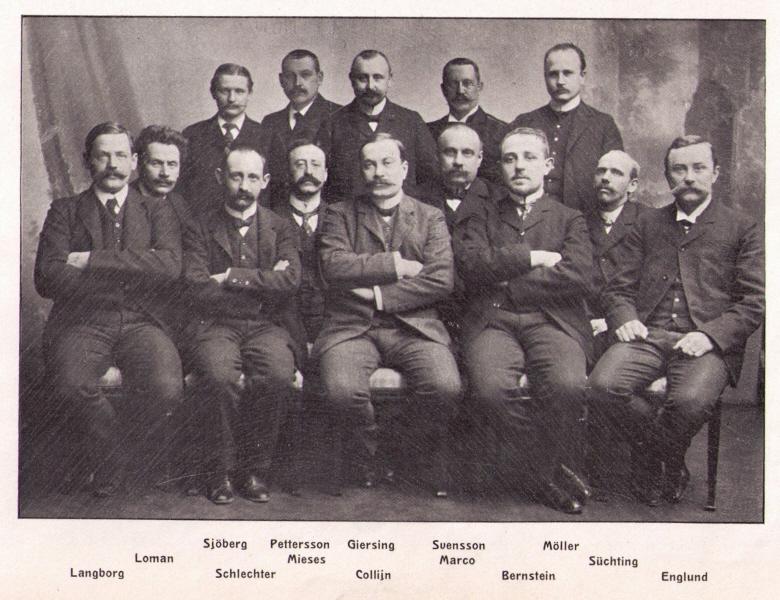
| Mar-07-04 | | uponthehill: Fritz Carl Anton Englund, 22.II.1871-14.I.1933, Swedish chessplayer. He is considered a creator of an opening idea called "Englund's countergambit": 1. d4 e5
Black sacrifice a pawn for an accelerated development. But in the opinion of theoreticians after 2. de5 Nc6 3. Nf3 Qe7 4. Qd5 f6 5. ef6 Nf6 6. Qb3 they don't have sufficient recompensate for given material. Strange thing that here is no game of Englund opened with his gambit. Maybe that name was misgiven? I've heard that it is not known if Philidor played ever Philidor's defence... |
|
| Oct-05-04 | | fasting: Yes it is strange, I was also looking through his games to find the Englund gambit... but I asume that the database is missing some games?! |
|
| Oct-13-07 | | Karpova: A photo from Stockholm 1906:
http://www.chesshistory.com/winter/... (scroll down to 5221) |
|
| Apr-21-08 | | Knight to f6: This guy's record isn't actually that bad, he's got 11 out of 29 and a draw against a young Alekhine. Losing to Ed isn't that bad, he was about the same playing strength (though Ed had more brilliant combinations on his record). |
|
Apr-02-12
 | | Tabanus: Sth. 1906: http://www.chesshistory.com/winter/... He does not seem to have played his gambit much, if at all. Still he deserves a picture, anyone? |
|
| Sep-30-13 | | Karpova: The result of the thematic tournament in Stockholm, ending in 1933, mentioned in the biography: 1. G Stoltz 7.0
2. E Lundin 6.0
3. G Danielsson 5.5
4. R Spielmann 5.0
5. Nyholm 3.5
6. Sjöstam 3.0
Apparently, Englund had been suffering from a severe sickness long before his death (<Er ist inzwischen am 14. Jänner 1933 nach langem, schwerem Siechtum im 66. Lebensjahr gerstorben.>). From page 45 of the February 1933 'Neue Wiener Schachzeitung'. |
|
| Aug-17-14 | | ljfyffe: Englund Attack: 1e4 e5 2Nf3 d5 3exd5 (Nxe5) e4 4Qe2 Nf6 5d3 Qxd5 ... |
|
| Sep-11-14 | | ljfyffe: Aton Olson-Fritz Englund, Stockholm 1917: Four Knights ~ 1e4 e5 2Nf3 Nc6 3Nc3 Nf6 4d4 Bb4 5Nxe5 0-0 6Bd3 Nxd4 70-0 d6 8Nc4 Bg4 9f3 Bh5 10Bg5 Bc5 11Kh1 Ne6 12Bh4 g5 13Bg3 Bg6 14f4 Nxf4 15Bxf4 gxf4 16Rxf4 Nh5 17Rf3 c6 18Qd2 b5 19Ne3 Qg5 20Raf1 Rae8 21Nb1 d5 22Nf5 Qxd2 23Nxd2 Bxf5 24Rxf5 Ng7 25R5f3 d4 26Rf6 Re6 27e5 Be7 28Rxe6 Nxe6 29Ne4 Nc5 30 Nxc5 Bxc5 31Rf6 Re8 32Rxc6 Rxe5 33g3 b4 34Rh6 Bb6 35Rxh7 Ra5 36Rh6 Rxa2 37b3 Ra5 38h4 Rc5 39g4 Bc7 40h5 Kg7 41Ra6 Bb6 42Ra1 Kh6 43Re1 Kg5 44Bf5 d3 45cxd3 Rc3 46d4 Rxb3 47d5 Rb2 48Rd1 a5 49Bd7 Ra2 50d6 b3 51Rd5+ Kh6 52Rb5 b2 53Bf5 Bd8 54d7 a4 55Rb8 Be7 56Rb6+ f6 57Re6 Bd8 58Re8 Bc7 59Rc8 Ba5 60Ra8 Bc7 61Rh8+ Kg7 62Rc8 Ba5 63Ra8 Bc7 64Rc8 Ba5 draw. |
|
| Sep-11-14 | | ljfyffe: That's <Anton> as in Englund's name as well. |
|
Sep-11-14
 | | perfidious: Did this player ever do battle with Scotland? |
|
| Sep-11-14 | | ljfyffe: You mean Scotlund!? |
|
| Sep-11-14 | | ljfyffe: Not positive about city and date in game above. |
|
| Sep-14-14 | | ljfyffe: Sweden, for sure. |
|
Sep-14-14
| | Tabanus: Updated link to picture from the Stockholm (1906) tournament: http://www.chesshistory.com/winter/... |
|
| Sep-14-14 | | ljfyffe: <Tabanus>interesting stuff. Also informs me that the above game posted by me was not from this 1906 event in Sweden. |
|
| Sep-14-14 | | ljfyffe: Englund came 5th in Stockholm in 1917 so heading to Olson-Englund game looks to be correct. |
|
| Sep-14-14 | | ljfyffe: And to top it off, the Olson-Englund game is in Dec. Issue of 1917 Swedish Chess Magazine. |
|
| Jan-14-16 | | TheFocus: Rest in peace, Fritz Englund. |
|
| Feb-22-16 | | TheFocus: Happy birthday, Fritz Englund.
Your gambit sucks. Enjoy your cake. |
|
Feb-22-16
 | | Sally Simpson: I have a Black OTB win with the infamous trap in this gambit so have many others. Silbermann vs Honich, 1930 In my book '100 Chess Traps to Play Before You Die', the chapter headed 'Over the Board Mind Games' I advocate playing it in reverse kicking off with 1.g3 d5 (the most popular reply) 2.e4 etc... 
click for larger viewThe ploy being when a players sees g3 played they automatically assume the Bishop will be going to g2 so miss Bb5. I end each trap with a "Good Luck with that one." |
|
| Apr-11-19 | | whiteshark: "<1 d4 e5 2 dxe5 Nc6 3 Nf3 Qe7> 
click for larger viewThe opening was invented by the same man who established the Latvian Gambit: <Karlis Betinš (1867-1943; in German sources: <Karl Behting>>). He published his analysis “Königsbauer gegen Damenbauer” in Deutsche Schachzeitung 1930, pp. 171-174. Two years later Fritz Englund (1871-1933), the leading chess figure in Sweden, sponsored a thematic tournament, held at Stockholm in late 1932 and early 1933. Every game had to begin with <Betinš’> main line 4 Qd5. Don’t ask me why the new planet wasn’t named after <Karlis Betinš> – probably because his article had already been forgotten, or – more probable – because <Englund> died shortly afterwards. When chess magazines reported his death, they rarely failed to mention <Englund’s Gambit Tournament.>” So the name stuck." Stefan Buecker in his ChessCafe.com column <Over the Horizons>: "Visiting Planet Englund" (PDF). Retrieved 2008-11-19. |
|


 Kibitzing