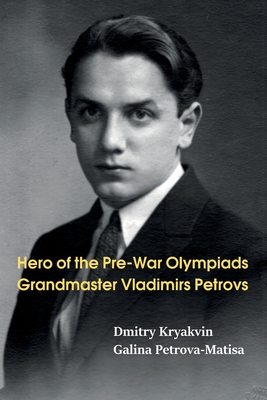
Vladimir Petrov (Latvian spelling: Vladimirs Petrovs) was born in Riga, Latvia, on 27th September 1907 (some sources list 1908 as the birth year).* Although he joined the ranks of the world chess elite in 1937, he is perhaps less well known than he should be, due to his being arrested by the NKVD in 1942 and imprisoned for the rest of his life.(1) He was subsequently expunged from Soviet chess history. Most of Petrov's colleagues in the Soviet bloc, with the notable exceptions of Alexander Koblents and Paul Keres, avoided publishing his games, or even mentioning his name in public.(2)
Consequently, little was heard about Petrov in the west until long after his career and life had ended. The political turmoil of the USSR kept him from being as well known as he deserved. He notched a lifetime 50% score against both Alexander Alekhine and Jose Raul Capablanca, and defeated an impressive list of international masters including Alekhine, Keres, Samuel Reshevsky, Reuben Fine,
Rudolf Spielmann,
Isaac Boleslavsky, Gideon Stahlberg, Savielly Tartakower, Grigory Levenfish, Erich Eliskases, Vladas Mikenas, Karel Treybal, Georgy Lisitsin,
Vladimir Makogonov, and Alexander Kotov.
Genesis of a Master
Petrov's father ran a modest cobbler's shop in Riga, while his mother worked as a housekeeper. In 1919, Petrov was accepted at the prestigious Lomonosov High School, where he received a first rate liberal arts education. In that same year, the streets of Riga were barricaded as nationalists fought Bolshevik and German armies to retain Latvian independence, which had been declared in 1918. Such concerns seemed far from Petrov's mind, however, as he enjoyed a vibrant school life centered largely around music, soccer, and gambling at cards with his friends. He and his friends grew bored with cards, and were introduced to chess by Viktors Rosenbergs , who offered to help hone their skills. Petrov soon challenged him to a 100 game chess match, which he ultimately won. In 1923, he won the school championship and joined the Riga-2 chess club, and a year later went on to win the reserves section of the first Latvian Chess Congress, earning the first category title. His optimism and spark in almost everything he tried earned him the nickname "Successful like Petka," and he was indeed successful in gaining admission to the Riga School of Jurisprudence in 1925, although he would not graduate for another 16 years. In 1926, he won the strong Riga City Championship, which prompted him to devote almost all of his time to a quest to become a chess master.
Chess Olympian
Setting law books aside, Petrov instead immersed himself in the games of Latvia's strongest players, Hermanis Mattison and Fricis Apsenieks. In his own games, he favored Mattisons' positional style, and soon became an expert at knowing exactly when to trade down to a winning endgame, a characteristic he would retain throughout his career. His star rose quickly as he finished shared second in the 1926 Latvian Chess Congress, and earned his Latvian master title by winning the 1930-1931 Latvian Chess Congress. Petrov played third board for Latvia at the inaugural FIDE Chess Olympiad at The Hague 1928, and went on to play for Latvia in all the Chess Olympiads up to 1939, garnering a gold medal on third board at Prague 1931, and a bronze medal on first board at Buenos Aires 1939. He won his first Latvian Championship in 1930, and tied with Apsenieks in the 1934 edition. Petrov had his heart set on playing first board for the Olympic team, so instead of a playoff match to decide the Latvian championship, Petrov struck a deal with Apsenieks: he would concede the title in exchange for first board in all subsequent Chess Olympiads.
Joining the Elite
Petrov won another Latvian championship in 1935, and gave a creditable performance on first board at the Warsaw 1935 Olympiad, scoring 55% and defeating both the Lithuanian and Argentine champions, Vladas Mikenas and Roberto Grau. On the strength of these results, Petrov was invited to his first major international tournament, the Czech Championship in Podebrady (1936). Despite a disappointing 10th place finish, Petrov was included in another top event, this time in his home city of Riga. At
Kemeri (1937) he stunned the chess world by finishing shared first with Reshevsky and Salomon Flohr, ahead of both Alekhine and Keres. Reshevsky and Flohr decided that it was most fitting that Petrov should accept the tournament prize from Latvian president Karlis Ulmanis. In addition, he was awarded a silver cup donated by the Aron Nimzowitsch family, honoring the "best result by a Latvian against a foreign master" for this brilliancy with the black pieces- L Rellstab vs Petrov, 1937. Petrov also earned the title of Grandmaster, due to a widely recognized convention in European chess at this time that if a home town player won a tournament in which at least six foreign Grandmasters participated, then that player would also be recognized as a Grandmaster. Petrov's surprise victory at Kemeri created a stir among European chess journals, which then began referring to him as a "Latvian Grandmaster."(3) He also received laudatory notices from prominent peers such as Max Euwe, Emanuel Lasker and Alexander Alekhine.
More invitations to premier events were forthcoming, but Petrov lacked consistency at the top level and he logged uneven international results from 1937-1939. He finished dead last at Semmering/Baden (1937) against a very tough field, featuring Capablanca, Keres, Fine, Reshevsky and Flohr. Petrov fared much better at Tallinn 1938 in the Latvia-Estonia team match, leading his side to victory by defeating Keres 1.5-.5 on first board. He then finished a respectable third at Margate (1938), surprising Alekhine by almost checkmating him in the middle of the board- Petrov vs Alekhine, 1938. After disappointing his Latvian fans with a dismal eighth place at Kemeri 1939, Petrov rebounded yet again with a bronze medal performance on first board at the Buenos Aires 1939 Olympiad. He scored 71% without losing a game, prompting Harry Golombek to remark "Petrov played the best chess at Buenos Aires."
Life as a Soviet Master
Shortly after a harrowing return journey from Buenos Aires through mine-filled seas, the Olympic bronze medalist was faced with a new challenge. Not only was Europe at war, but in 1940 the Soviet Union invaded Latvia and established a puppet communist government. No more would Latvia field Olympic teams, and Petrov was no longer allowed to participate as an organizer of Latvian chess events. At first, however, Petrov was guardedly optimistic about this upheaval. Although he had always been dubious and wary about the Bolshevik life in Russia, he and his wife Galina had long been members of what might be termed Latvia's Russian cultural intelligentsia. Though both considered themselves Latvian, they were steeped in Russian music, literature, theatre, and dance, and frequently attended such cultural events in Riga. Even better, after Latvia became the Latvian SSR (Latvian Soviet Socialist Republic), Petrov was awarded the title of Soviet master and seeded into the 12th USSR Championship (1940). Petrov did well to finish in the middle of the field, behind future world champions Mikhail Botvinnik and Vasily Smyslov, but ahead of Grigory Levenfish, who had won the 1937 USSR Championship, and Alexander Kotov, who had finished second in the 1939 Championship. In addition, he defeated both Levenfish and Kotov in their individual games. Petrov also drew both of the event's co-winners, Andre Lilienthal and Igor Bondarevsky.
On his return to Riga to rejoin his family and play in the inaugural Latvian Soviet Socialist Republic (SSR) Championship, Petrov found his wife worrying about the current Bolshevik regime. She reported that availability of food and other materials in Riga was already scarce, and even worse, local government purges and general deportations were well under way. Petrov, now employed by the Soviet TASS news agency, had experienced no particular trouble during his trip to Russia, and he tried to assuage her fears. Nonetheless, as he left again for the USSR Championship Semi-finals in Rostov-on-Don, she pressed a photo of herself and their child into his palm for "good luck." He never saw either of them again. After six rounds of the semi-finals had been completed, in Petrov's section only Alexander Tolush had a better score, and it seemed that he was destined to qualify for his second USSR Championship.(4) However, the Semi-final was abandoned on 23 June 1941 when news reached the tournament that the Germans had invaded the Soviet Union. There was a mad rush as the players attempted to reach home. Petrov, accompanied by Latvian chess colleagues Alexander Koblents and
Janis Fride, was halted at a customs station near Abrene, in the Latvian district of Latgale. They were informed that they could travel no further, as the German army had already overrun Latvia. Petrov was forced to return to Moscow, but soon left for Gorky to volunteer in the Russian-Latvian Rifle Division. He was summoned back to Moscow in the winter of 1941, where he finished second to Isaak Mazel, ahead of Vasily Panov and Vladimir Alatortsev in the Moscow City Championship. Petrov then took a position as Assistant Commandant in the Moscow council "Dynamo," devoted to organizing logistics and defense in a city many feared would soon be under siege. Despite the German advance into the heart of Russia, however, the Soviet Chess Section still managed to keep organizing tournaments. At the Moscow national tournament in 1942 Petrov finished second behind Bondarevsky, ahead of Alatortsev, Mikenas, and Panov. Evacuated to Sverdlosk in 1942, Petrov competed in another national tournament, finishing second to Viacheslav Ragozin, ahead of Alexey Sokolsky, Boleslavsky, and Georgy Ilivitsky.
Gulag
Characteristically, Petrov had a habit of speaking frankly to friends and colleagues about his impressions of life in Soviet Latvia and Russia, some of which were critical of the Bolshevik regime. According to both Galina Petrova and Russian historian Sergey Voronkov, three fellow chess masters denounced Petrov to the authorities.(5) After Sverdlovsk, Vladas Mikenas recalls that he expected to see Petrov participate at the next major tournament in Kuibishev, but he never showed up. On August 31, 1942, Petrov was arrested and questioned for two weeks in Moscow at Lubyanka prison for violating "Article 58," a catch-all law that forbade any kind of anti-Soviet statements or activities. He was subsequently transferred to Moscow's notorious Butyrka jail for a further five months of detention and interrogation. On February 3, 1943 Petrov was sentenced to ten years in Vorkuta Gulag for criticizing decreased living standards in Latvia after the Soviet annexation of 1940. According to a death certificate released by the KGB in 1989, Petrov died of pneumonia in, or en route to, the gulag on August 26, 1943.(5)
Rehabilitation
Galina Petrova lost contact with her husband in 1942, and spent the rest of her life trying to find out what happened to him. Galina was given conflicting reports of his arrest and detention, so she moved to Siberia in an attempt to find any record he had been at a gulag. After Stalin's death in 1953, Nikita Khrushchev rehabilitated the names of thousands who had died during "The Terror," but the conviction against Petrov was upheld. It would not be until the era of Glasnost that Mikhail Gorbachev finally rehabilitated Vladimir Petrov's name, with an official pardon in March 1989.
Notes
(*) There are conflicting sources on the birth year of Vladimirs Petrovs. The Russian Wikipedia article, for example, gives *both* 1907 and 1908 as the birth year: Wikipedia article: Петров, Владимир Михайлович (шахматист) In the kibitzing section below, one can read a detailed account of which sources favor which birth year.
(1) The NKVD (Peoples Commissariat for Internal Affairs) was a predecessor of the KGB.
(2) Andris Fride <Vladimirs Petrovs: A Chessplayer's Story - From Greatness to the Gulags>, Caissa Editions, 2004.
(3) Vladimir Dedkov, ed. <Star Extinguished Before its Time> Riga, 2008
(4) At Rostov-on-Don 1941, the USSR Championship semifinal was organized into four separate sections. When the tournament abruptly ended, Petrov sat second in his section, a half point behind Tolush.
(5) Alexei Shirov, with Sergey Voronkov and Vladimir Dedkov <"Restoring the Annals of Latvian Chess History"> (ru) http://chess-news.ru/node/5341
Sources
Andris Fride <Vladimirs Petrovs: A Chessplayer's Story - From Greatness to the Gulags>, Caissa Editions, 2004.
Vladimir Dedkov, ed. <Star Extinguished Before its Time> Riga, 2008
Sergey Grodzensky <The Lubyanka Gambit>, Olympia Press, Moscow 2004
Alexei Shirov, with Sergey Voronkov and Vladimir Dedkov <"Restoring the Annals of Latvian Chess History"> (ru) http://chess-news.ru/node/5341
Biographical Game Collection
1.Game Collection: Vladimirs Petrovs Tournaments/Matches 1923-1942


 Kibitzing