|
< Earlier Kibitzing · PAGE 99 OF 99 ·
Later Kibitzing> |
Mar-02-25
 | | perfidious: The 1973 edition of that event was one of the toughest of a series which was never a free ride. Spassky had numerous fine results, and that was one of the better ones. |
|
| Mar-02-25 | | visayanbraindoctor: <perfidious: The 1973 edition of that event was one of the toughest of a series which was never a free ride. Spassky had numerous fine results, and that was one of the better ones.> Quite true. |
|
Mar-02-25
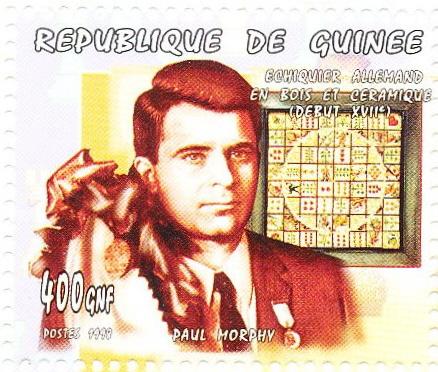
 | | Sally Simpson: In that link I gave above Boris mentions among his chess heroes is Paul Morphy. I suspect if Boris saw this stamp dedicated to him and mixing him up with Morphy he would have been quite amused. Picture here along with other stamps dedicated to chess players at Edward Winter's site; http://www.chesshistory.com/winter/... |
|
| Mar-02-25 | | stone free or die: <Though not much was known about him in the West, the genial, dapper, ever-courteous Spassky could not have presented a greater contrast. The London Sunday Times described him as ’the more benign type of Soviet bureaucrat.” However, behind the Soviet monolith, his peers saw him variously as artist, joker, nihilist–a free spirit. Most significantly, they regarded him as an un-Soviet man (an epithet he cheerfully accepted). A Russian nationalist, he was a headache for the authorities in his refusal to toe the party line and honor his political role as a Soviet world champion.> David Edmounds (BBC)
https://websites.umich.edu/~mjfello... |
|
| Mar-03-25 | | ewan14: IIRC two of Boris' other chess heroes were Paul Keres and Leonid Stein , both of whom gave him tough games One of Boris' favourite games was a loss against Keres in their 1965 Candidates match |
|
| Mar-04-25 | | Chessinfinite: Rest In Peace. A great player and legend of Chess. |
|
| Mar-04-25 | | stone free or die: Has anyone mentioned this game of Spassky's, when he was just 18 years old? Spassky vs Taimanov, 1955 (USSR-ch 1955) <White to move after 14...g5> 
click for larger view. |
|
Mar-15-25
 | | 6t4addict: RIP RIP RIP RIP RIP RIP RIP RIP RIP BORIS SPASSKY --- THE WIZARD OF ICE
Note: "The Wizard of Ice" is a title from the James Bond novel "From Russia With Love". The chapter portrays a Russian Grandmaster pursuing his love for chess in defiance of the Soviet State Authority - at considerable risk of loss/injury to himself. The character bears a striking resemblance to the late Mr. Boris Spassky, who, endured hardships while pursuing his love for the royal game in d
efiance of the Kremllin Stranglehold. |
|
Mar-15-25
 | | Dionysius1: I hope there'll be a commemoration tournament announced soon. In terms of which he would approve. |
|
Mar-16-25
 | | HeMateMe: Didn't Spassky live in Paris for years, after divorcing himself from USSR chess? Maybe France could put up a tournament. Good lord, if they're willing to pay Killian Mboppe $40M/yr to play club football in France surely there's a few hundred thousand euros available to sponsor a GM chess tournament? Europeans are obsessed with football; it's not healthy. |
|
Apr-23-25
 | | offramp: Spassky had a tough journey to become World Champion. Beating Petrosian was hard! Spassky won
Amsterdam Interzonal (1964)
Then came
Spassky - Keres Candidates Quarterfinal (1965)
Spassky - Geller Candidates Semifinal (1965)
Spassky - Tal Candidates Final (1965) followed by the
Petrosian - Spassky World Championship Match (1966). Spassky had another go...
Spassky - Geller Candidates Quarterfinal (1968)
Spassky - Larsen Candidates Semifinal (1968)
Spassky - Korchnoi Candidates Final (1968)
Spassky went on to Spassky - Korchnoi Candidates Final (1968) where he beat Petrosian and therefore became World Champion.
What a long, hard journey! |
|
| Apr-23-25 | | Muttley101: Spassky's journey to become world champion didn't start with Amsterdam. The earlier years were important too: Spassky played in the Amsterdam Candidates' tournament at the age of 19 in 1956. But he repeatedly had to endure failing to progress in either of the next two the world championship cycles, being in the hardest zone from which to qualify of course. Tough journey indeed. Stein's fate was even more tragic- Stein never even became a candidate, in part due to the nonsensical "only 3 players from one country" rule. As Bronstein said, if the number of strong players is a problem, then increase the number of players who can play in the candidates matches from 8 to 16 instead of limiting the number of players from one country. Stein and Bronstein were both penalised by this. |
|
Apr-23-25
| | Sally Simpson: <Hi Muttley>
I think we can say Spassky took his first step on the slippery ladder to the title back in 1955 in the USSR Championship (1955) when he finished 2nd= to qualify for the Gothenburg Interzonal (1955) which in turn took him to the Amsterdam Candidates (1956) The list of players and how they qualified for the 1955 Gothenburg Interzonal https://www.mark-weeks.com/chess/zo... |
|
Apr-23-25
| | perfidious: Unfortunately for Spassky, some goo was applied to certain rungs of that ladder at Riga 1958, then he fell into official disfavour by losing a critical game to Lombardy in Leningrad 1960 before winning the tournament of seven to book his table for Amsterdam Interzonal (1964). |
|
| Apr-23-25 | | Petrosianic: <Unfortunately for Spassky, some goo was applied to certain rungs of that ladder at Riga 1958> Yes, but to be clear, he applied that goo himself by unnecessarily losing that game to Tal. Had he drawn it as he easily could have, he'd have been in a tie with Averbakh for that last qualifying position. Not sure what would have happened then, but he'd probably have won on Sonnenborn if they used that. Disfavor or no, he was in the next Zonal, in 1961, and again failed to qualify. Maybe he just wasn't ready yet, and it was his qualification in 1955 that was the oddball result (although he did do credibly at Amsterdam). |
|
Apr-23-25
| | perfidious: <Petrosianic....Disfavor or no, (Spassky) was in the next Zonal, in 1961, and again failed to qualify. Maybe he just wasn't ready yet, and it was his qualification in 1955 that was the oddball result (although he did do credibly at Amsterdam).> Spassky demonstrated excellent form as early as Bucharest 1953, though it is far-fetched to see him as anything like a title contender, aged sixteen. Others have qualified for IZs at an even earlier age than Spassky first did, yet fared worse at the next stop. Not sure why making it out of Goteborg would be considered an aberration. |
|
| Apr-23-25 | | Petrosianic: Yeah, he was good enough to be there, I just don't know if he was good enough to have a lock on it. There were a lot of really good players in the Soviet Union around that time. It's a bit of a tragedy that he didn't make it in 1958, but I'm not sure about 1961. He was a point short, and Petrosian, Korchnoi, Stein and Geller finished above him, and none of those are flukes. Smyslov didn't qualify either. Four years after being world champion, he wasn't even in the interzonal. It was a jungle back then. |
|
Apr-23-25
| | perfidious: As you say, in that rarefied air, who really had a mortal lock on reaching an Interzonal from Mother Russia? Even the relatively weaker versions were far more difficult to navigate than championships of any other country. No less than Korchnoi could win one year and finish minus the next, though naturally the latter was very much the exception rather than the rule in his praxis. In Vasiukov vs Alburt, 1972, one kibitzer took a swipe at Black; what the poster obviously failed to understand was that for anyone to make three Soviet finals was--for those outside the elite in particular--impressive. |
|
Apr-24-25
 | | MarcusBierce: <Petrosianic>
A quick AI summary of Spassky training with Bondarevsky, which seems to be a major part of his dominance in the 1960’s <Boris Spassky's training with Igor Bondarevsky was significant in his chess career. Bondarevsky began coaching Spassky in 1961, which marked a turning point as Spassky started achieving his greatest successes with Bondarevsky's guidance. However, their relationship was not always smooth. Bondarevsky was known for his strategic approach, and he and Spassky had professional and personal differences.In preparation for the 1972 World Chess Championship match against Bobby Fischer, Spassky and Bondarevsky had planned to start training in earnest in March and April 1971, focusing on developing working plans for the whole year. Despite this, the training did not progress as planned. They spent time discussing practical matters such as travel and weather conditions instead of focusing on chess preparation. Bondarevsky was upset by this and resigned from his role as Spassky's trainer, which was seen as a serious blow to Spassky's preparation for the match.> |
|
Apr-24-25
| | MarcusBierce: Speaking of trainers, Furman has to be considered one of the best, having had a big part in Karpov’s development, and some of Bronstein’s greatest results (Gothenburg ‘55 being one) |
|
Apr-24-25
| | perfidious: One could have done far worse than to have trained under Furman, who also played at a high level into his fifties. |
|
| Jun-11-25 | | Olavi: "He should be remembered for much more than his loss to Bobby Fischer in Reykjavik in 1972. He had a long and illustrious career, and from 1968 to 1971, he was the strongest chess player in the world." Jan Timman, New in Chess 3/2025 i disagree. Spassky was the best 1964-1970. |
|
| Jun-11-25 | | ewan14: Boris was the best , 1964 - 70
WRT Bondarevsky it was he that decided Boris's main aim in the 1963 ( zonal ? ) USSR championship was to avoid defeat in games |
|
| Jun-11-25 | | ewan14: as opposed to producing an artistic masterpiece to win the game |
|
| Aug-10-25 | | ewan14: I thought Paul Keres was one of Boris's favourite players.
One of his losses to Keres was one of Boris's favourite games ! |
|
 |
|
|
< Earlier Kibitzing · PAGE 99 OF 99 ·
Later Kibitzing> |


 Kibitzing