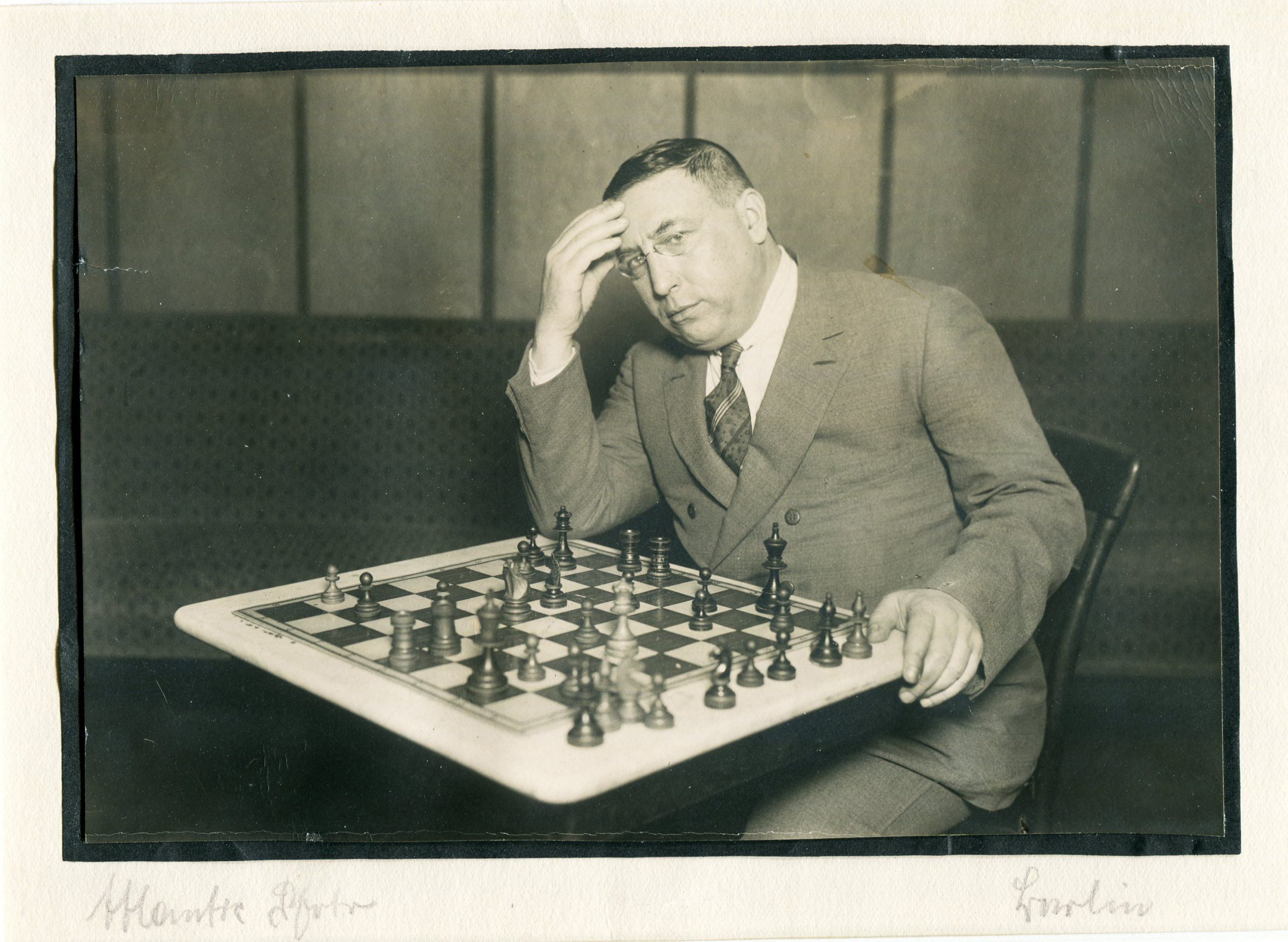
Akiba (Akiva, Akiwa) Kiwelowicz Rubinstein (1) was born on 1 December 1880 (2) in Stawiski, Poland.(3) He was the youngest of 12 children of a family of rabbis and scholars living in extreme poverty.(4) Ten of his siblings died of tuberculosis in infancy, and his father also died a few weeks before Akiba was born.(4) Akiba was raised by his grandparents to become a rabbi and went to the Cheder,(UK, p. 15) where he got acquainted with chess at the age of 14.(5) At age 16, he became interested in chess theory (5) and decided to become a chess professional instead of a rabbi.(6) Around the turn of the century, Rubinstein moved to Bialystok, Poland and left his family.(7) He soon became too strong for G G Bartoszkiewicz, the best player of Bialystok and Rubinstein's first nemesis.(8)
Early Chess Career
Rubinstein moved to Lódz, Poland in 1902 (AS, page CV) where he faced Georg Salwe. They played a match in 1903 to qualify for the 3rd All-Russian Championship in Kiev, 1903 (UK, pp. 19-20) (TLY, p. 390). The match ended drawn at 7.0-7.0 (UK, p. 20) and both chessplayers competed in the Championship later that year.(9) In 1904, Rubinstein and Salwe played a second match and Rubinstein emerged as the winner (TLY, pp. 390-391). He crowned his international debut at the Barmen 1905 Hauptturnier by sharing first place with Oldrich Duras, and became recognized as a master.(10) In the fall of 1905, Rubinstein beat Jacques Mieses in a match by the score of 3.0-0.0 (included in Rubinstein - Mieses (1909)).
Rubinstein continued to improve in 1906, sharing second place at the 4th All-Russian Championship in St. Petersburg behind Salwe,(11) and winning Lódz 1906 ahead of Mikhail Chigorin. (12) At Ostende 1906, a 5-stage 36-player tournament won by Carl Schlechter, Rubinstein achieved an excellent third place (UK, pp. 58-73). He was also successful in local events in Lódz.
Ascending to the Top
Rubinstein shared first place together with Ossip Bernstein at Ostende B 1907,(13) before he had his final breakthrough by winning Karlsbad (1907). (14) Rubinstein was also successful in his last match against Salwe, winning 16.0-6.0 (TLY, pp. 395-402). The year 1907 concluded with Rubinstein's win at the 5th All-Russian Championship 1907-1908 in Lódz,(15) where he played probably his most famous game Rotlewi vs Rubinstein, 1907.
The year 1908 was a bit disappointing, as he managed only 4th place at both Vienna (1908) and Prague (1908). He won two matches, one against Richard Teichmann (16) and Rubinstein - Marshall (1908). He also won Lodz (1908).
A contender for the title
At St. Petersburg (1909), Rubinstein shared first place with world champion Emanuel Lasker and beat him in their individual encounter. He went on to win Rubinstein - Mieses (1909) and was successful in smaller events. A match against Jose Raul Capablanca was planned in 1909, but never took place for reasons unknown (UK, pp. 207-208).
In 1910, a quiet year for the chess world, Rubinstein moved to Warsaw, Poland (AS, page CV). The Warsaw championship 1910 ended with a surprise, since Alexander Flamberg won ahead of Rubinstein (UK, p. 210). Soon afterwards, the two masters played a match which Rubinstein won 4.5-0.5 (UK, pp. 213-214). Rubinstein did not participate in Hamburg (1910) with respect to his health.(17) A planned match against Bernstein, which was to start in December 1910 and consist of 16 games, was postponed several times and, in the end, never took place (UK, pp. 215-216).
Rubinstein beat Capablanca in their individual encounter and remained unbeaten at San Sebastian (1911), but he still had to share second place behind the young Cuban. He also had to be content with a shared second place at Karlsbad (1911), Teichmann's great triumph. The year concluded with Rubinstein winning the strong Warsaw championship.(18)
The year 1912 was Rubinstein's magical year. He won four consecutive major tournaments: San Sebastian (1912), Bad Pistyan (1912), the 18th DSB Kongress (1912) and Vilnius All-Russian Masters (1912).
World Championship Challenger
During San Sebastian 1912, Rubinstein wrote to Lasker that he wanted to play a title match against him. Lasker was still bound by the ill-fated negotiations with Capablanca.(19) Rubinstein officially challenged Lasker in August 1912, and the world champion accepted. The negotiations and the arrangement of the world championship took place mainly in 1912 and 1913.(20) The match was to take place in autumn 1914 in Europe, mainly in Germany and Russia. Rubinstein doesn't seem to have played serious chess in 1913, but probably prepared for the match. He spend a few months in Bad Reichenhall, a popular health resort in Germany.(21)
1914 - The end of a dream, but not of all hopes
Rubinstein only scored 50% at St. Petersburg (1914) and was eliminated in the preliminary tournament.(22) This had no influence on the planned world championship match, and Lasker went on with the arrangements for the match.(23) The outbreak of the First World War was the force majeure that forced the cancellation of the title match (UK, p. 304).
The First World War
From 1914 to 1917, Rubinstein was confined to Poland, a major battleground. He could only compete in events in Warsaw and Lódz and did so with success (UK, pp. 304-311). There were also good moments, as Akiba married Eugenie Lew in 1917 and their son Jonas Jacob was born on 24 January 1918 in Szczuczyn, Poland (AS, page Family Tree) (TLY, p. 26). He was able to travel to Berlin in early 1918 (UK, p. 311) and competed in several events. His play became uneven and very good performances took turns with very bad results. First, he won the Rubinstein - Schlechter (1918) match in January, and then came in last at Berlin Four Masters (1918). He followed up with a second place, unbeaten behind world champion Lasker, at Berlin Grandmasters (1918).
The post-war era
In late 1919, the Rubinstein family moved to Sweden where they lived until 1921 (UK, p. 323) (AS, page CV). He came in second in the Stockholm quadrangular tournament in December 1919 (behind Rudolf Spielmann, ahead of Efim Bogoljubov and Richard Reti) (UK, pp. 327-333). At the beginning of 1920, Rubinstein beat Bogoljubov in a match.(24) During a Simul tour through the Netherlands (20 March 1920), Rubinstein spoke about the world championship (UK, p. 370), since Capablanca had emerged as Lasker's main rival. He reminded the public of still having a contract with Lasker, yet did not deny Lasker's and Capablanca's right to play for the title. He thought that an official body should administer the world championship and also suggested a triangular match between Lasker, Capablanca and himself. However, Rubinstein had lost his financial basis in post-war Europe and couldn't raise the necessary funds. Capablanca met Lasker in The Hague in January 1920 and they drew up a draft agreement for a title match, not to begin before 1 January 1921.(25) Capablanca had already declared in August 1919 that Lasker, Rubinstein and he himself were considered the strongest chessplayers in the world and that he would accept a challenge from Rubinstein, if he won the title from Lasker.(26) Rubinstein ended the year with a good second place at Gothenburg (1920) and then won the small Göteborg Winter tournament, which extended from 1920 to 1921, in convincing fashion (TLY, pp. 29-34).
At The Hague (1921), Rubinstein came in third behind Alexander Alekhine and Savielly Tartakower. Rubinstein co-authored the Lärobok i Schack, one of the most important contemporaneous works on opening theory.(27) He went on to win the strong Triberg tournament, December 1921, ahead of Bogoljubov and Spielmann (TLY, pp. 44-52). Alekhine wanted to challenge the new world champion Capablanca already after The Hague (1921), but the Cuban granted Rubinstein the right of a first challenge. He had already accepted Rubinstein's challenge on 7 September 1921. Dutch chess officials suggested a candidates match between Rubinstein and Alekhine. Both masters agreed to the match. The winner would receive 1,000 Guilders, the loser 500 Guilders. The match was to take place not earlier than March 1922. In the end, Alekhine avoided the match.(28)
At London (1922), Rubinstein came in fourth and Capablanca drew up the London Rules.(29) Capablanca granted Rubinstein some time to meet the high financial demands, setting the deadline for 31 December 1923, but Rubinstein couldn't raise the funds.(30) After a second place at Hastings (1922), he came in fifth at Teplitz-Schönau, October 1922, but won 4 Brilliancy prizes (TLY, pp. 72-83). At the end of the year, he had one of his greatest successes at Vienna (1922). Rubinstein, who had to support his family and raise money for the title match, suffered a severe financial set-back when Austrian frontier officials impounded his prize money (TLY, p. 84). In 1922, the Rubinstein family moved to Germany, where they stayed until 1926 (AS, page CV). After winning Hastings 1922/1923 (TLY, pp. 96-100), Rubinstein had very disappointing performances at Karlsbad (1923) and Maehrisch-Ostrau (1923).
Although Rubinstein had to content himself with a third place in Meran, February 1924 he popularized the Meran variation of the Semi-Slav by beating the tournament winner in Gruenfeld vs Rubinstein, 1924. Rubinstein was willing to compete in New York (1924), but this was out of question for the organizers. Bernhard Kagan, responsible for contacting the European masters and trying to help Rubinstein, explained that the number of participants was limited and the Grandmasters who were already in New York had an influential word.(31) He competed in smaller events, before managing a good second place at Baden-Baden (1925). The year 1925 continued to be a successful one with a shared first place at Marienbad (1925). At Breslau (1925), he only shared third place and ended the year with a very disappointing performance in Moscow (1925), his first and only trip to the Soviet Union (TLY, p. 165). While his results improved in 1926, at Semmering (1926), Dresden (1926), Budapest, June-July 1926 (shared third to fifth place) (TLY, pp. 196-203), Hannover (1926) and Berlin (1926), they were not outstanding. The Rubinstein family moved to Belgium in 1926, where Akiba lived until the end of his life (AS, page CV). In the spring of 1927, Rubinstein visited Poland and won the Second Polish Championship in Lódz (TLY, pp. 212-221). On 19 March 1927, his son Samy Rubinstein was born in Antwerp, Belgium (AS, page Family Tree).
In early 1928, Rubinstein visited the USA, gave Simuls and played several exhibition games (TLY, pp. 348-362). An international tournament had originally been planned and then a match against Marshall was suggested in its stead, but neither took place. He shared third place with Max Euwe at Bad Kissingen (1928), but Berlin (1928) was a disappointment. Then came the year 1929, which was one of his best years and stands out among the post-World War I years. First, he scored +3 -0 =4 against the British players in the Scheveningen-style Ramsgate tournament, March-April 1929 (TLY, pp. 238-241). Then followed three large tournaments, where Rubinstein came in fourth at Karlsbad (1929), second at Budapest (1929) and won Rogaška Slatina (today Slovenia), September-October 1929, ahead of Salomon Flohr (TLY, pp. 265-273). Donaldson and Minev on these three tournaments: "Rubinstein's overall result, which included only three losses in forty-nine games, was 34 1/2 - 14 1/2 during the sixty-nine days span."(TLY, p. 238)
The end of his chess career
He reached third place at San Remo (1930). Rubinstein also competed in the Belgian Team Championship in March and beat Johannes Hendrik Otto van den Bosch (3.0-0.0) and Salo Landau (2.5-0.5) in short matches in June (TLY, pp. 282-286). After a third place at Scarborough (1930), Rubinstein played on first board for the Polish team at the Hamburg Chess Olympiad, scoring +13 -0 =4. Rubinstein, together with Savielly Tartakower, David Przepiorka, Kazimierz Makarczyk and Paulino Frydman won the Gold medal.(32) Possibly tired from the Olympiad, which took place in July, Rubinstein disappointed at Liege (1930) in August.
In the spring of 1931, Rubinstein conducted a Simul tour through Palestine. He was the first well-known chess master to do so and the visit had a great, positive and long-lasting influence on chess in Palestine.(33) Then came the Prague Olympiad, July 1931, and Rubinstein played on first board again for the Silver-medal winning Polish team.(34) He was invited to Bled (1931), (35) but did not participate. After a successful Scheveningen-style tournament in Antwerp, July-August 1931 (TLY, pp. 316-318), Rubinstein came in last at Rotterdam, December 1931 (TLY, pp. 318-321) which was followed in January 1932 by a consultation event, which also took place in Rotterdam. Rubinstein scored the most points (TLY, p. 322). This was the last serious chess event he participated in, ending his professional chess career in early 1932.
The later years
The Rubinstein family had moved to Brussels, Belgium in 1931, where his wife Eugenie operated a restaurant (TLY, p. 26). With Akiba retiring from chess in 1932, Eugenie had to feed the family (two children) and the situation became critical. An appeal for help was made in 1932 and the publishing house of the Wiener Schach-Zeitung tried to help by publishing the book Rubinstein gewinnt!, with an introduction by Jacques Hannak and annotations by Hans Kmoch. (36) Akiba stayed for some time in a sanatorium before being reunited with his family (TLY, p. 16). In 1936, Eugenie reported that Akiba's health at least hadn't declined compared to the years before and he still occupied himself with chess, having followed the Alekhine - Euwe World Championship Match (1935) also.(37)
The fact that the Rubinstein family survived the Holocaust seems like a miracle. Sammy spent 1943-1944 in prison but was released. Factors which helped them to survive: They were probably all Belgian citizens by 1940 living in Brussels, and the Germans had no clear plans for Belgium which affected its administration (about 44% of the Jewish population in Belgium perished in the Holocaust), in addition, Akiba hid in a sanatorium (TLY, pp. 18-19).
Rubinstein's last public appearance as a chess player was a Simul he gave in Liège, Belgium in March 1946, scoring +24 -2 =4 (TLY, p. 377). It was reported that he would participate in a tournament in Maastricht soon afterwards, but he withdrew (TLY, p. 19). The financial situation of the Rubinstein family became critical again, and an appeal to help him was made in 1948 (TLY, pp. 17-18). In 1950, FIDE awarded the Grandmaster title to Rubinstein.(38)
Akiba had two students, Paul Devos and the third correspondence chess world champion Alberic O'Kelly de Galway (TLY, p. 19). He was also visited by Daniel Abraham Yanofsky and Miguel Najdorf, who said that Rubinstein won two fantastic games against him, and possibly Euwe.(39)
After his wife Eugenie died in 1954, Akiba moved to a home for old people. Sammy and Jonas remember visiting him and analysing the games of the world championship matches between Mikhail Botvinnik and Vasily Smyslov together.(TLY, p. 21) On 15 March 1961, Akiba Rubinstein passed away in Antwerp, Belgium (TLY, p. 21).
Contributions to Opening Theory
Akiba Rubinstein invented and popularized many important opening variations, or turned innovations by others into fully-fledged opening systems. Many opening variations therefore bear his name. Among them are the Rubinstein variation of the Nimzo-Indian Defense (1.d4 ♘f6 2.c4 e6 3.♘c3 ♗b4 4.e3), the Rubinstein variation of the French Defense (1.e4 e6 2.d4 d5 3.♘c3 dxe4), the Rubinstein variation of the Symmetrical English (1.c4 c5 2.♘c3 ♘f6 3.g3 d5 4.cxd5 ♘xd5 5.♗g2 ♘c7), an important variation in the Four Knights Game (1.e4 e5 2.♘f3 ♘c6 3.♘c3 ♘f6 4.♗b5 ♘d4), the important system against the Tarrasch Defence of the Queen's Gambit Declined with 6.g3 (introduced by Schlechter), and the already mentioned Meran variation in the Semi-Slav.
Testimonials
Garry Kasparov "Careful analysis shows that modern chess, proceeding from the Botvinnik era, is very strongly influenced by the games of Rubinstein, who was, essentially, one of the fathers of modern chess history." (40)
Vladimir Kramnik Rubinstein was “...an incredibly talented and fantastic chess player...Why didn't he become a World Champion? That's a mystery to me…” (41)
Boris Gelfand on the question if Rubinstein was his favorite player: "Yes, sure, definitely." (42)
Additional Information
An overview of Rubinstein's individual scores against the strongest players of his time: User: RubinsteinScores
An overview of Rubinstein's matches: User: RubinsteinMatches
An overview of Rubinstein's tournament career: http://www.phileo.demon.co.uk/uk_ar...
User: jessicafischerqueen 's documentary of Rubinstein can be found in three parts at http://www.youtube.com/watch?v=hi3h... http://www.youtube.com/watch?v=PQQO... and http://www.youtube.com/watch?v=3sqG...
Sources and Footnotes
The most important sources, apart from contemporaneous newspapers, were Donaldson's and Minev's two volumes on Rubinstein and Anita Sikora's website on Rubinstein with a lot of original research. In order to save space, these sources will simply be abbreviated in the text and don't get their own footnotes. The abbreviation "UK" stands for John William Donaldson and Nikolay N Minev, The Life & Games of Akiva Rubinstein - Volume 1: Uncrowned King, 2nd edition, 2006, Russell Enterprises, Inc., Milford CT USA. The abbreviation "TLY" stands for John William Donaldson and Nikolay N Minev, The Life & Games of Akiva Rubinstein - Volume 2: The Later Years, 2nd edition, 2011, Russell Enterprises, Inc., Milford CT USA. The abbreviation "AS" stands for Anita Sikora's (User: anyi) website http://rubina.yfw24.de/.
(1) His forename is usually written Akiba with b. In the Hebrew alphabet b, v and w are the same letter and v is the correct transliteration. See the discussion in AS (page CV). Rubinstein himself once used the German transliteration Akiwa (cover of KARL 3/2013). His name is spelled Akiba in the biography because it is the official spelling on chessgames.com. Kiwelowicz is his patronym (other transliterations are Kivelovitch and Kiwelowitsch, see AS, page CV) according to Jeremy Gaige's Chess Personalia (p. 364 of the paperback edition, 2005, McFarland) since Poland was occupied by Russia at that time.
(2) Rubinstein's birthday was unclear for a long time, see the discussion on p. 384 of UK. The earliest sources gave 12 October 1882 (Gregorian calender, converted from 30 September 1882 of the Julian calender), while later sources gave 12 December 1882. It has lately been established that the birthdate on his gravestone, 1 December 1880, is correct, by Elzbieta Kusina and Jan Kusina of the Malopolska Chess Association, Krakow, Poland (19 April 2014, news of the Kenneth Whyld Foundation & Association, http://www.kwabc.org/index.php/17-l...).
(3) Tomasz Lissowski wrote a photo article on Stawiski, Irgendwo im Nirgendwo, KARL 3/2013, pp. 12-17.
(4) Ernst Strouhal, Alles Schöne war geistig..., KARL 3/2013, pp. 12-17. AS, page Family Tree. UK, p. 15. Strouhal notes that rabbis and Jewish scholars usually lived in great poverty in Eastern Europe at that time.
(5) Akiba Rubinstein, Wiener Schach-Zeitung, June 1926, pp. 164-165. Provided in "ANNO / Österreichische Nationalbibliothek". Rubinstein was answering Eugen Gömöri's question on how he became a chessmaster.
(6) Ernst Strouhal, Alles Schöne war geistig..., KARL 3/2013, pp. 12-17. Rubinstein's first chess book was Zosints' Instructor, written in Hebrew.
(7) Ernst Strouhal, Alles Schöne war geistig..., KARL 3/2013, pp. 12-17. This decision haunted him throughout his life, see for example TLY, p. 16 where the misunderstood story of the fly is explained. What pestered him was not an actual fly (it's a midrash) but the decision to leave behind his family and Jewish tradition to become a chess professional.
(8) Rubinstein vs G G Bartoszkiewicz, 1897 is Rubinstein's first recorded game. The date of the game is not clear: UK tentatively gives 1897 and played by correspondence (according to S. Postma, Jeugdpartijen van Beroemde Meesters), while Strouhal (see source (7)) has 1901 and played in Steins Café in Bialystok. Lissowski offers 1901 and 1902 as possible dates in Szachowa Vistula Chess Monthly, http://szachowavistula.pl/vistula/b...
(9) Rod Edwards, http://www.edochess.ca/tournaments/...
(10) Rod Edwards, http://www.edochess.ca/tournaments/.... UK, pp. 33-40. A play-off between Rubinstein and Duras ended 1.0-1.0 (two draws).
(11) Rod Edwards, http://www.edochess.ca/tournaments/.... UK, pp. 43-50.
(12) Rod Edwards, http://www.edochess.ca/tournaments/.... UK, pp. 51-57.
(13) Rod Edwards, http://www.edochess.ca/tournaments/.... UK, pp. 79-88. Walter John criticized the Ostend (Championship) (1907) for not inviting Rubinstein instead of the two tail-enders (Generalanzeiger für Elberfeld-Barmen, 6 July 1907; reprinted in Wiener Schach-Zeitung, August-September 1907, p. 254. Provided in "ANNO / Österreichische Nationalbibliothek")
(14) Jacques Hannak called the Karlsbad 1907 tournament the "historical turning point of our chess history" (Der historische Wendepunkt unserer Schachgeschichte), because the youth triumphed over the established masters (Jacques Hannak, Wiener Schach-Zeitung, November-December 1907, p. 252. Provided in "ANNO / Österreichische Nationalbibliothek").
(15) Rod Edwards, http://www.edochess.ca/tournaments/.... UK, pp. 117-125.
(16) Game Collection: Rubinstein vs. Teichmann, Match (1908)
(17) Wiener Schach-Zeitung, October-November 1910, p. 354. Provided in "ANNO / Österreichische Nationalbibliothek".
(18) UK, pp. 244-245. Salwe of Lódz was a special guest. This championship, played in December 1911, counted as the 1912 city championship.
(19) Emanuel Lasker, Pester Lloyd, 31 March 1912, p. 10. Provided in "ANNO / Österreichische Nationalbibliothek". See Lasker - Capablanca World Championship Match (1921) for more information on the negotiations between Capablanca and Lasker.
(20) UK, pp. 290-295 provides extensive coverage, e. g. the conditions can be found there. Lasker announced the successful conclusion of the negotiations on 28 August 1913 (Emanuel Lasker, Pester Lloyd, 31 August 1913, p. 11. Provided in "ANNO / Österreichische Nationalbibliothek").
(21) Wiener Schach-Zeitung, July 1913, p. 200. Provided in "ANNO / Österreichische Nationalbibliothek".
(22) The artificial division into a preliminary and a final tournament, instead of a double round robin event, was criticised by many people according to the St. Petersburger Zeitung (Wiener Schach-Zeitung, May-June 1914, p. 96. Provided in "ANNO / Österreichische Nationalbibliothek"). Rudolf Spielmann also criticised the format in the Münchner Neuesten Nachrichten, 31 May 1914 (Wiener Schach-Zeitung, May-June 1914, p. 97. Provided in "ANNO / Österreichische Nationalbibliothek").
(23) UK, p. 294 quotes the American Chess Bulletin (1914, p. 139): "Word comes from St. Petersburg that Dr. Lasker will go ahead with his arrangements to play the match for the championship with A. K. Rubinstein of Lodz." It's worth remembering that Carl Schlechter only scored 50% at St. Petersburg (1909), before drawing the Lasker - Schlechter World Championship Match (1910).
(24) Game Collection: Bogoljubov-Rubinstein Match, Sweden 1920
(25) Edward G Winter, Capablanca: a compendium of games, notes, articles, correspondence, illustrations and other rare materials on the Cuban chess genius José Raúl Capablanca, 1888-1942, 1989, McFarland 1989, pp. 108-109 (originally from the American Chess Bulletin, March 1920, pp. 45-46). Edward Winter notes that it is unclear why Capablanca didn't want to play prior to 1921. The consequence was that clause 15 stated that Lasker had the right to play a title match against someone else before 1921. Despite the signed contract, Rubinstein could have played a title match against Lasker, if he had raised the necessary funds. Also telling is Winter's comment on Capablanca's My Chess Career, published in early 1920 on p. 105: "...he also had to convince the chess world of his right to a world title match with Lasker." defending Capablanca from critics accusing him of self-laudation in this book.
(26) Winter, Capablanca, pp. 97-98 (originally from The Observer, 24 August 1919, p. 9).
(27) This was the fourth edition, Stockholm 1921, by Gustaf Collijn and Ludvig Collijn, written by Rubinstein, Richard Reti and Rudolf Spielmann (Aron Nimzowitsch also contributed). Sources are TLY, p. 26; AS, page Mysteries; there are also online resources from libraries, but the fourth edition is not publicly available.
(28) Toni Preziuso, Amerika! Amerika!, KARL 3/2013, pp. 36-37.
(29) Edward G Winter, The London Rules, 2008, http://www.chesshistory.com/winter/...
(30) Toni Preziuso, Amerika! Amerika!, KARL 3/2013, pp. 37-38. In 1923, Rubinstein tried to finance a trip to the USA as a part of his title campaign, but couldn't raise the money.
(31) Toni Preziuso, Amerika! Amerika!, KARL 3/2013, pp. 38-39 (Kagan gave the explanation in his Neueste Schachnachrichten, 1924, p. 176). According to Preziuso, it is not clear why Rubinstein wasn't invited. He was never considered and financial reasons appear unlikely.
(32) TLY, pp. 289-299. Wojciech Bartelski & Co., http://www.olimpbase.org/1930/1930i...
(33) TLY, pp. 368-371. Avital Pilpel, Rubinsteins Abenteuer im Heiligen Land, KARL 3/2013, pp. 46-49. For Rubinstein, the trip was not a success as he suffered a financial set-back.
(34) TLY, pp. 307-315. Wojciech Bartelski & Co., http://www.olimpbase.org/1931/1931i...
(35) Wiener Schach-Zeitung, July 1931, p. 220. Provided in "ANNO / Österreichische Nationalbibliothek"
(36) TLY, pp. 16-17. An advertisement for the book in the Wiener Schachzeitung can be seen here: http://anno.onb.ac.at/cgi-content/a... (Provided in "ANNO / Österreichische Nationalbibliothek").
(37) Wiener Schach-Zeitung, February 1936, p. 60 (originally from the British Chess Magazine). Provided in "ANNO / Österreichische Nationalbibliothek"
(38) Jeremy Gaige, Chess Personalia, 2005 (paperback edition), McFarland, p. 364.
(39) TLY, p. 19. Edward G Winter, Akiba Rubinstein’s Later Years, http://www.chesshistory.com/winter/...
(40) Garry Kasparov, On My Great Predecessors Part I, 2003, Everyman, p. 204)
(41) Interview with Vladimir Barsky, Kramnik Interview: From Steinitz to Kasparov, 15 May 2005, http://www.kramnik.com/interviews/61
(42) Interview on 5 June 2012, part 2, http://www.chessvibes.com/?q=report...


 Kibitzing